







Question: 1-5 Question 1 4 pts A supervisor at work decided not to promote a qualified subordinate because the subordinate refused to have a romantic relationship
1-5 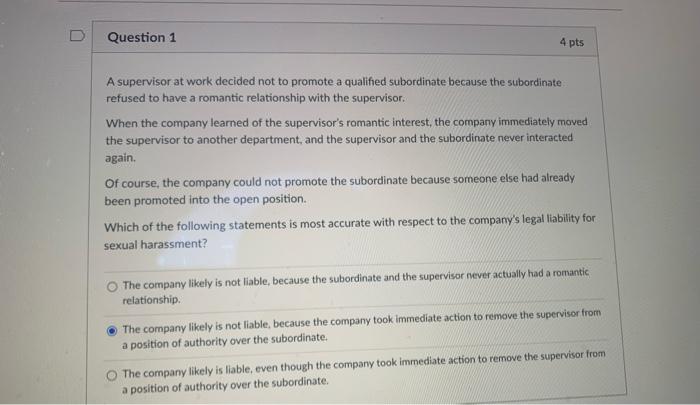
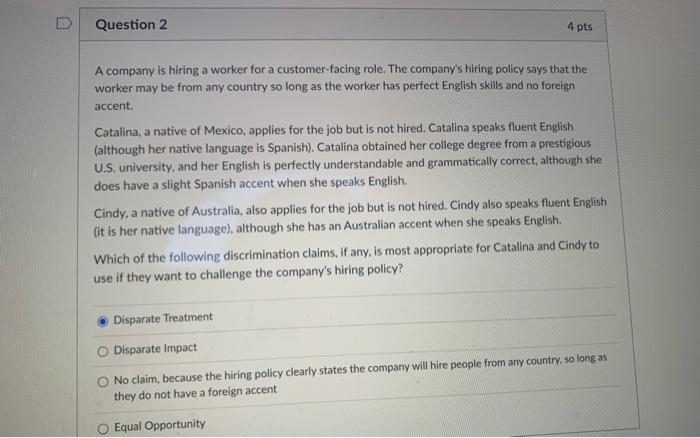
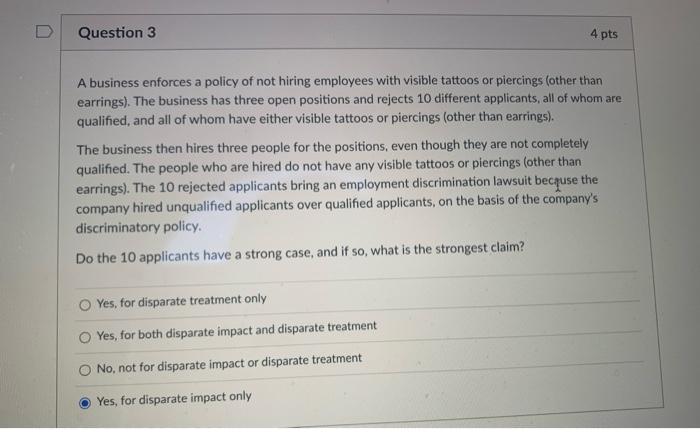
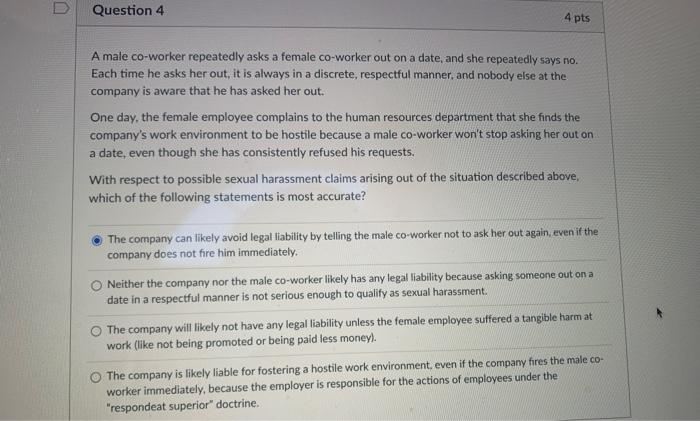
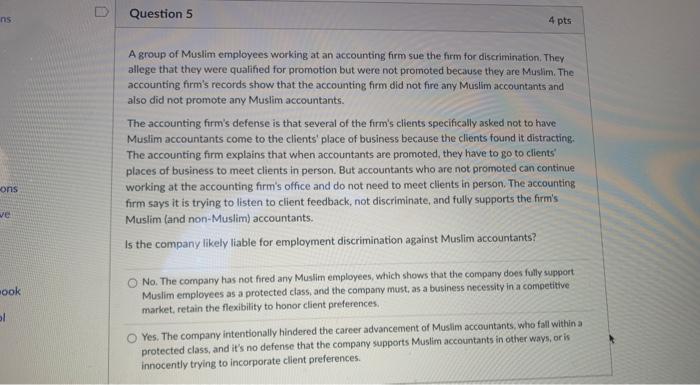
Question 1 4 pts A supervisor at work decided not to promote a qualified subordinate because the subordinate refused to have a romantic relationship with the supervisor. When the company learned of the supervisor's romantic interest, the company immediately moved the supervisor to another department, and the supervisor and the subordinate never interacted again. Of course, the company could not promote the subordinate because someone else had already been promoted into the open position. Which of the following statements is most accurate with respect to the company's legal liability for sexual harassment? The company likely is not liable, because the subordinate and the supervisor never actually had a romantic relationship The company likely is not liable, because the company took immediate action to remove the supervisor from a position of authority over the subordinate. The company likely is liable, even though the company took immediate action to remove the supervisor from a position of authority over the subordinate. Question 2 4 pts A company is hiring a worker for a customer-facing role. The company's hiring policy says that the worker may be from any country so long as the worker has perfect English skills and no foreign accent. Catalina, a native of Mexico, applies for the job but is not hired. Catalina speaks fluent English (although her native language is Spanish). Catalina obtained her college degree from a prestigious U.S. university, and her English is perfectly understandable and grammatically correct, although she does have a slight Spanish accent when she speaks English. Cindy, a native of Australia, also applies for the job but is not hired. Cindy also speaks fluent English (it is her native language), although she has an Australian accent when she speaks English Which of the following discrimination claims, if any, is most appropriate for Catalina and Cindy to use if they want to challenge the company's hiring policy? Disparate Treatment Disparate Impact No claim, because the hiring policy clearly states the company will hire people from any country, so long as they do not have a foreign accent Equal Opportunity D Question 3 4 pts A business enforces a policy of not hiring employees with visible tattoos or piercings (other than earrings). The business has three open positions and rejects 10 different applicants, all of whom are qualified, and all of whom have either visible tattoos or piercings (other than earrings). The business then hires three people for the positions, even though they are not completely qualified. The people who are hired do not have any visible tattoos or piercings (other than earrings). The 10 rejected applicants bring an employment discrimination lawsuit because the company hired unqualified applicants over qualified applicants, on the basis of the company's discriminatory policy. Do the 10 applicants have a strong case, and if so, what is the strongest claim? Yes, for disparate treatment only Yes, for both disparate impact and disparate treatment No, not for disparate impact or disparate treatment Yes, for disparate impact only D Question 4 4 pts A male co-worker repeatedly asks a female co-worker out on a date, and she repeatedly says no. Each time he asks her out, it is always in a discrete, respectful manner and nobody else at the company is aware that he has asked her out. One day, the female employee complains to the human resources department that she finds the company's work environment to be hostile because a male co-worker won't stop asking her out on a date, even though she has consistently refused his requests. With respect to possible sexual harassment claims arising out of the situation described above. which of the following statements is most accurate? The company can likely avoid legal liability by telling the male co-worker not to ask her out again, even if the company does not fire him immediately. Neither the company nor the male co-worker likely has any legal liability because asking someone out on a date in a respectful manner is not serious enough to qualify as sexual harassment. The company will likely not have any legal liability unless the female employee suffered a tangible harm at work (like not being promoted or being paid less money). The company is likely liable for fostering a hostile work environment, even if the company fires the male co- worker immediately, because the employer is responsible for the actions of employees under the "respondeat superior" doctrine. ns Question 5 4 pts A group of Muslim employees working at an accounting firm sue the form for discrimination. They allege that they were qualified for promotion but were not promoted because they are Muslim. The accounting firm's records show that the accounting firm did not fire any Muslim accountants and also did not promote any Muslim accountants. The accounting firm's defense is that several of the firm's clients specifically asked not to have Mustim accountants come to the clients' place of business because the clients found it distracting The accounting firm explains that when accountants are promoted, they have to go to clients places of business to meet clients in person. But accountants who are not promoted can continue working at the accounting firm's office and do not need to meet clients in person. The accounting firm says it is trying to listen to client feedback, not discriminate, and fully supports the firm's Muslim (and non-Muslim) accountants Is the company likely liable for employment discrimination against Muslim accountants? ons ve ook ol No. The company has not fired any Muslim employees, which shows that the company does fully support Muslim employees as a protected class, and the company must, as a business necessity in a competitive market, retain the flexibility to honor client preferences. Yes. The company intentionally hindered the career advancement of Muslim accountants, who fall within a protected class, and it's no defense that the company supports Muslim accountants in other ways, or is innocently trying to incorporate client preferences
Step by Step Solution
There are 3 Steps involved in it
1 Expert Approved Answer
Step: 1 Unlock

Question Has Been Solved by an Expert!
Get step-by-step solutions from verified subject matter experts
Step: 2 Unlock
Step: 3 Unlock
 Study Help