







Question: 1.5 Surface Illumination Let's assume that we are given the above-sealevel-elevation of a surface h(x) with x[2,2][1,3]R2 in analytical form as follows: h(x)=10(x1)2(y1)42xy with x=(x,y).
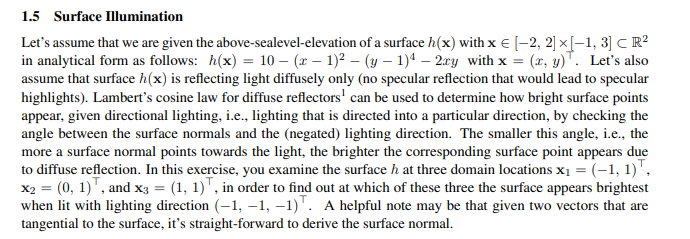
1.5 Surface Illumination Let's assume that we are given the above-sealevel-elevation of a surface h(x) with x[2,2][1,3]R2 in analytical form as follows: h(x)=10(x1)2(y1)42xy with x=(x,y). Let's also assume that surface h(x) is reflecting light diffusely only (no specular reflection that would lead to specular highlights). Lambert's cosine law for diffuse reflectors 1 can be used to determine how bright surface points appear, given directional lighting, i.e., lighting that is directed into a particular direction, by checking the angle between the surface normals and the (negated) lighting direction. The smaller this angle, i.e., the more a surface normal points towards the light, the brighter the corresponding surface point appears due to diffuse reflection. In this exercise, you examine the surface h at three domain locations x1=(1,1), x2=(0,1), and x3=(1,1), in order to find out at which of these three the surface appears brightest when lit with lighting direction (1,1,1). A helpful note may be that given two vectors that are tangential to the surface, it's straight-forward to derive the surface normal
Step by Step Solution
There are 3 Steps involved in it

Get step-by-step solutions from verified subject matter experts
 Study Help