







Question: 15. The parse tree represents higher-level constructs (statements, expressions, subroutines and so on). Each construct is a ------ ----------in the tree; its constituents are its
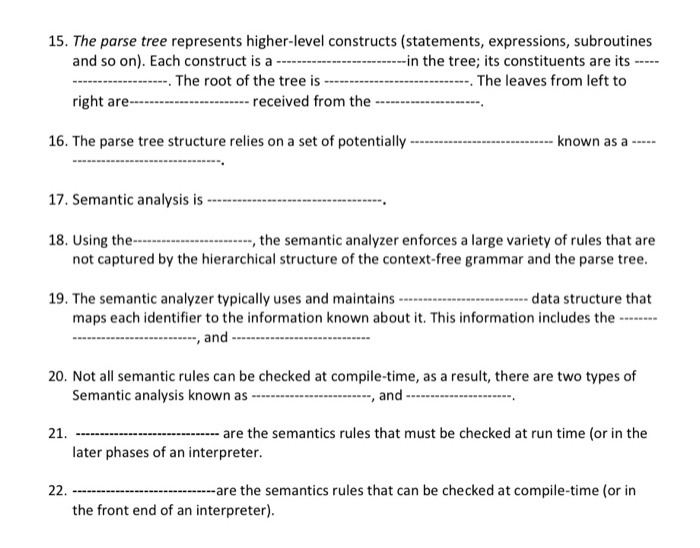
15. The parse tree represents higher-level constructs (statements, expressions, subroutines and so on). Each construct is a ------ ----------in the tree; its constituents are its ---- ---------- The root of the tree is ----- ----- --- The leaves from left to right are ------- ---received from the 16. The parse tree structure relies on a set of potentially ........... - known as a -- 17. Semantic analysis is 18. Using the ......, the semantic analyzer enforces a large variety of rules that are not captured by the hierarchical structure of the context-free grammar and the parse tree. 19. The semantic analyzer typically uses and maintains ..... ........... data structure that maps each identifier to the information known about it. This information includes the ..... -------------, and ---------- 20. Not all semantic rules can be checked at compile-time, as a result, there are two types of Semantic analysis known as ------ , and 21. ------------ ----------------- are the semantics rules that must be checked at run time (or in the later phases of an interpreter. 22. ---- ............--are the semantics rules that can be checked at compile-time (or in the front end of an interpreter)
Step by Step Solution
There are 3 Steps involved in it

Get step-by-step solutions from verified subject matter experts
 Study Help