







Question: 1.6, 1.7,1.8 (a) (b) # (c) (d) (e) (f) (g) (h) (i) = (j) a Styrofoam coffee cup (no decoration) (k) a ceramic coffee mug
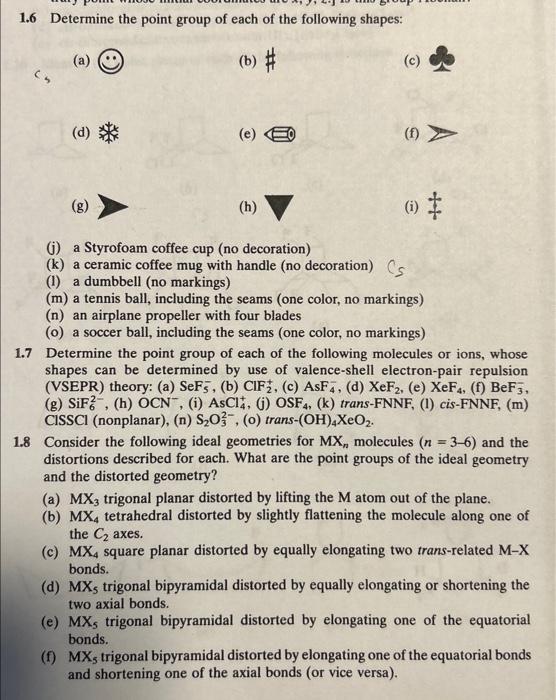
(a) (b) \# (c) (d) (e) (f) (g) (h) (i) = (j) a Styrofoam coffee cup (no decoration) (k) a ceramic coffee mug with handle (no decoration) C5 (1) a dumbbell (no markings) (m) a tennis ball, including the seams (one color, no markings) (n) an airplane propeller with four blades (o) a soccer ball, including the seams (one color, no markings) 1.7 Determine the point group of each of the following molecules or ions, whose shapes can be determined by use of valence-shell electron-pair repulsion (VSEPR) theory: (a) SeF5, (b) ClF2+, (c) AsF4, (d) XeF2, (e) XeF4, (f) BeF3, (g) SiF62, (h) OCN, (i) AsCl4+, (j) OSF4, (k) trans-FNNF, (l) cis-FNNF, (m) CISSCl (nonplanar), (n) S2O32, (o) trans-(OH) XeO2. 1.8 Consider the following ideal geometries for MXn molecules (n=36) and the distortions described for each. What are the point groups of the ideal geometry and the distorted geometry? (a) MX3 trigonal planar distorted by lifting the M atom out of the plane. (b) MX4 tetrahedral distorted by slightly flattening the molecule along one of the C2 axes. (c) MX4 square planar distorted by equally elongating two trans-related MX bonds. (d) MX5 trigonal bipyramidal distorted by equally elongating or shortening the two axial bonds. (e) MX5 trigonal bipyramidal distorted by elongating one of the equatorial bonds. (f) MX5 trigonal bipyramidal distorted by elongating one of the equatorial bonds and shortening one of the axial bonds (or vice versa)
Step by Step Solution
There are 3 Steps involved in it

Get step-by-step solutions from verified subject matter experts
 Study Help