





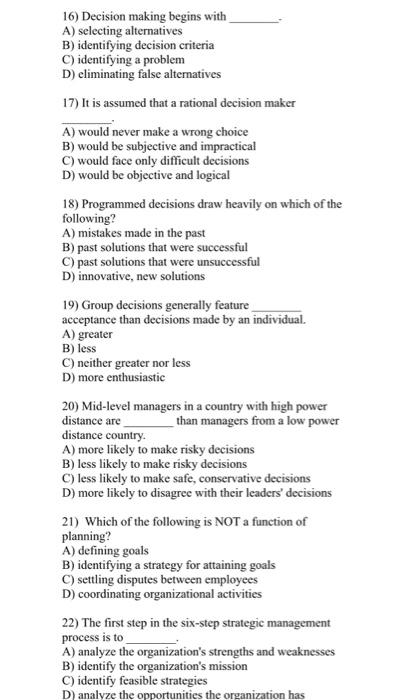
Question: 16) Decision making begins with A) selecting alternatives B) identifying decision criteria C) identifying a problem D) eliminating false alternatives 17) It is assumed that
16) Decision making begins with A) selecting
16) Decision making begins with A) selecting alternatives B) identifying decision criteria C) identifying a problem D) eliminating false alternatives 17) It is assumed that a rational decision maker A) would never make a wrong choice B) would be subjective and impractical C) would face only difficult decisions D) would be objective and logical 18) Programmed decisions draw heavily on which of the following? A) mistakes made in the past B) past solutions that were successful C) past solutions that were unsuccessful D) innovative, new solutions 19) Group decisions generally feature acceptance than decisions made by an individual. A) greater B) less C) neither greater nor less D) more enthusiastic 20) Mid-level managers in a country with high power distance are than managers from a low power distance country. A) more likely to make risky decisions B) less likely to make risky decisions C) less likely to make safe, conservative decisions D) more likely to disagree with their leaders' decisions 21) Which of the following is NOT a function of planning? A) defining goals B) identifying a strategy for attaining goals C) settling disputes between employees D) coordinating organizational activities 22) The first step in the six-step strategic management process is to A) analyze the organization's strengths and weaknesses B) identify the organization's mission C) identify feasible strategies D) analyze the opportunities the organization has

Step by Step Solution

There are 3 Steps involved in it

1 Expert Approved Answer
Step: 1 Unlock blur-text-image

Question Has Been Solved by an Expert!

Get step-by-step solutions from verified subject matter experts

Step: 2 Unlock
Step: 3 Unlock

Students Have Also Explored These Related General Management Questions!