







Question: ** 16. Ron pulls with a string on a wooden block of mass m = 80 kg. The tension in the string is 300
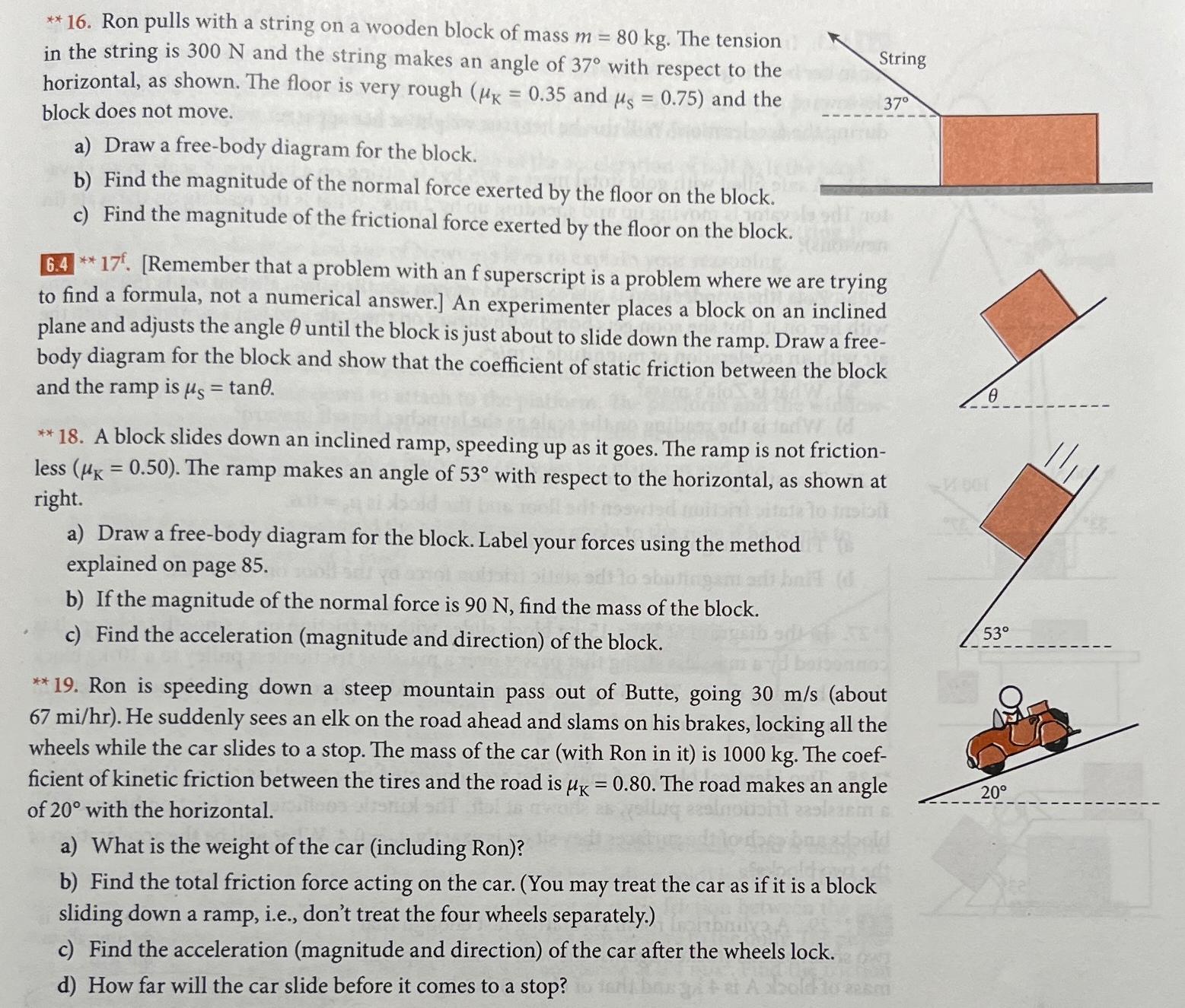
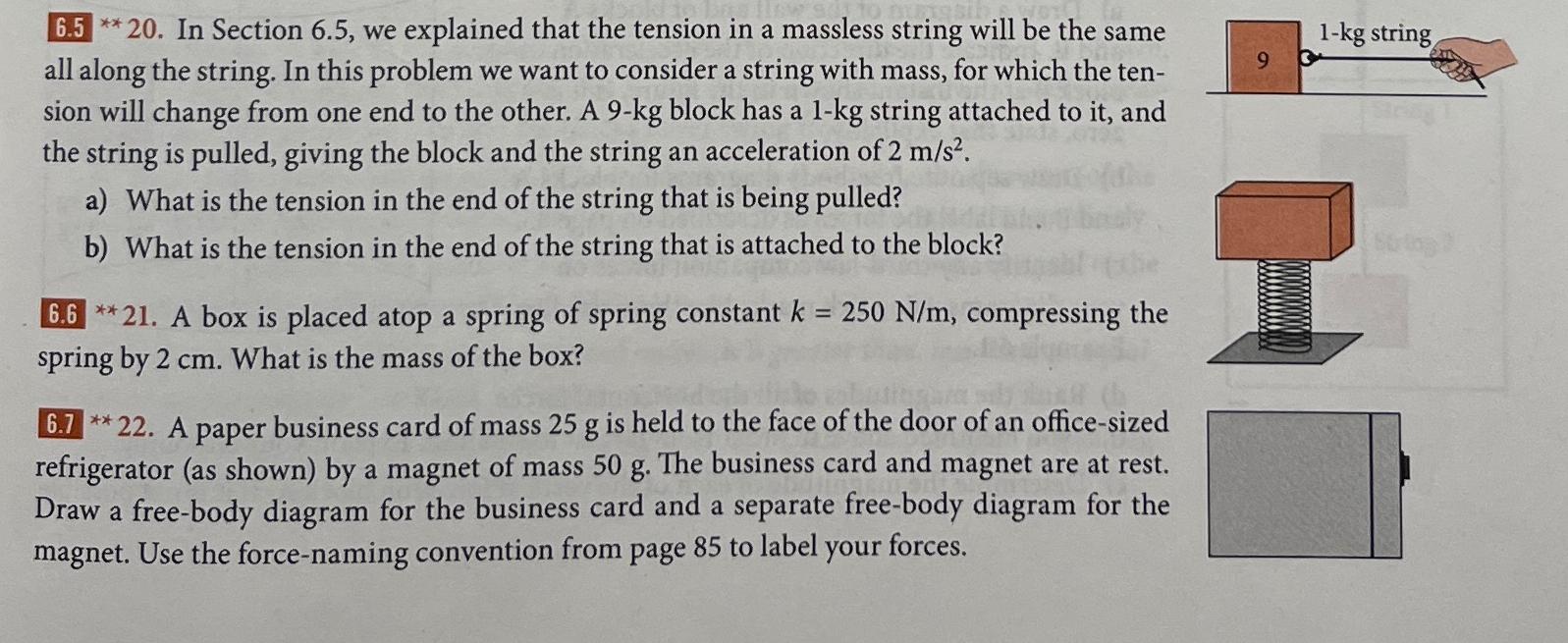
** 16. Ron pulls with a string on a wooden block of mass m = 80 kg. The tension in the string is 300 N and the string makes an angle of 37 with respect to the horizontal, as shown. The floor is very rough (k = 0.35 and s = 0.75) and the block does not move. a) Draw a free-body diagram for the block. b) Find the magnitude of the normal force exerted by the floor on the block. c) Find the magnitude of the frictional force exerted by the floor on the block. 6.4 ** String 17. [Remember that a problem with an f superscript is a problem where we are trying to find a formula, not a numerical answer.] An experimenter places a block on an inclined plane and adjusts the angle until the block is just about to slide down the ramp. Draw a free- body diagram for the block and show that the coefficient of static friction between the block and the ramp is s = tano. ** 18. A block slides down an inclined ramp, speeding up as it goes. The ramp is not friction- less (k = 0.50). The ramp makes an angle of 53 with respect to the horizontal, as shown at right. a) Draw a free-body diagram for the block. Label your forces using the method explained on page 85. b) If the magnitude of the normal force is 90 N, find the mass of the block. c) Find the acceleration (magnitude and direction) of the block. ** 19. Ron is speeding down a steep mountain pass out of Butte, going 30 m/s (about 67 mi/hr). He suddenly sees an elk on the road ahead and slams on his brakes, locking all the wheels while the car slides to a stop. The mass of the car (with Ron in it) is 1000 kg. The coef- ficient of kinetic friction between the tires and the road is k = 0.80. The road makes an angle of 20 with the horizontal. a) What is the weight of the car (including Ron)? b) Find the total friction force acting on the car. (You may treat the car as if it is a block sliding down a ramp, i.e., don't treat the four wheels separately.) c) Find the acceleration (magnitude and direction) of the car after the wheels lock. d) How far will the car slide before it comes to a stop? 37 53 20 6.5 **20. In Section 6.5, we explained that the tension in a massless string will be the same all along the string. In this problem we want to consider a string with mass, for which the ten- sion will change from one end to the other. A 9-kg block has a 1-kg string attached to it, and the string is pulled, giving the block and the string an acceleration of 2 m/s. a) What is the tension in the end of the string that is being pulled? b) What is the tension in the end of the string that is attached to the block? 6.6 **21. A box is placed atop a spring of spring constant k = 250 N/m, compressing the spring by 2 cm. What is the mass of the box? 6.7 ** 22. A paper business card of mass 25 g is held to the face of the door of an office-sized refrigerator (as shown) by a magnet of mass 50 g. The business card and magnet are at rest. Draw a free-body diagram for the business card and a separate free-body diagram for the magnet. Use the force-naming convention from page 85 to label your forces. 9 1-kg string
Step by Step Solution
There are 3 Steps involved in it

Get step-by-step solutions from verified subject matter experts
 Study Help