







Question: 16. The HTTP GET message Consider the figure below, where a client is sending an HTTP GET message to a web server, gaia.cs.umass.edu. http message
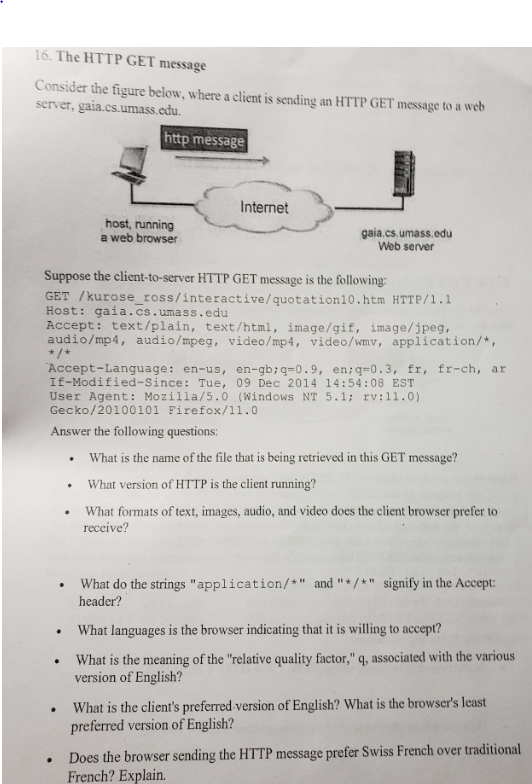
16. The HTTP GET message Consider the figure below, where a client is sending an HTTP GET message to a web server, gaia.cs.umass.edu. http message Internet host, running a web browser gaia.cs.umass.edu Web server Suppose the client-to-server HTTP GET message is the following: GET /kurose_ross/interactive/quotation10.htm HTTP/1.1 Host: gaia.cs.umass.edu Accept: text/plain, text/html, image/gif, image/jpeg, audio/mp4, audio/mpeg, video/mp4, video/wmv, application/*, +/+ Accept-Language: en-us, en-gb;q=0.9, en;q=0.3, fr, fr-ch, ar If-Modified-Since: Tue, 09 Dec 2014 14:54:08 EST User Agent: Mozilla/5.0 (Windows NT 5.1; rv:11.0) Gecko/20100101 Firefox/11.0 Answer the following questions: What is the name of the file that is being retrieved in this GET message? What version of HTTP is the client running? What formats of text, images, audio, and video does the client browser prefer to receive? What do the strings "application/*" and "*/*" signify in the Accept: header? What languages is the browser indicating that it is willing to accept? What is the meaning of the "relative quality factor," q, associated with the various version of English? What is the client's preferred version of English? What is the browser's least preferred version of English? Does the browser sending the HTTP message prefer Swiss French over traditional French? Explain
Step by Step Solution
There are 3 Steps involved in it

Get step-by-step solutions from verified subject matter experts
 Study Help