







Question: 16. The sources of quantitative standards include a. engineering studies. b. input from operating personnel. c. historical experience. d. historical experience, engineering studies, and
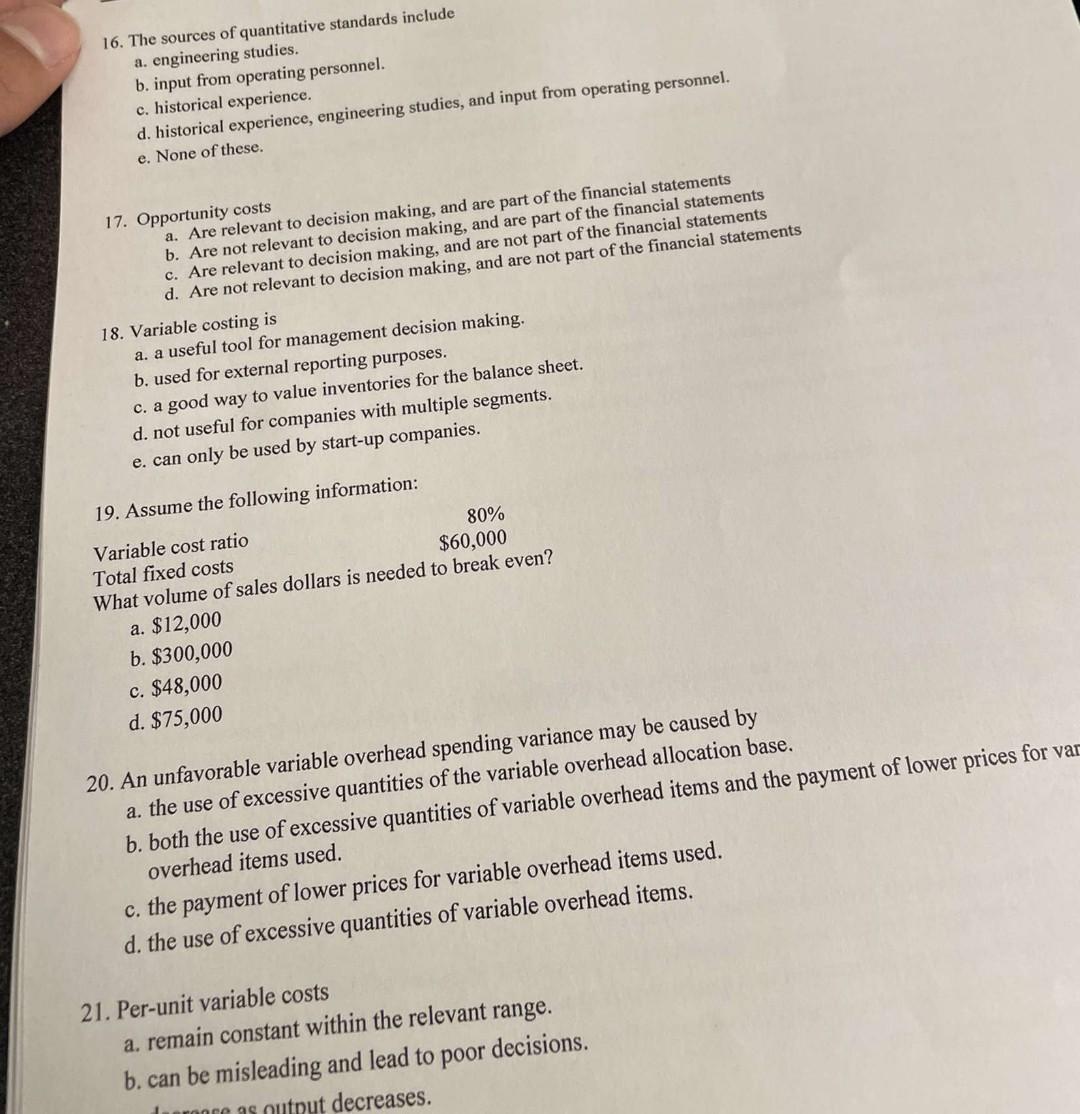
16. The sources of quantitative standards include a. engineering studies. b. input from operating personnel. c. historical experience. d. historical experience, engineering studies, and input from operating personnel. e. None of these. 17. Opportunity costs a. Are relevant to decision making, and are part of the financial statements b. Are not relevant to decision making, and are part of the financial statements c. Are relevant to decision making, and are not part of the financial statements d. Are not relevant to decision making, and are not part of the financial statements 18. Variable costing is a. a useful tool for management decision making. b. used for external reporting purposes. c. a good way to value inventories for the balance sheet. d. not useful for companies with multiple segments. e. can only be used by start-up companies. 19. Assume the following information: Variable cost ratio Total fixed costs 80% $60,000 What volume of sales dollars is needed to break even? a. $12,000 b. $300,000 c. $48,000 d. $75,000 20. An unfavorable variable overhead spending variance may be caused by a. the use of excessive quantities of the variable overhead allocation base. b. both the use of excessive quantities of variable overhead items and the payment of lower prices for var overhead items used. c. the payment of lower prices for variable overhead items used. d. the use of excessive quantities of variable overhead items. 21. Per-unit variable costs a. remain constant within the relevant range. b. can be misleading and lead to poor decisions. ace as output decreases.
Step by Step Solution
There are 3 Steps involved in it

Get step-by-step solutions from verified subject matter experts
 Study Help