


Question: 16. Which statement is false? A. M-time cultures view time as tangible and concrete. B. P-time cultures take a flexible approach to time, involvement of
16. Which statement is false? A. M-time cultures

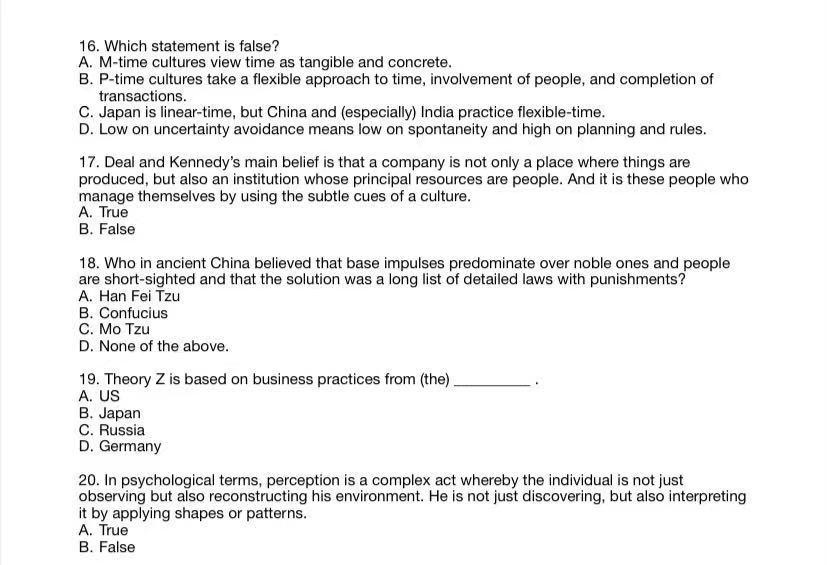
16. Which statement is false? A. M-time cultures view time as tangible and concrete. B. P-time cultures take a flexible approach to time, involvement of people, and completion of transactions. C. Japan is linear-time, but China and (especially) India practice flexible-time. D. Low on uncertainty avoidance means low on spontaneity and high on planning and rules. 17. Deal and Kennedy's main belief is that a company is not only a place where things are produced, but also an institution whose principal resources are people. And it is these people who manage themselves by using the subtle cues of a culture. A. True B. False 18. Who in ancient China believed that base impulses predominate over noble ones and people are short-sighted and that the solution was a long list of detailed laws with punishments? A. Han Fei Tzu B. Confucius C. Mo Tzu D. None of the above. 19. Theory Z is based on business practices from (the) A. US B. Japan C. Russia D. Germany 20. In psychological terms, perception is a complex act whereby the individual is not just observing but also reconstructing his environment. He is not just discovering, but also interpreting it by applying shapes or patterns. A. True B. False

Step by Step Solution

There are 3 Steps involved in it

1 Expert Approved Answer
Step: 1 Unlock blur-text-image

Question Has Been Solved by an Expert!

Get step-by-step solutions from verified subject matter experts

Step: 2 Unlock
Step: 3 Unlock

Students Have Also Explored These Related General Management Questions!