







Question: 1.6.4 Question 4d Suppose you are going to simulate a random variable Y and plot the empirical histogram based on your simulations. Let [a, b)
1.6.4 Question 4d
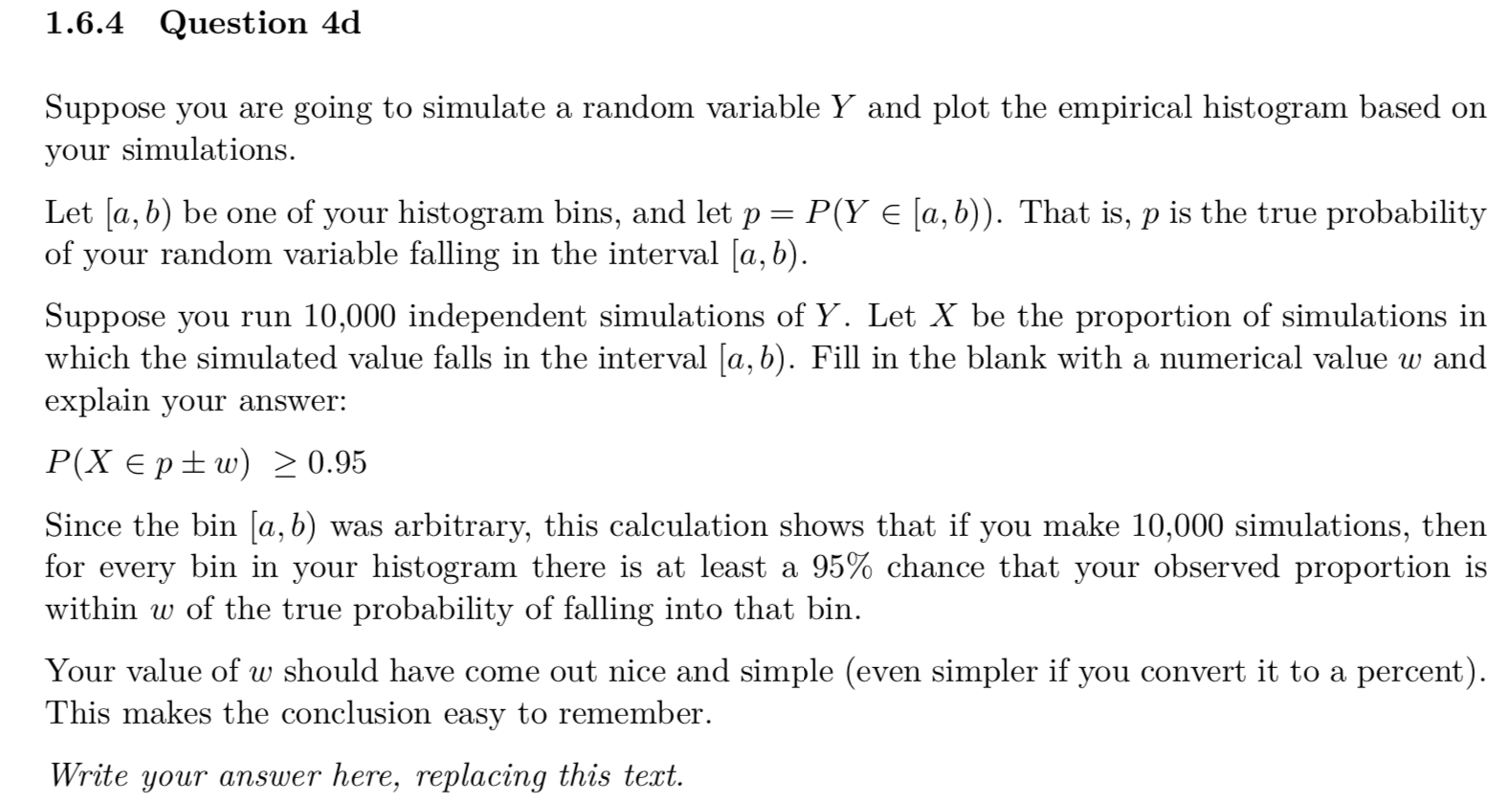
Suppose you are going to simulate a random variable Y and plot the empirical histogram based on your simulations.
Let [a, b) be one of your histogram bins, and let p = P (Y ? [a, b)). That is, p is the true probability of your random variable falling in the interval [a, b).
Suppose you run 10,000 independent simulations of Y . Let X be the proportion of simulations in which the simulated value falls in the interval [a, b). Fill in the blank with a numerical value w and explain your answer:
P(X?pw) ?0.95
Since the bin [a, b) was arbitrary, this calculation shows that if you make 10,000 simulations, then for every bin in your histogram there is at least a 95% chance that your observed proportion is within w of the true probability of falling into that bin.
Your value of w should have come out nice and simple (even simpler if you convert it to a percent). This makes the conclusion easy to remember.
Write your answer here, replacing this text.
1.6.4 Question 4d Suppose you are going to simulate a random variable Y and plot the empirical histogram based on your simulations. Let [0,, b) be one of your histogram bins, and let p = P(Y E [a, (2)). That is, p is the true probability of your random variable falling in the interval [0,, 1)). Suppose you run 10,000 independent simulations of Y. Let X be the proportion of simulations in which the simulated value falls in the interval [0,, b). Fill in the blank with a numerical value in and explain your answer: P(X e pzlzw) 2 0.95 Since the bin [a, b) was arbitrary, this calculation shows that if you make 10,000 simulations, then for every bin in your histogram there is at least a 95% chance that your observed proportion is within 11) of the true probability of falling into that bin. Your value of w should have come out nice and simple (even simpler if you convert it to a percent). This makes the conclusion easy to remember. Write your answer here, replacing this text
Step by Step Solution
There are 3 Steps involved in it

Get step-by-step solutions from verified subject matter experts
 Study Help