



Question: 17- (2 points) Given the following information: cash = $75, accounts payable = $100, notes payable = $130, inventory = $175, long term debt -
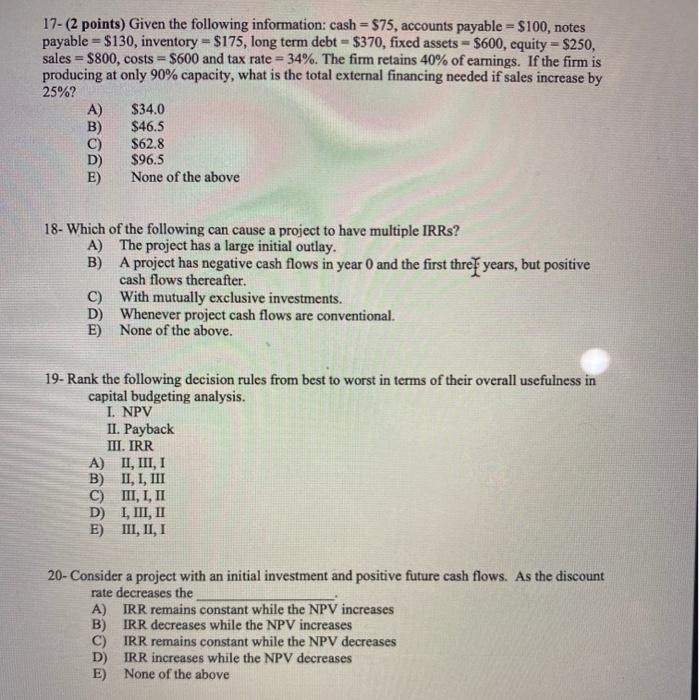
17- (2 points) Given the following information: cash = $75, accounts payable = $100, notes payable = $130, inventory = $175, long term debt - $370, fixed assets = $600, equity -$250, sales = $800, costs = $600 and tax rate = 34%. The firm retains 40% of earnings. If the firm is producing at only 90% capacity, what is the total external financing needed if sales increase by 25%? A) $34.0 B) $46.5 $62.8 $96.5 E) None of the above 18- Which of the following can cause a project to have multiple IRRs? A) The project has a large initial outlay. B) A project has negative cash flows in year 0 and the first threr years, but positive cash flows thereafter. C) With mutually exclusive investments. D) Whenever project cash flows are conventional. E) None of the above. 19- Rank the following decision rules from best to worst in terms of their overall usefulness in capital budgeting analysis. I. NPV II. Payback III. IRR A) II, III, I B) II, I, III C) II, I, D) I, III, II E) III, II, I 20- Consider a project with an initial investment and positive future cash flows. As the discount rate decreases the A) IRR remains constant while the NPV increases B) IRR decreases while the NPV increases C) IRR remains constant while the NPV decreases D) IRR increases while the NPV decreases E) None of the above
Step by Step Solution
There are 3 Steps involved in it

Get step-by-step solutions from verified subject matter experts