







Question: 17. As difficult as it is to visualize the changes in velocity, a good understanding of acceleration is needed to master kinematics problems. Recognizing that
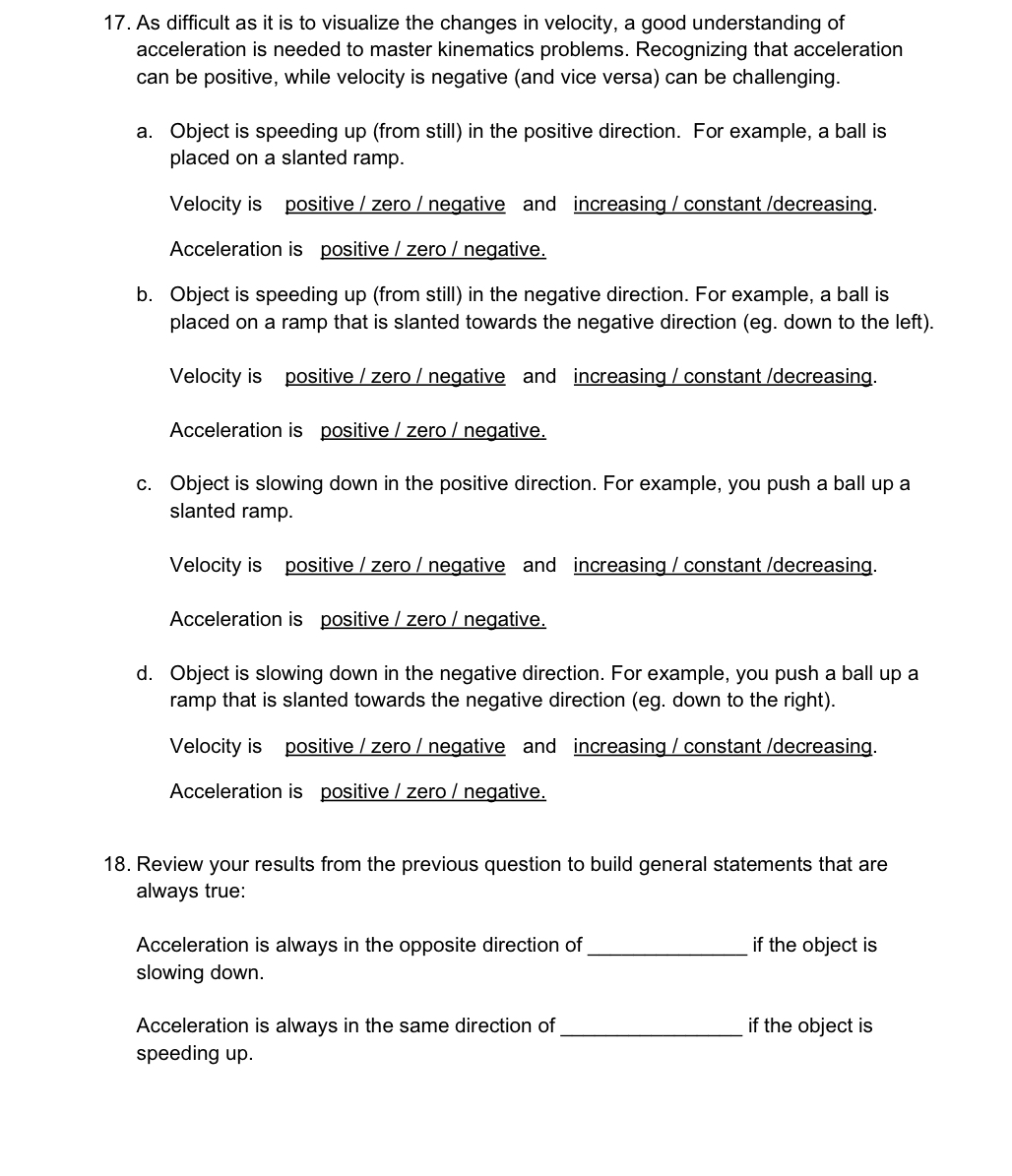
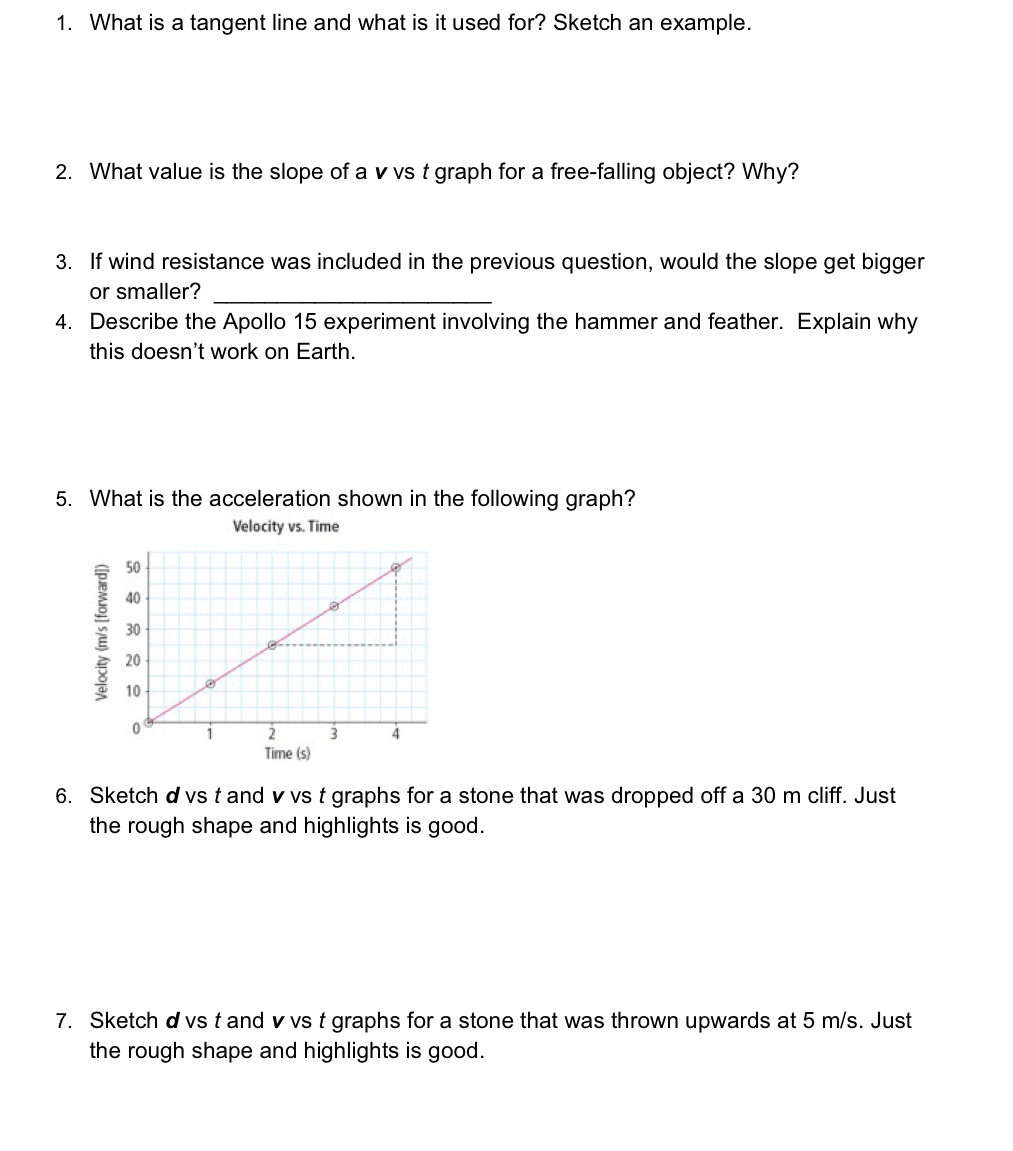
17. As difficult as it is to visualize the changes in velocity, a good understanding of acceleration is needed to master kinematics problems. Recognizing that acceleration can be positive, while velocity is negative (and vice versa) can be challenging. a. Object is speeding up (from still) in the positive direction. For example, a ball is placed on a slanted ramp. Velocity is positive / zero / negative and increasing / constant /decreasing. Acceleration is positive / zero / negative. b. Object is speeding up (from still) in the negative direction. For example, a ball is placed on a ramp that is slanted towards the negative direction (eg. down to the left). Velocity is positive / zero / negative and increasing / constant /decreasing. Acceleration is positive / zero / negative. c. Object is slowing down in the positive direction. For example, you push a ball up a slanted ramp. Velocity is positive / zero / negative and increasing / constant /decreasing. Acceleration is positive / zero / negative. d. Object is slowing down in the negative direction. For example, you push a ball up a ramp that is slanted towards the negative direction (eg. down to the right). Velocity is positive / zero / negative and increasing / constant /decreasing. Acceleration is positive / zero / negative. 18. Review your results from the previous question to build general statements that are always true: Acceleration is always in the opposite direction of if the object is slowing down. Acceleration is always in the same direction of if the object is speeding up.1. What is a tangent line and what is it used for? Sketch an example. 2. What value is the slope of a v vs t graph for a free-falling object? Why? 3. If wind resistance was included in the previous question, would the slope get bigger or smaller? 4. Describe the Apollo 15 experiment involving the hammer and feather. Explain why this doesn't work on Earth. 5. What is the acceleration shown in the following graph? Velocity vs. Time 40 30 Velocity (m/s [forward]) 10 Time (s) 6. Sketch d vs t and v vs t graphs for a stone that was dropped off a 30 m cliff. Just the rough shape and highlights is good. 7. Sketch d vs t and v vs t graphs for a stone that was thrown upwards at 5 m/s. Just the rough shape and highlights is good
Step by Step Solution
There are 3 Steps involved in it

Get step-by-step solutions from verified subject matter experts
 Study Help