







Question: 17. To keep things simple, let us assume we have a microcontroller with only 28 256 bytes of RAM, so each address is given by
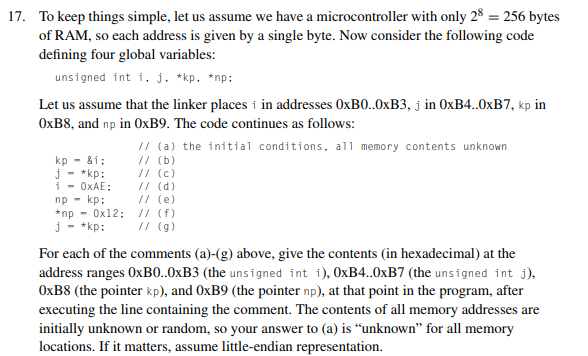
17. To keep things simple, let us assume we have a microcontroller with only 28 256 bytes of RAM, so each address is given by a single byte. Now consider the following code defining four global variables: unsigned int i. j. *kp. np: Let us assume that the linker places i in addresses 0xB0.0xB3, j in 0xB4..0xB7, kp in OxB8, and np in OxB9. The code continues as follows: /1 (a) the initial conditions. al1 memory contents unknown KP K kp: -0XAE: (d) np-kp: np 0x12: 11 (f 11 (g) For each of the comments (a)-(g) above, give the contents (in hexadecimal) at the OxB8 (the pointer kp), and 0xB9 (the pointer np), at that point in the program, after initially unknown or random, so your answer to (a) is "unknown" for all memory address ranges 0xB0.0xB3 (the unsigned int i), 0xB4..0xB7 (the unsigned int j). addresses are executing the line containing the comment. The contents of all memory locations. If it matters, assume little-endi an representation
Step by Step Solution
There are 3 Steps involved in it

Get step-by-step solutions from verified subject matter experts
 Study Help