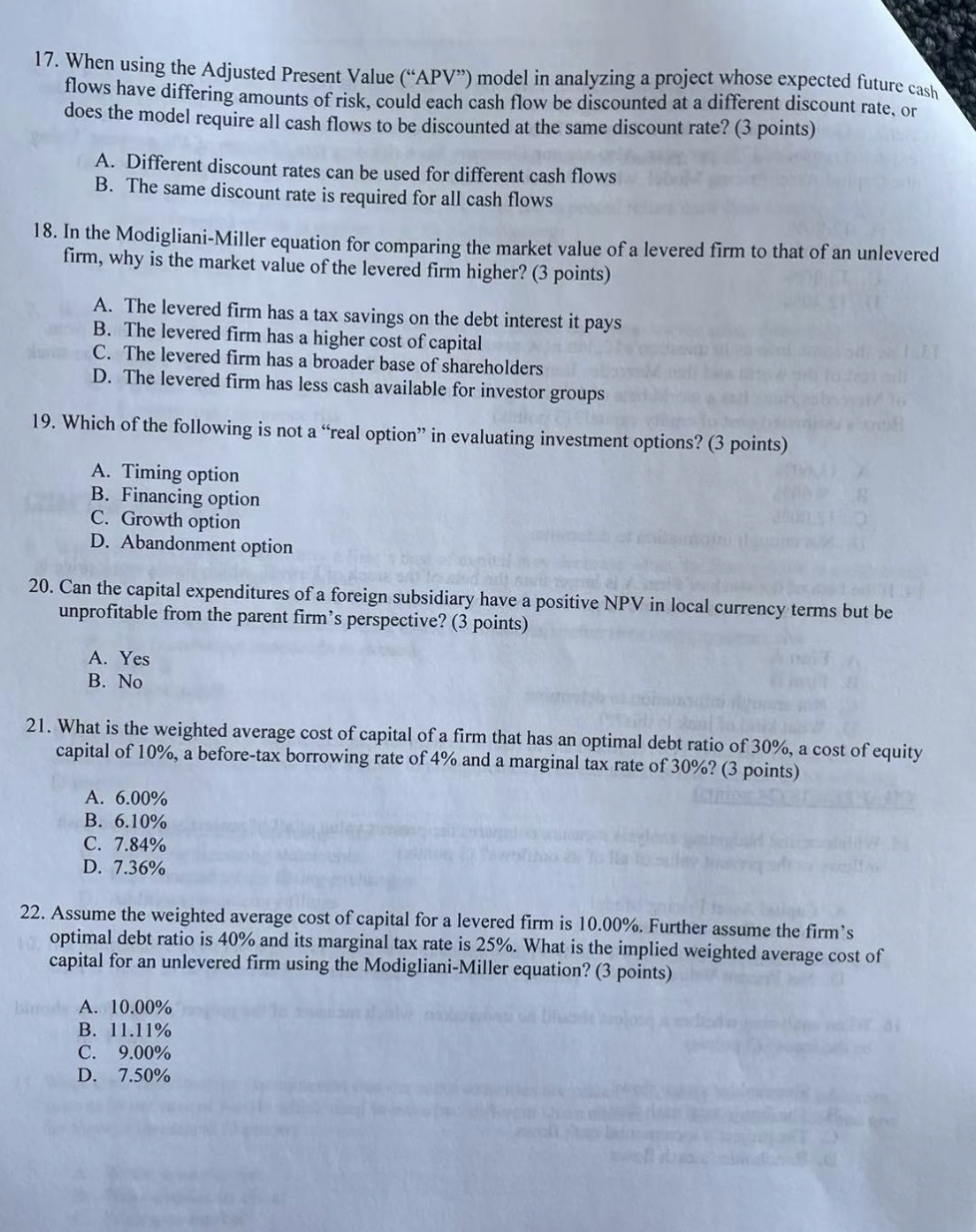
Question: 17. When using the Adjusted Present Value (APV) model in analyzing a project whose expected future cash flows have differing amounts of risk, could each
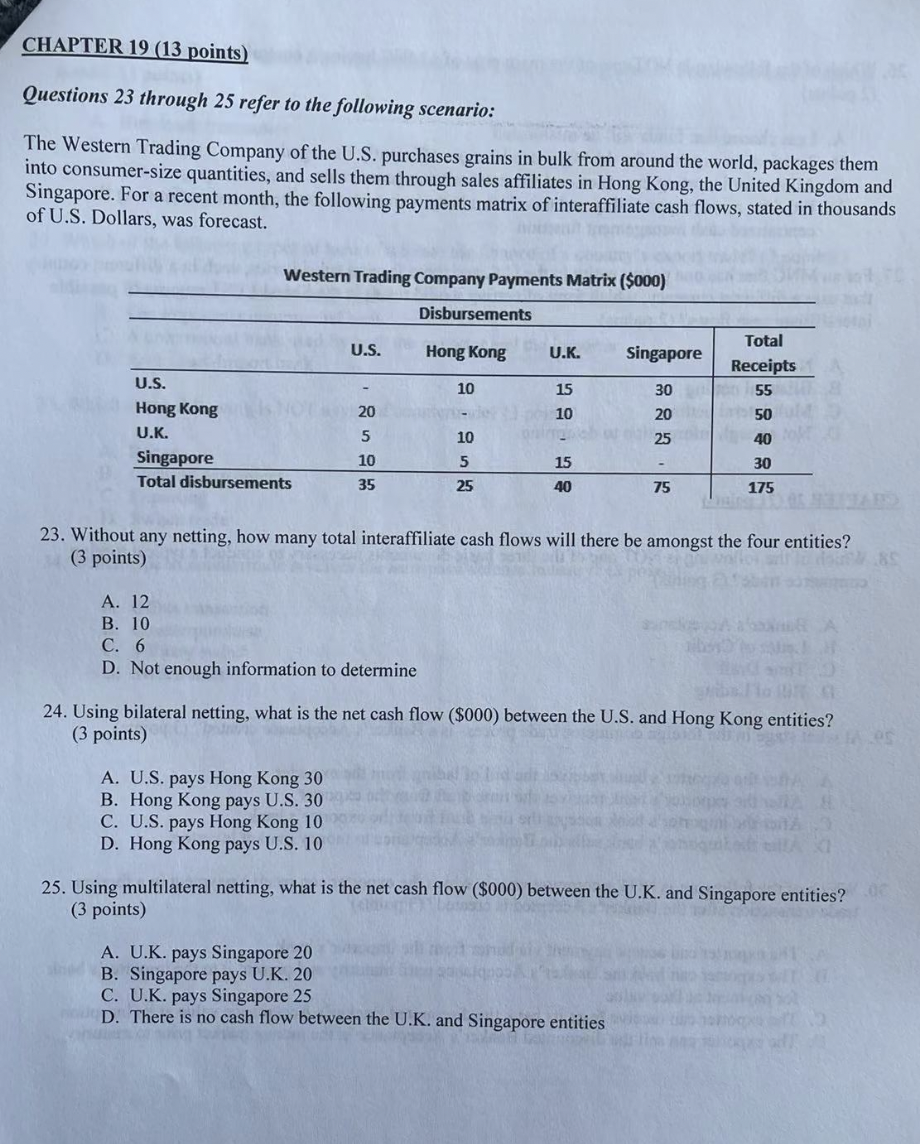
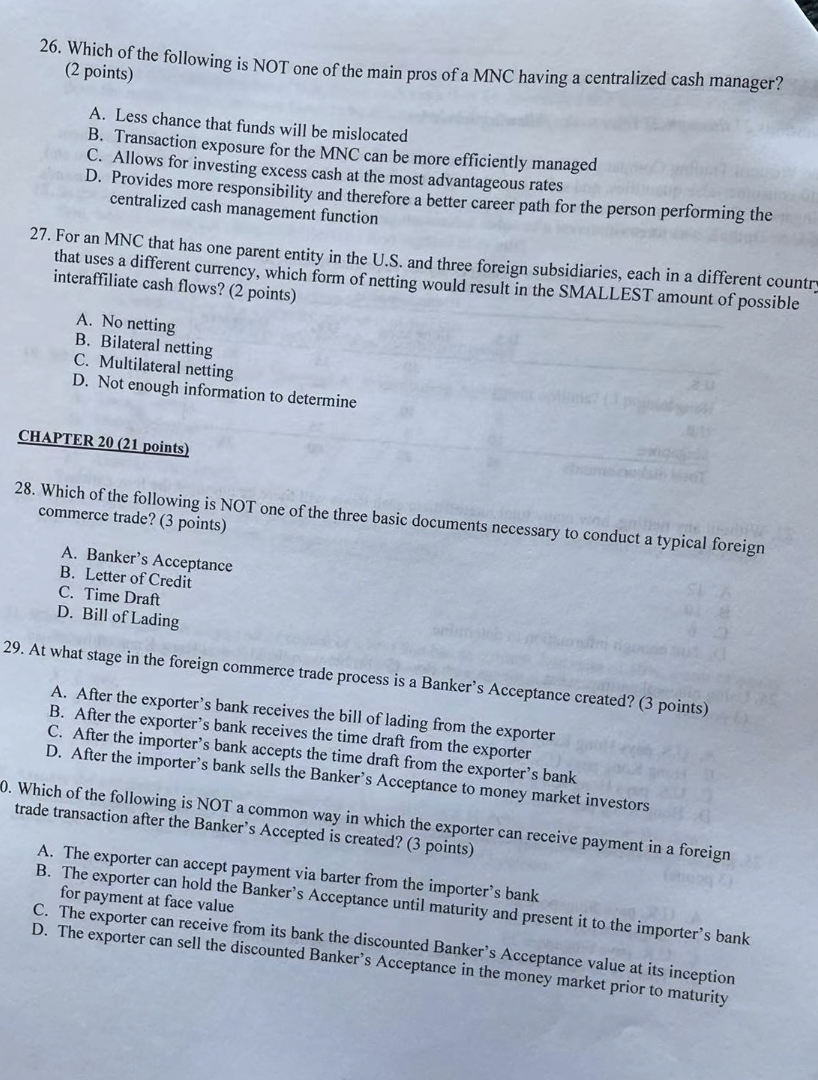
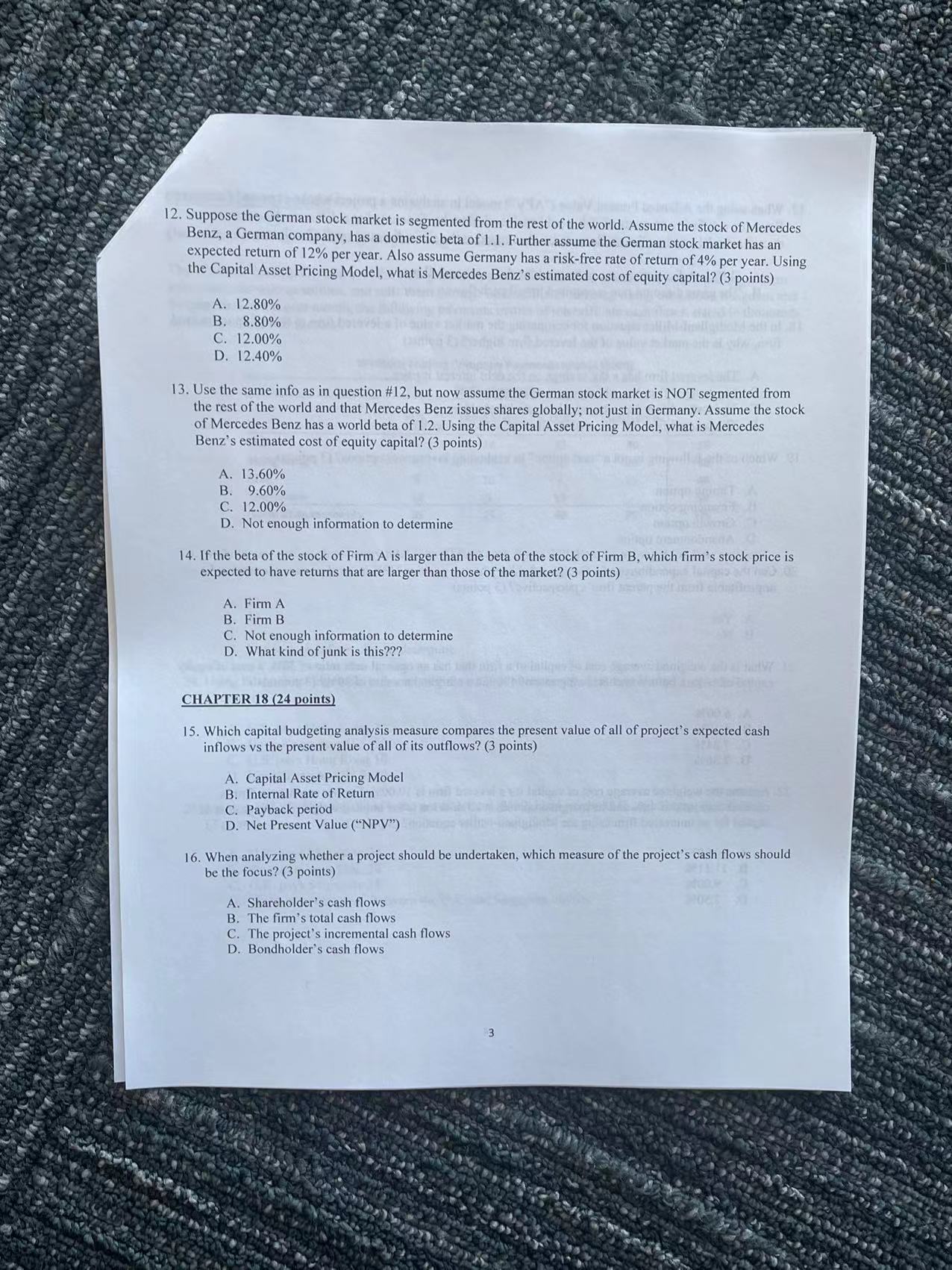
17. When using the Adjusted Present Value ("APV") model in analyzing a project whose expected future cash flows have differing amounts of risk, could each cash flow be discounted at a different discount rate, or does the model require all cash flows to be discounted at the same discount rate? (3 points) A. Different discount rates can be used for different cash flows B. The same discount rate is required for all cash flows 18. In the Modigliani-Miller equation for comparing the market value of a levered firm to that of an unlevered firm, why is the market value of the levered firm higher? (3 points) A. The levered firm has a tax savings on the debt interest it pays B. The levered firm has a higher cost of capital C. The levered firm has a broader base of shareholders D. The levered firm has less cash available for investor groups 19. Which of the following is not a "real option" in evaluating investment options? (3 points) A. Timing option B. Financing option C. Growth option D. Abandonment option 20. Can the capital expenditures of a foreign subsidiary have a positive NPV in local currency terms but be unprofitable from the parent firm's perspective? (3 points) A. Yes B. No 21. What is the weighted average cost of capital of a firm that has an optimal debt ratio of 30%, a cost of equity capital of 10%, a before-tax borrowing rate of 4% and a marginal tax rate of 30%? (3 points) A. 6.00% B. 6.10% C. 7.84% D. 7.36% 22. Assume the weighted average cost of capital for a levered firm is 10.00%. Further assume the firm's optimal debt ratio is 40% and its marginal tax rate is 25%. What is the implied weighted average cost of capital for an unlevered firm using the Modigliani-Miller equation? (3 points) A. 10.00% B. 11.11% C. 9.00% D. 7.50%CHAPTER 19 (13 points) Questions 23 through 25 refer to the following scenario: The Western Trading Company of the U.S. purchases grains in bulk from around the world, packages them into consumer-size quantities, and sells them through sales affiliates in Hong Kong, the United Kingdom and Singapore. For a recent month, the following payments matrix of interaffiliate cash flows, stated in thousands of U.S. Dollars, was forecast. Western Trading Company Payments Matrix ($000) Disbursements Total U.S. Hong Kong U.K. Singapore Receipts U.S. 10 15 30 55 Hong Kong 20 10 20 50 U.K. 5 10 25 40 Singapore 10 5 15 30 Total disbursements 35 25 40 75 175 23. Without any netting, how many total interaffiliate cash flows will there be amongst the four entities? (3 points) 85 A. 12 B. 10 C. 6 D. Not enough information to determine 24. Using bilateral netting, what is the net cash flow ($000) between the U.S. and Hong Kong entities? (3 points) A. U.S. pays Hong Kong 30 B. Hong Kong pays U.S. 30 C. U.S. pays Hong Kong 10 D. Hong Kong pays U.S. 10 25. Using multilateral netting, what is the net cash flow ($000) between the U.K. and Singapore entities? (3 points) A. U.K. pays Singapore 20 B. Singapore pays U.K. 20 C. U.K. pays Singapore 25 D. There is no cash flow between the U.K. and Singapore entities26. Which of the following is NOT one of the main pros of a MNC having a centralized cash manager? (2 points) A. Less chance that funds will be mislocated B. Transaction exposure for the MNC can be more efficiently managed C. Allows for investing excess cash at the most advantageous rates D. Provides more responsibility and therefore a better career path for the person performing the centralized cash management function 27. For an MNC that has one parent entity in the U.S. and three foreign subsidiaries, each in a different count that uses a different currency, which form of netting would result in the SMALLEST amount of possible interaffiliate cash flows? (2 points) A. No netting B. Bilateral netting C. Multilateral netting D. Not enough information to determine CHAPTER 20 (21 points) 28. Which of the following is NOT one of the three basic documents necessary to conduct a typical foreign commerce trade? (3 points) A. Banker's Acceptance B. Letter of Credit C. Time Draft D. Bill of Lading 29. At what stage in the foreign commerce trade process is a Banker's Acceptance created? (3 points) A. After the exporter's bank receives the bill of lading from the exporter B. After the exporter's bank receives the time draft from the exporter C. After the importer's bank accepts the time draft from the exporter's bank D. After the importer's bank sells the Banker's Acceptance to money market investors 0. Which of the following is NOT a common way in which the exporter can receive payment in a foreign trade transaction after the Banker's Accepted is created? (3 points) A. The exporter can accept payment via barter from the importer's bank B. The exporter can hold the Banker's Acceptance until maturity and present it to the importer's bank for payment at face value C. The exporter can receive from its bank the discounted Banker's Acceptance value at its inception D. The exporter can sell the discounted Banker's Acceptance in the money market prior to maturity12. Suppose the German stock market is segmented from the rest of the world. Assume the stock of Mercedes Benz, a German company, has a domestic beta of 1.1. Further assume the German stock market has an expected return of 12% per year. Also assume Germany has a risk-free rate of return of 4% per year. Using the Capital Asset Pricing Model, what is Mercedes Benz's estimated cost of equity capital? (3 points) A. 12.80% B. 8.80% C. 12.00% D. 12.40% 13. Use the same info as in question #12, but now assume the German stock market is NOT segmented from the rest of the world and that Mercedes Benz issues shares globally; not just in Germany. Assume the stock of Mercedes Benz has a world beta of 1.2. Using the Capital Asset Pricing Model, what is Mercedes Benz's estimated cost of equity capital? (3 points) A. 13.60% B. 9:60% C. 12.00% D. Not enough information to determine 14. If the beta of the stock of Firm A is larger than the beta of the stock of Firm B, which firm's stock price is expected to have returns that are larger than those of the market? (3 points) A. Firm A B. Firm B C. Not enough information to determine D. What kind of junk is this??? CHAPTER 18 (24 points) 15. Which capital budgeting analysis measure compares the present value of all of project's expected cash inflows vs the present value of all of its outflows? (3 points) A. Capital Asset Pricing Model B. Internal Rate of Return C. Payback period D. Net Present Value ("NPV") 16. When analyzing whether a project should be undertaken, which measure of the project's cash flows should be the focus? (3 points) A. Shareholder's cash flows B. The firm's total cash flows C. The project's incremental cash flows D. Bondholder's cash flows
Step by Step Solution
There are 3 Steps involved in it
1 Expert Approved Answer
Step: 1 Unlock
Question Has Been Solved by an Expert!
Get step-by-step solutions from verified subject matter experts
Step: 2 Unlock
Step: 3 Unlock
Students Have Also Explored These Related Finance Questions!









 Study Help