







Question: 17. Your classmate wants to model an individual whose consumption of a particular good becomes less responsive to the individual's income as the individual becomes
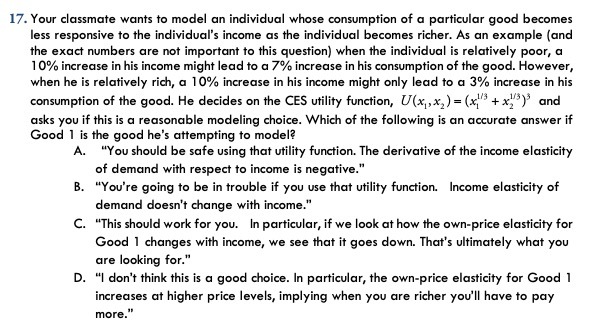
17. Your classmate wants to model an individual whose consumption of a particular good becomes less responsive to the individual's income as the individual becomes richer. As an example (and the exact numbers are not important to this question) when the individual is relatively poor, a 10% increase in his income might lead to a 7% increase in his consumption of the good. However, when he is relatively rich, a 10% increase in his income might only lead to a 3% increase in his consumption of the good. He decides on the CES utility function, U(x, x, ) = (x)) + x! ) and asks you if this is a reasonable modeling choice. Which of the following is an accurate answer if Good 1 is the good he's attempting to model? A. "You should be safe using that utility function. The derivative of the income elasticity of demand with respect to income is negative." B. "You're going to be in trouble if you use that utility function. Income elasticity of demand doesn't change with income." C. "This should work for you. In particular, if we look at how the own-price elasticity for Good 1 changes with income, we see that it goes down. That's ultimately what you are looking for." D. "I don't think this is a good choice. In particular, the own-price elasticity for Good 1 increases at higher price levels, implying when you are richer you'll have to pay more."
Step by Step Solution
There are 3 Steps involved in it

Get step-by-step solutions from verified subject matter experts
 Study Help