



Question: 17.5 Exercises 1) The ufc data we examined in last chapter's exercises can be loaded from ufc.csv (in the data directory of EssentialR). This contains
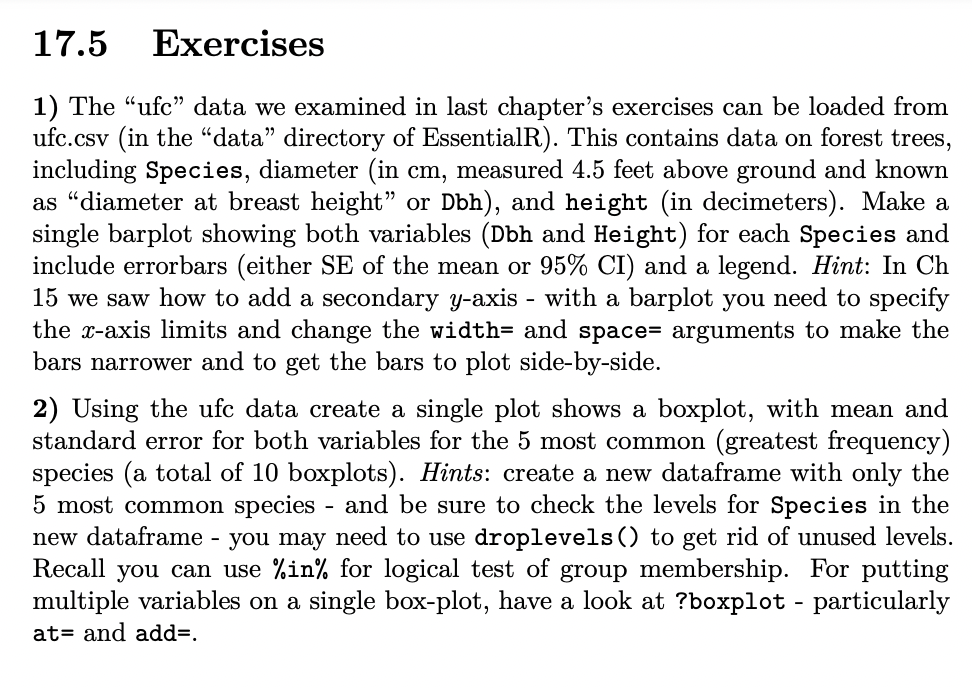
17.5 Exercises 1) The \"ufc\" data we examined in last chapter's exercises can be loaded from ufc.csv (in the \"data\" directory of EssentialR). This contains data on forest trees, including Species, diameter (in cm, measured 4.5 feet above ground and known as \"diameter at breast height\" or Dbh), and height (in decimeters). Make a single barplot showing both variables (Dbh and Height) for each Species and include errorbars (either SE of the mean or 95% CI) and a legend. Hint: In Ch 15 we saw how to add a secondary yaxis - with a barplot you need to specify the :r-axis limits and change the Uidth= and space= arguments to make the bars narrower and to get the bars to plot side-by-side. 2) Using the ufc data create a single plot shows a boxplot, with mean and standard error for both variables for the 5 most common (greatest frequency) species (a total of 10 boxplots). Hints: create a new dataframe with only the 5 most common species - and be sure to check the levels for Species in the new dataframe - you may need to use droplevels O to get rid of unused levels. Recall you can use Kink, for logical test of group membership. For putting multiple variables on a single boxplot, have a look at ?boxplot particularly at= and add=
Step by Step Solution
There are 3 Steps involved in it

Get step-by-step solutions from verified subject matter experts