







Question: 18. Let U = [a, b, c, d, e, f.g. h,i, j. k, I, m, n, o, p, q, r ,s , t, uv, w,x,
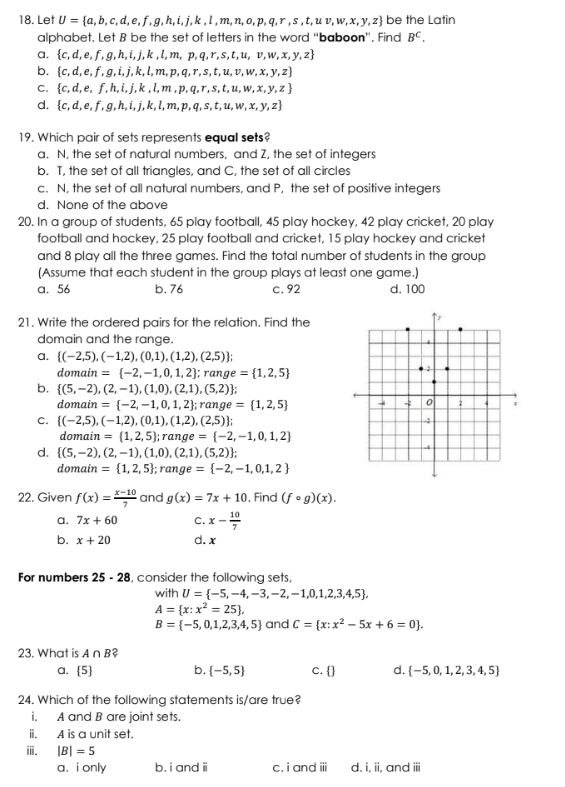
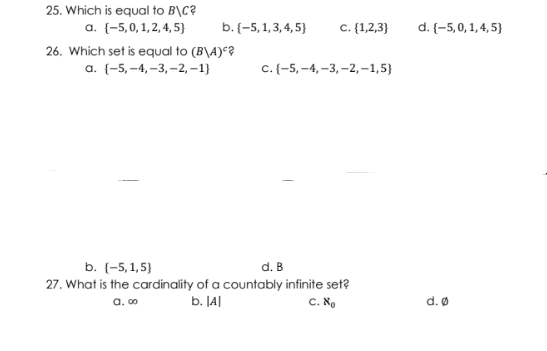
18. Let U = [a, b, c, d, e, f.g. h,i, j. k, I, m, n, o, p, q, r ,s , t, uv, w,x, y, z) be the Latin alphabet. Let B be the set of letters in the word "baboon". Find BC a. {c, d, e, f.g, h, i, j, k, I, m, p. q, r,s, t, u, v,w, x, y, z } b. (c, d, e. f.g. i, j. k, I,m. p. q, r, s, t, u, v, w,x, y,z ] c. {c, d, e, f. h,i. j.k , I,m.p. q.r,s, t, u, w,x, y.z } d. {c, d, e, f. g, h, i, j, k, l, m, p, q, s, t, u, w, x, y, z ] 19. Which pair of sets represents equal sets? a. N, the set of natural numbers, and Z, the set of integers b. T, the set of all triangles, and C, the set of all circles C. N, the set of all natural numbers, and P, the set of positive integers d. None of the above 20. In a group of students, 65 play football, 45 play hockey, 42 play cricket, 20 play football and hockey, 25 play football and cricket, 15 play hockey and cricket and 8 play all the three games. Find the total number of students in the group (Assume that each student in the group plays at least one game.) a. 56 b. 76 C. 92 d. 100 21. Write the ordered pairs for the relation. Find the domain and the range. a. {(-2,5), (-1,2), (0,1). (1,2), (2,5)): domain = {-2,-1,0, 1,2); range = (1,2.5} b. {(5,-2), (2, -1), (1,0), (2,1). (5,2)}: domain = {-2, -1, 0, 1, 2}; range = {1, 2,5} C. {(-2,5). (-1,2), (0,1). (1,2). (2,5)]: domain = (1,2, 5}: range = {-2, -1,0,1,2] d. {(5,-2), (2, -1), (1,0), (2,1). (5,2)): domain = {1, 2, 5}; range = {-2, -1, 0,1,2 } 22. Given f(x) = _ and g(x) = 7x + 10. Find (f . g)(x). a. 7x + 60 C. X - - b. x +20 d. x For numbers 25 - 28, consider the following sets, with U = {-5,-4,-3,-2, -1,0,1,2,3,4,5}. A = (x: x = 25]. B = {-5, 0,1,2,3,4,5} and C = (x:x2 - 5x + 6 = 0]. 23. What is An B? a. (5] b. {-5,5) C. 0 d. {-5, 0, 1, 2,3,4,5] 24. Which of the following statements is/are true? i. A and B are joint sets. ii. A is a unit set. ifi. IBI = 5 a. i only b. i and ii c. i and ili d. i, ii, and ii25. Which is equal to B\\C? a. {-5,0, 1, 2, 4,5} b. {-5,1,3,4,5} C. {1,2,3} d. {-5, 0, 1, 4,5} 26. Which set is equal to (B\\A)"? a. {-5,-4,-3,-2,-1] C. {-5, -4,-3,-2,-1,5} b. [-5,1,5] d. B 27. What is the cardinality of a countably infinite set? b. JAI C. No d. 0
Step by Step Solution
There are 3 Steps involved in it

Get step-by-step solutions from verified subject matter experts
 Study Help