







Question: 19. problem 6.19 In late 1980 , the U.S. Commerce Department released new data stowing inflation was 15%. At the time, the prime rate of
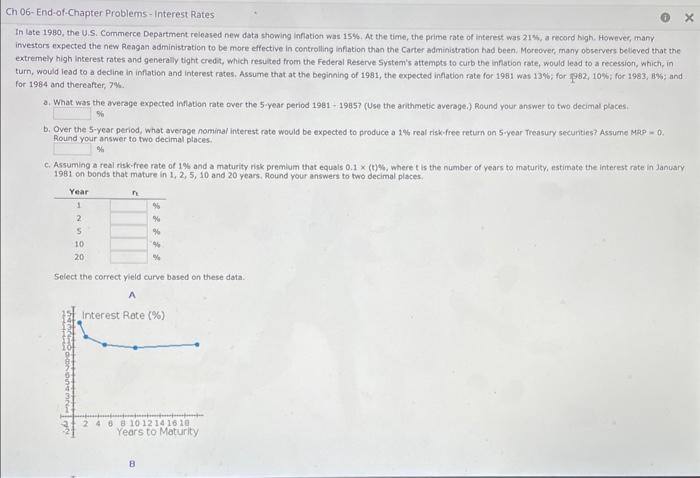
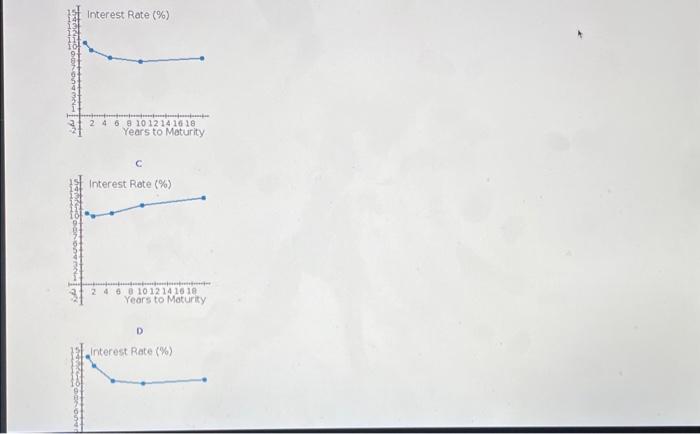
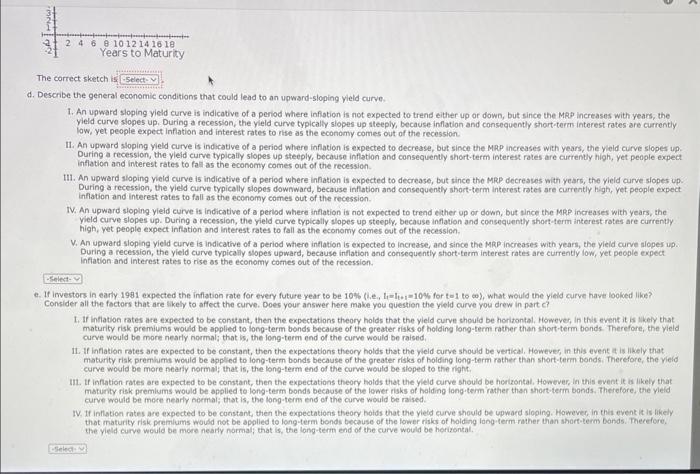
In late 1980 , the U.S. Commerce Department released new data stowing inflation was 15%. At the time, the prime rate of interect was 21%, a record high. However, inany, investors expected the new Reagan administration to be more effective in controlling infiation than the Carter administrabion had been, Moreorec, many observers betloved that the extremeiy high interest rates and generally tight credit, which resulted from the Federal Reserve System's attempts to curb the infiation rate, would lead to a recession, which, in turn, would iead to a decline in inflation and interest rates. Assume that at the beginning of 1981, the expected infation rate for 1981 was 13%; for proz, 10\%; for 1983, 89; and. for 1984 and thereafter, 7%. a. What was the average expected infation rate over the 5 -year pericd 196119857 (Use the anthmetic average.) Round your answer to two decimal places. 9 b. Over the 5-year period, what average nominal interest rate would be expected to produce a 1% real risk.free return on 5 -year Treasury secunties? Assume Map = 0. Round vour answer to two decimal places. \% c. Assuming a real risk-free rate of 1% and a maturity nisk premlum that equals 0.1(t)%, where t is the number of years to inaturity, estimate the interest rate in January 1981 on bonds that mature in 1, 2, 5, 10 and 20 years. found your answers to two decimal places. Solect the correct yield curve bosed on these data. C D Interest Rate (\%) d. Describe the general economic conditions that could lead to an upward-sloping yleld curve: 1. An upward sloping yield curve is indicative of a period where infiotion is not expected to trend either up or down, but since the Meg increases with years, the yield curve slopes up. During a recession, the yield curve typically slopes up steeply, because inflation and consequently short-term interest rotes are currently law, yet people expect infiation and interest rates to rise as the economy comes out of the recession- I1. An upward sloping yield curve is indicative of a period where inflation is expected to decrease, but since the Map increases with years, the yield curve slopes up. During a recession, the yieid curve typically slopes up steeply, because inflation and consequently short-term interest rates are currently high, yet people expect. inflation and interest rates to fall as the economy comes out of the recession. III. An upward sloping vield curve is indicative of a period where inflation is expected to decrease, but since the MRP decreases with yearb, the yieid curve siopes up. During a recession, the yield curve typically slopes downward, because inflation and conseguently short-term interest rates are currently bigh, yet people expect. inflation and interest rates to fall as the economy comes out of the recession. IV. An upward sloping yieid curve is indicative of a period where inflation is not expected to tread either op or dowa, but since the MRp increases with years, the yield curve slopes up. During a recession, the yield curve typically slopes up steeply, because inflation and consequently short-term interest rates are currenty high, yet people expect infation and interest rates to fall as the economy comes out of the recession. V. An upward sloping yield curve is indicative of a period where inflation is expected to increase, and since the MRp increases with years, the yield curve alopes up. During a recession, the yield curve typicaily slopes upward, because inflation and consequently short-term interest rates are currentiy low, yet people expect inflation and interest rates to rise as the economy comes out of the recession. e. If invectors in early 1991 expected the infiation rate for every future year to be 10% (i.e, Li=lter=10\% for toi to to ), what would the yield curve have looked like? Consider all the foctors that are likely to affect the curve. Does your answer here make you question the yield curve you drew in part c? 1. If infiation rates are expected to be constant, then the expectations theory holds that the yieid curve should be horitontal, However, in this event it is ikely that. maturity risk premiums would be applied to long-term bonds because of the greater risks of holding long-term rather than short-term bonds. Therefore, the yield curve would be more nearly normal, that is, the long-term end of the curve would be raised, II. If inflation rates are expected to be constant, then the expectations theory holds that the vield curve should be yertical, However, in this event it is likely that maturity risk premiums would be applied to long-term bonds because of the greater risks of bolding long-term rather than short-term bonds. Therefore, the vieid curve would be more neariy normal; that is, the long-term end of the curve would be sloped to the right. Iit. If infation rates are expected to be constant, then the expectations theory holds that the yleld curve should be herizontal. However, in this event it is likely that maturity risk premiums would be applied to long-term bonds because of the lower risks of halding long-tem rather than short-term bonds. Therefore, the yieid curve would be more nearly hoemal; that is, the long-term end of the curve would be raised. IV. If inflation rates are expected to be constant, then the expectations theory holds that the yieid eurve should be upward sloping. Howevec, in thit event it is likely that maturity risk premlums woudd not be applied to longterm bonds because of the fower risks of hoiding lang term rather than shortelerm bonds. Therefore. the yield curve would be more neady normal; that is, the lang-term end of the curve would be herizontal
Step by Step Solution
There are 3 Steps involved in it

Get step-by-step solutions from verified subject matter experts
 Study Help