







Question: 1.9 The Pentium 4 Prescott processor, released in 2004, had a clock rate of 3.6 GHz and voltage of 1.25 V. Assume that, on average,
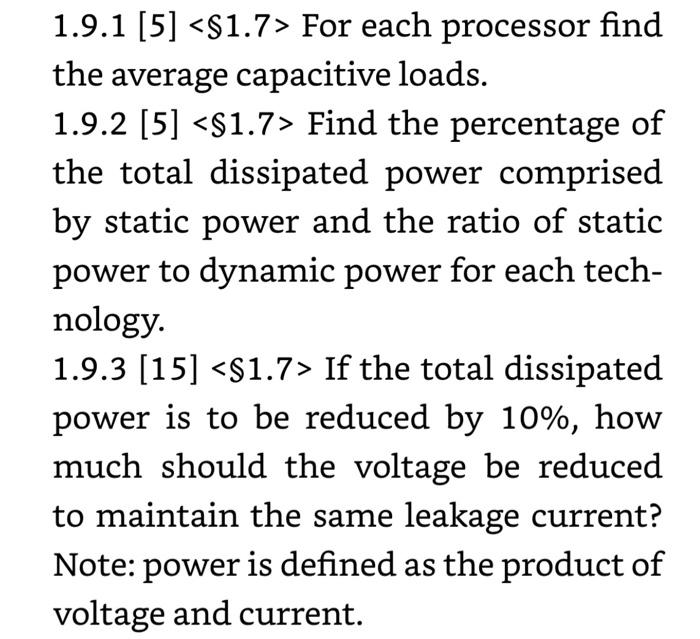
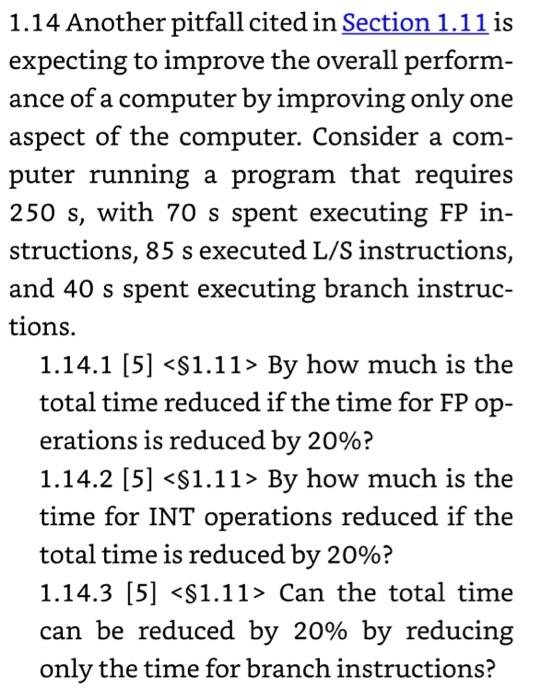
1.9.1 [5] For each processor find the average capacitive loads. 1.9.2 [5] Find the percentage of the total dissipated power comprised by static power and the ratio of static power to dynamic power for each tech- nology. 1.9.3 [15] If the total dissipated power is to be reduced by 10%, how much should the voltage be reduced to maintain the same leakage current? Note: power is defined as the product of voltage and current. 1.14 Another pitfall cited in Section 1.11 is expecting to improve the overall perform- ance of a computer by improving only one aspect of the computer. Consider a com- puter running a program that requires 250 s, with 70 s spent executing FP in- structions, 85 s executed L/S instructions, and 40 s spent executing branch instruc- tions. 1.14.1 [5] By how much is the total time reduced if the time for FP op- erations is reduced by 20%? 1.14.2 [5] By how much is the time for INT operations reduced if the total time is reduced by 20%? 1.14.3 [5] Can the total time can be reduced by 20% by reducing only the time for branch instructions
Step by Step Solution
There are 3 Steps involved in it

Get step-by-step solutions from verified subject matter experts
 Study Help