



Question: 1.91 Treating Heart Failure. In the journal article Cardiac- Resynchronization Therapy with or without an Implantable Defib- rillator in Advanced Chronic Heart Failure (New England
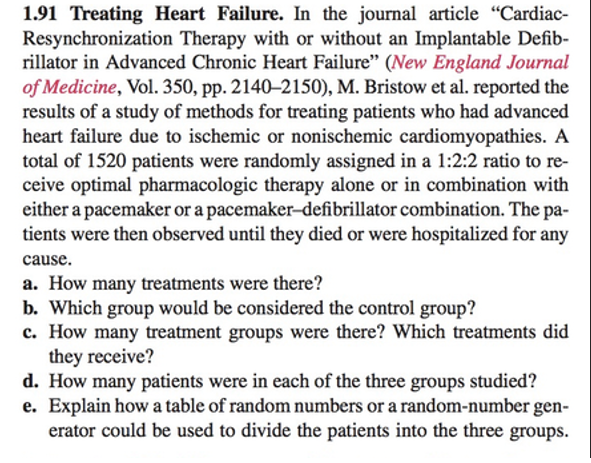
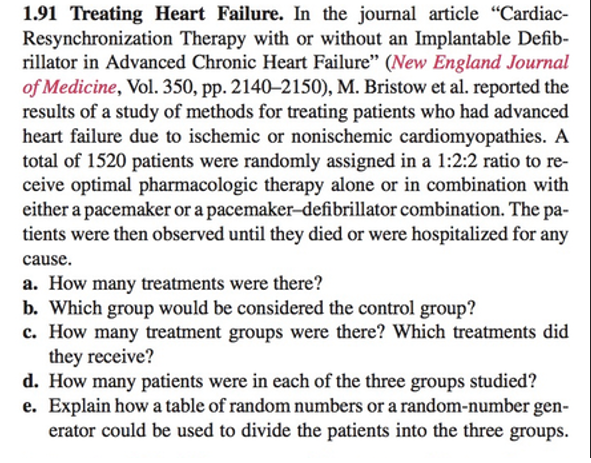
1.91 Treating Heart Failure. In the journal article "Cardiac- Resynchronization Therapy with or without an Implantable Defib- rillator in Advanced Chronic Heart Failure" (New England Journal of Medicine, Vol. 350, pp. 2140-2150), M. Bristow et al. reported the results of a study of methods for treating patients who had advanced heart failure due to ischemic or nonischemic cardiomyopathyes. A total of 1520 patients were randomly assigned in a 1:2:2 ratio to re- ceive optimal pharmacologic therapy alone or in combination with either a pacemaker or a pacemaker-defibrillator combination. The pa- tients were then observed until they died or were hospitalized for any cause. a. How many treatments were there? b. Which group would be considered the control group? c. How many treatment groups were there? Which treatments did they receive? d. How many patients were in each of the three groups studied? e. Explain how a table of random numbers or a random-number gen- erator could be used to divide the patients into the three groups
Step by Step Solution
There are 3 Steps involved in it

Get step-by-step solutions from verified subject matter experts