





Question: 192 Eigenvalues and eigenvectors 3. Consider the plane as the real linear space R2, and let T be a rotation of R through an angle
192 Eigenvalues and eigenvectors 3. Consider the
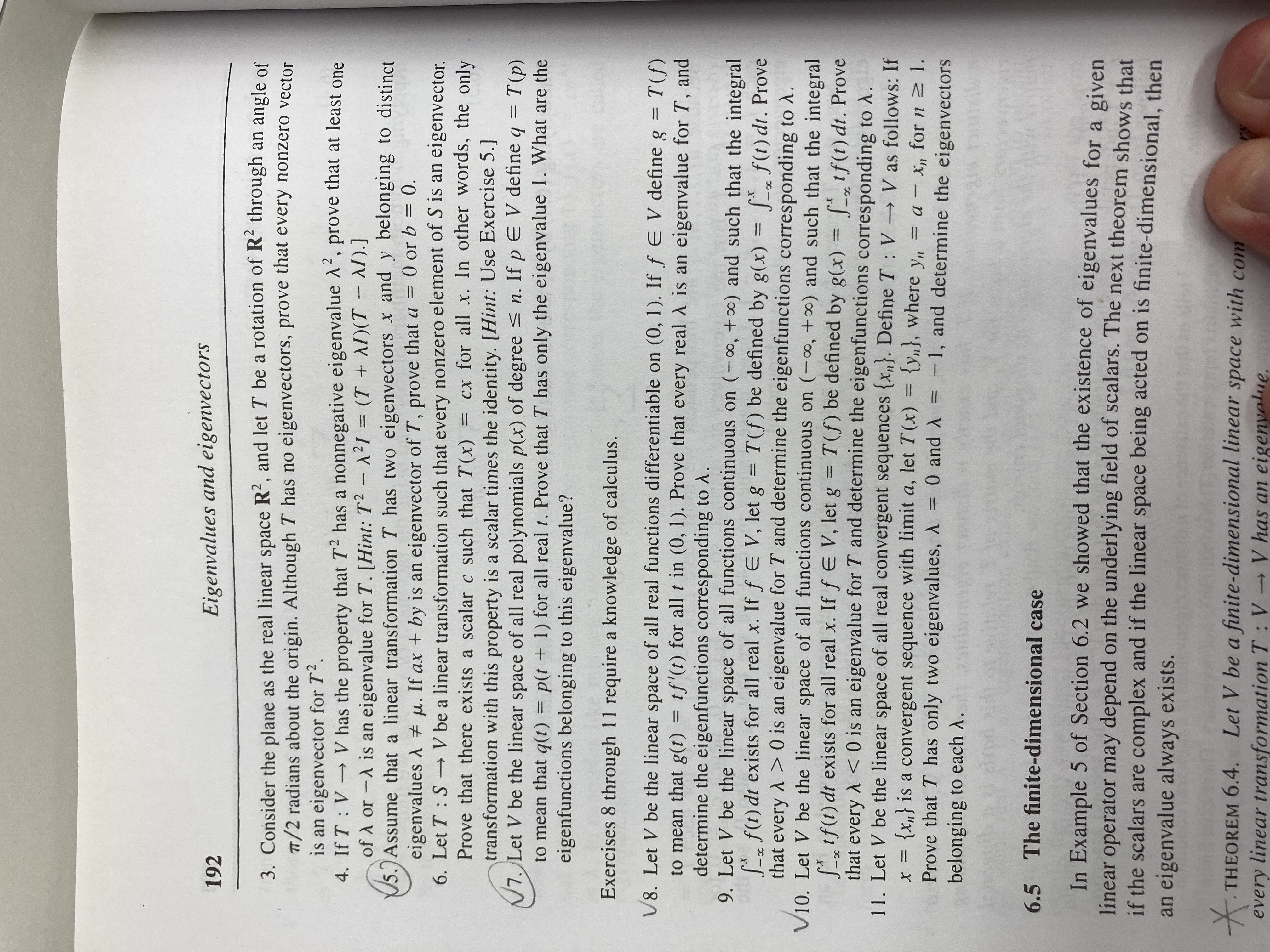
192 Eigenvalues and eigenvectors 3. Consider the plane as the real linear space R2, and let T be a rotation of R through an angle of TT / 2 radians about the origin. Although T has no eigenvectors, prove that every nonzero vector is an eigenvector for T2. 4. If T : V - V has the property that 72 has a nonnegative eigenvalue A, prove that at least one of A or - A is an eigenvalue for T. [Hint: T2 - 121 = (T + MI)(T - MI).] 5.) Assume that a linear transformation T has two eigenvectors x and y belonging to distinct eigenvalues A # M. If ax + by is an eigenvector of T, prove that a = 0 or b = 0. 6. Let T : S - V be a linear transformation such that every nonzero element of S is an eigenvector. Prove that there exists a scalar c such that T(x) = cx for all x. In other words, the only transformation with this property is a scalar times the identity. [Hint: Use Exercise 5.] (7. Let V be the linear space of all real polynomials p(x) of degree - n. If p E V define q = T(p) to mean that q(t) = p(t + 1) for all real t. Prove that T has only the eigenvalue 1. What are the eigenfunctions belonging to this eigenvalue? Exercises 8 through 1 1 require a knowledge of calculus. V8. Let V be the linear space of all real functions differentiable on (0, 1). If f E V define g = T(f) to mean that g(t) = tf'(t) for all t in (0, 1). Prove that every real A is an eigenvalue for T, and determine the eigenfunctions corresponding to A. 9. Let V be the linear space of all functions continuous on (-co, + 0) and such that the integral J_x f(t) dt exists for all real x. If f E V, let g = T(f) be defined by g(x) = S, f(t) dt. Prove that every A > 0 is an eigenvalue for T and determine the eigenfunctions corresponding to A. V10. Let V be the linear space of all functions continuous on (-co, + 0) and such that the integral J_x if(t) dt exists for all real x. If f E V, let g = T(f) be defined by g(x) = ], if(t) dt. Prove that every A

Step by Step Solution

There are 3 Steps involved in it

1 Expert Approved Answer
Step: 1 Unlock blur-text-image

Question Has Been Solved by an Expert!

Get step-by-step solutions from verified subject matter experts

Step: 2 Unlock
Step: 3 Unlock

Students Have Also Explored These Related Mathematics Questions!