





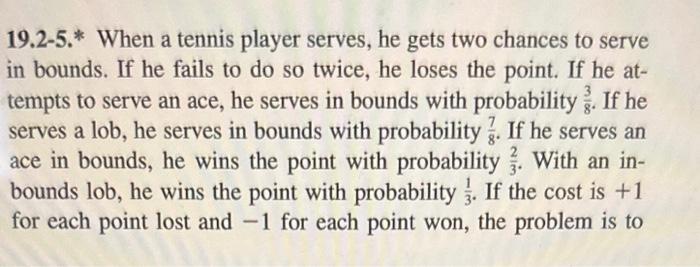
Question: 19.2-5.* When a tennis player serves, he gets two chances to serve in bounds. If he fails to do so twice, he loses the point.
19.2-5.* When a tennis player serves, he gets two
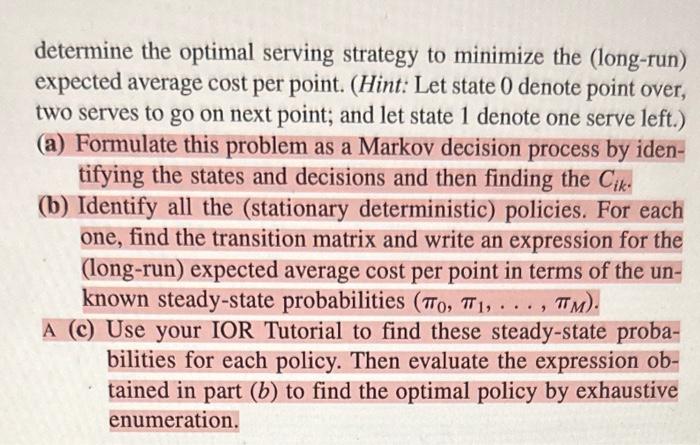
19.2-5.* When a tennis player serves, he gets two chances to serve in bounds. If he fails to do so twice, he loses the point. If he attempts to serve an ace, he serves in bounds with probability 83. If he serves a lob, he serves in bounds with probability 87. If he serves an ace in bounds, he wins the point with probability 32. With an inbounds lob, he wins the point with probability 31. If the cost is +1 for each point lost and 1 for each point won, the problem is to determine the optimal serving strategy to minimize the (long-run) expected average cost per point. (Hint: Let state 0 denote point over, two serves to go on next point; and let state 1 denote one serve left.) (a) Formulate this problem as a Markov decision process by identifying the states and decisions and then finding the Cik. (b) Identify all the (stationary deterministic) policies. For each one, find the transition matrix and write an expression for the (long-run) expected average cost per point in terms of the unknown steady-state probabilities (0,1,,M). A (c) Use your IOR Tutorial to find these steady-state probabilities for each policy. Then evaluate the expression obtained in part (b) to find the optimal policy by exhaustive enumeration

Step by Step Solution

There are 3 Steps involved in it

1 Expert Approved Answer
Step: 1 Unlock blur-text-image

Question Has Been Solved by an Expert!

Get step-by-step solutions from verified subject matter experts

Step: 2 Unlock
Step: 3 Unlock

Students Have Also Explored These Related General Management Questions!