







Question: 1a) Please give a descriptive explanation of what this algorithm does. 1b) What is an example of an array of size 15 for a best-case
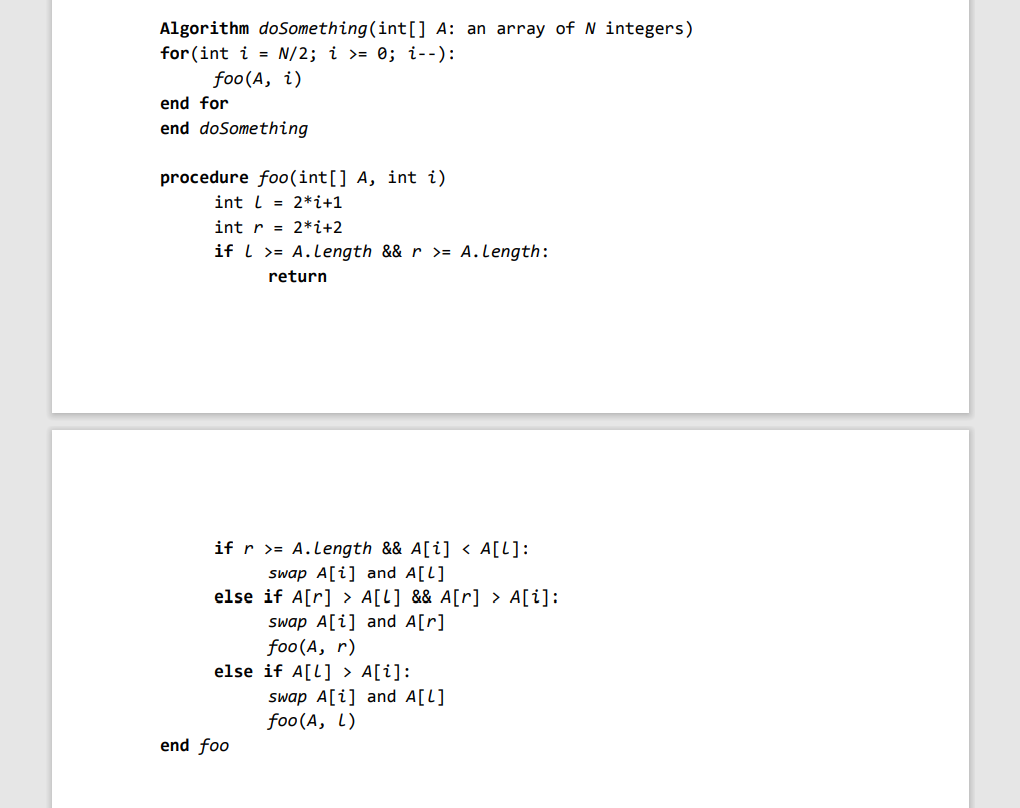
1a) Please give a descriptive explanation of what this algorithm does.
1b) What is an example of an array of size 15 for a best-case scenario.
1c) What is an example of an array of size 15 for a worst-case scenario.
Algorithm do something(int[] A: an array of N integers) for(int i = N/2; i >= 0; i--): foo(A, i) end for end do something procedure foo(int[] A, int i) int L = 2*1+1 int r = 2*1+2 if (>= A.Length && r >= A.Length: return if r >= A.Length && A[i] A[L] && A[r] > A[i]: swap A[i] and A[r] foo(A, r) else if A[L] > A[i]: swap A[i] and A[L] foo(A, L) end foo Algorithm do something(int[] A: an array of N integers) for(int i = N/2; i >= 0; i--): foo(A, i) end for end do something procedure foo(int[] A, int i) int L = 2*1+1 int r = 2*1+2 if (>= A.Length && r >= A.Length: return if r >= A.Length && A[i] A[L] && A[r] > A[i]: swap A[i] and A[r] foo(A, r) else if A[L] > A[i]: swap A[i] and A[L] foo(A, L) end foo
Step by Step Solution
There are 3 Steps involved in it

Get step-by-step solutions from verified subject matter experts
 Study Help