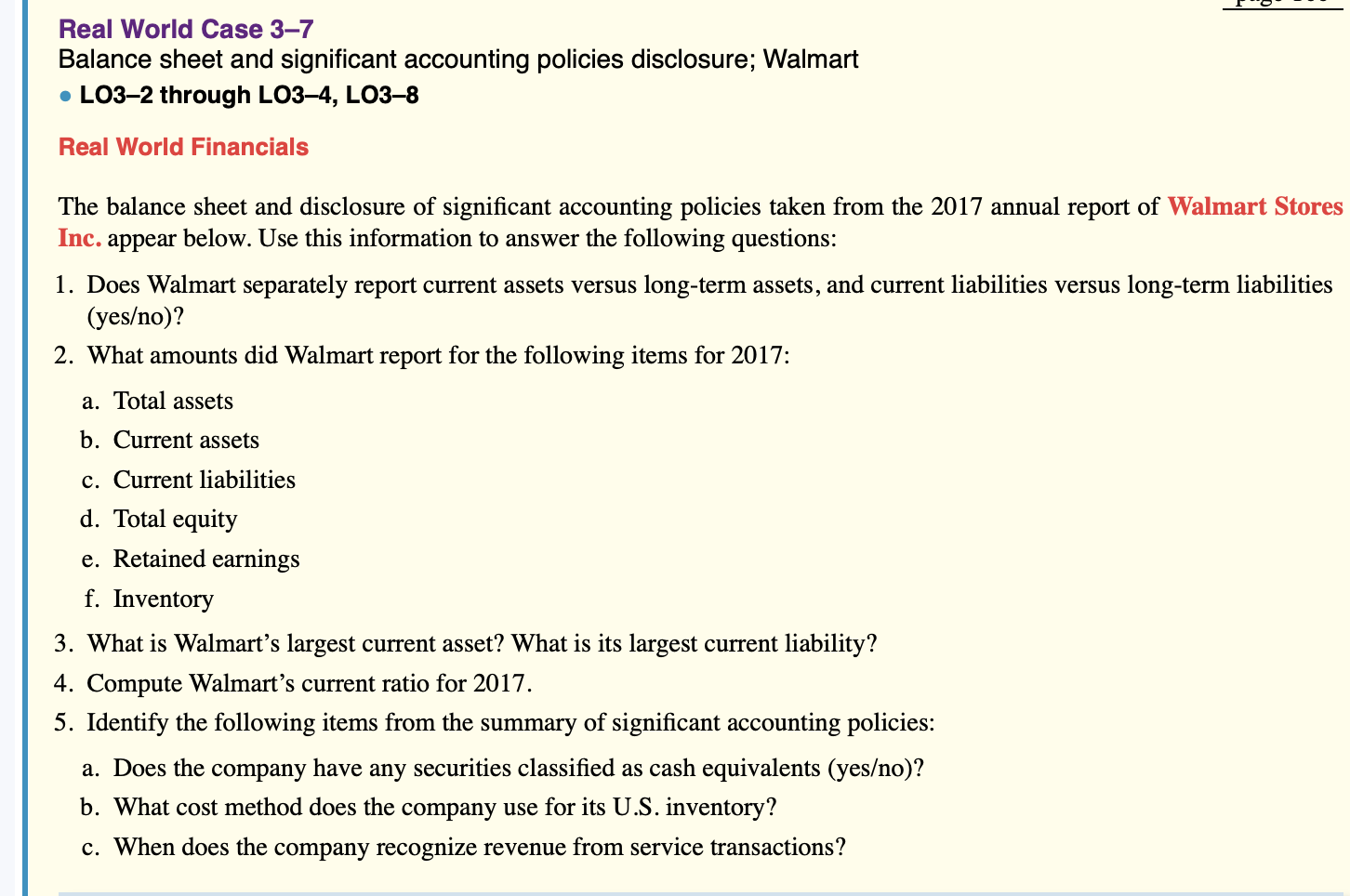
Question: 1'D ' Real World Case 3-7 Balance sheet and significant accounting policies disclosure; Walmart o L032 through L034, L038 Real World Financials The balance sheet
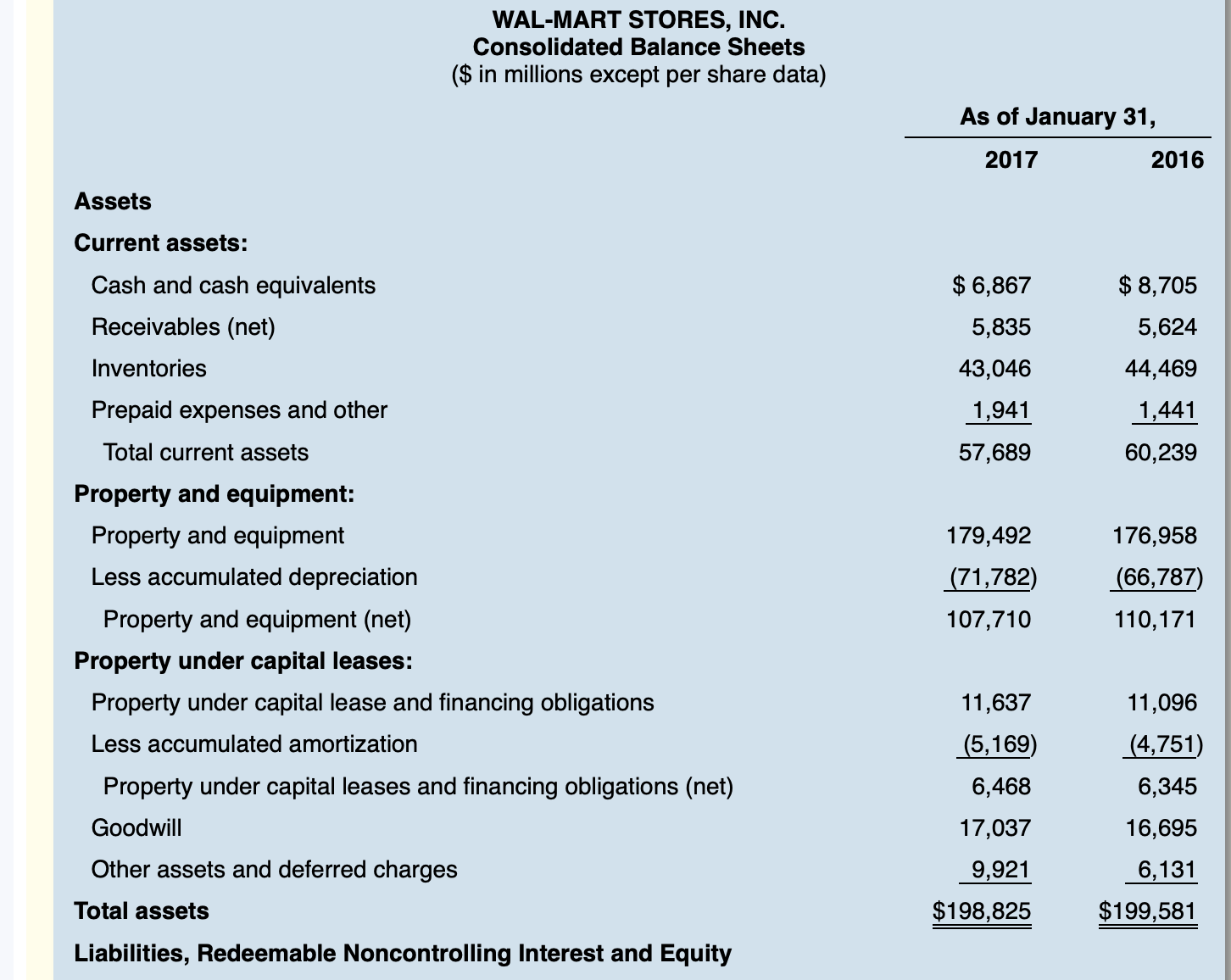
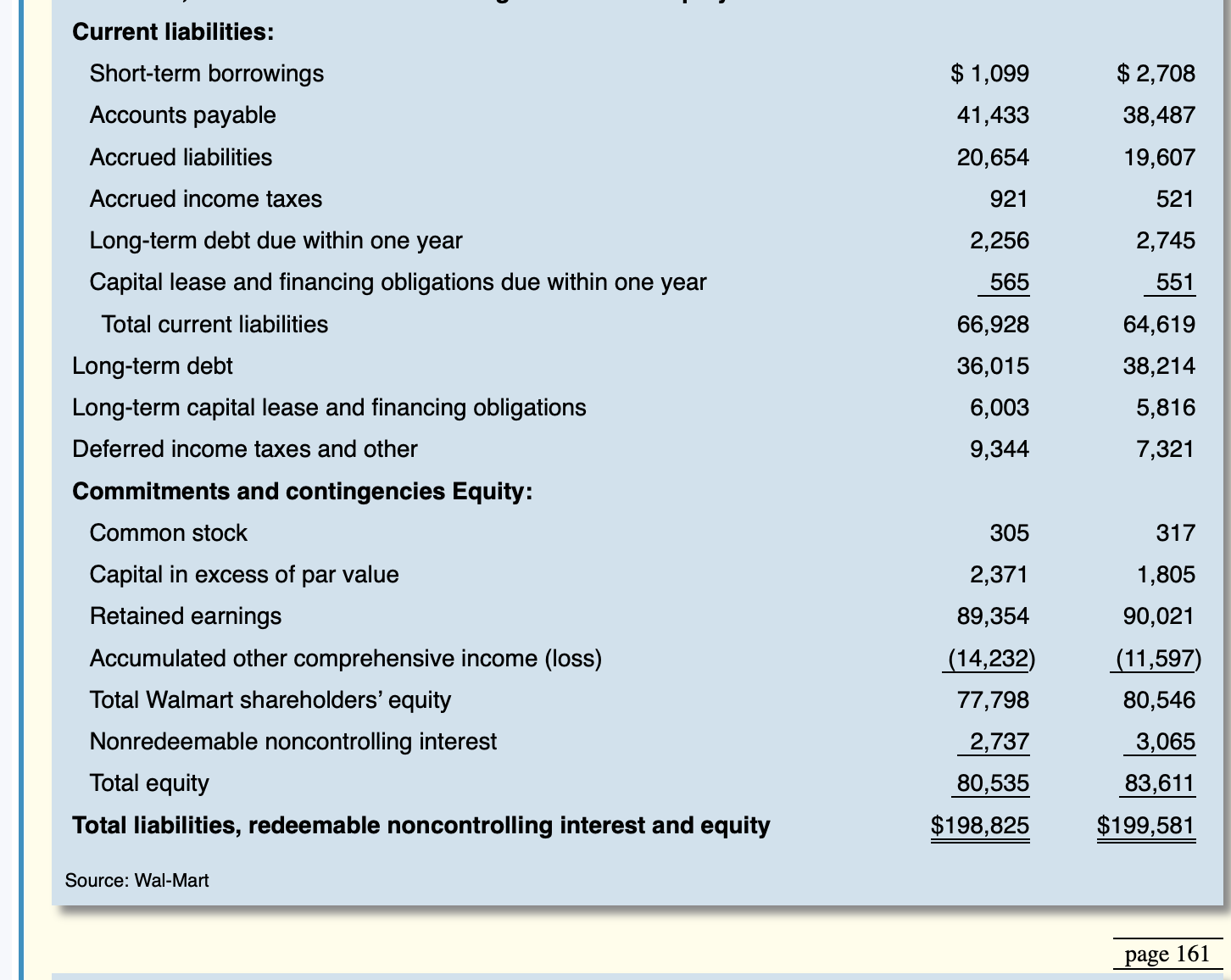
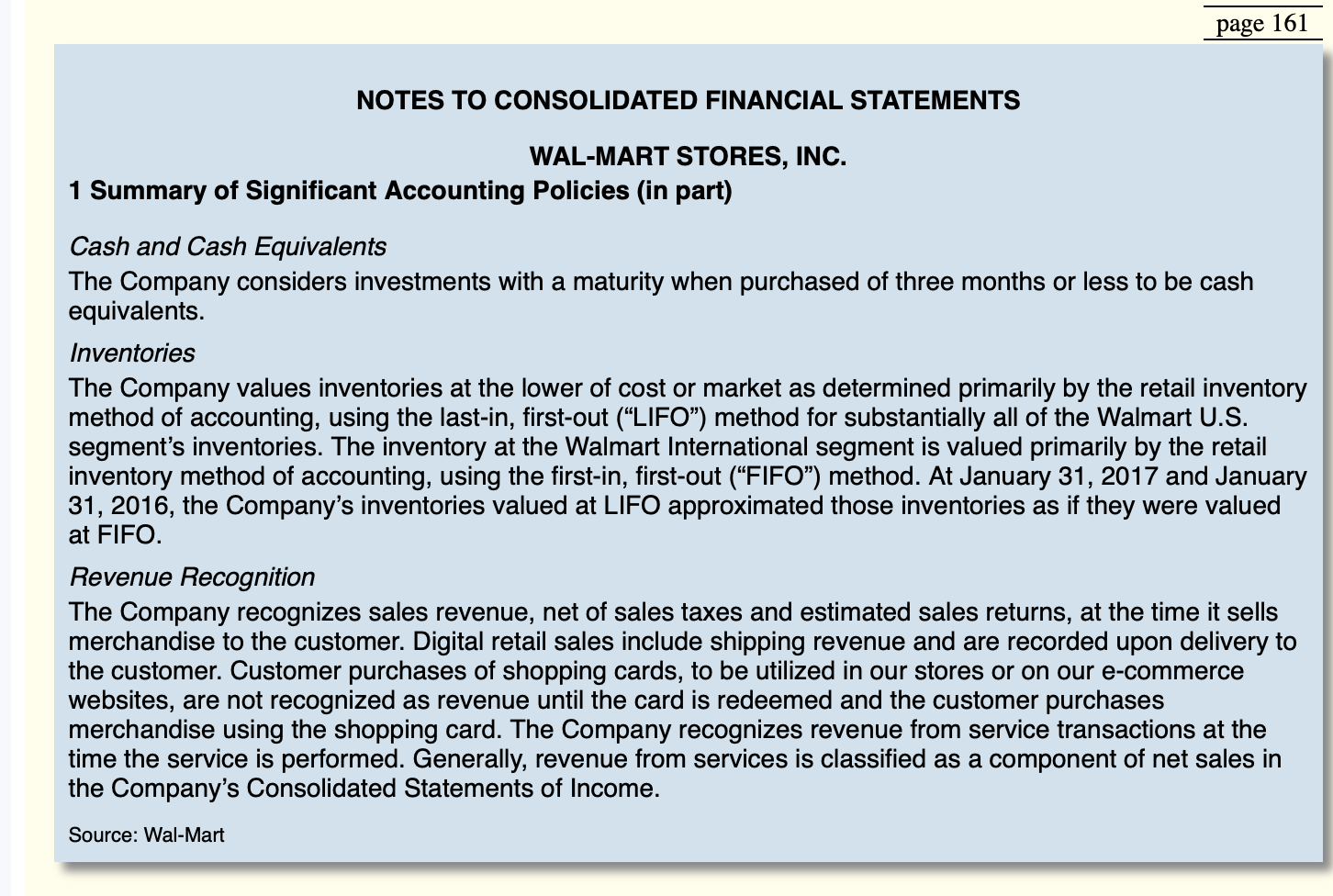
1'"D \"' Real World Case 3-7 Balance sheet and significant accounting policies disclosure; Walmart o L032 through L034, L038 Real World Financials The balance sheet and disclosure of signicant accounting policies taken from the 2017 annual report of Walmart Stores Inc. appear below. Use this information to answer the following questions: 1. Does Walmart separately report current assets versus long-term assets, and current liabilities versus long-term liabilities (yesfno)? 2. What amounts did Walmart report for the following items for 2017: a. Total assets b. Current assets c. Current liabilities d. Total equity e. Retained earnings f. Inventory 3. What is Walmart's largest current asset? What is its largest current liability? 4. Compute Walmart's current ratio for 2017. 5. Identify the following items from the summary of signicant accounting policies: a. Does the company have any securities classied as cash equivalents (yeso)? b. What cost method does the company use for its US. inventory? c. When does the company recognize revenue from service transactions? WAL-MART STORES, INC. Consolidated Balance Sheets ($ in millions except per share data) Assets Current assets: Cash and cash equivalents Receivables (net) Inventories Prepaid expenses and other Total current assets Property and equipment: Property and equipment Less accumulated depreciation Property and equipment (net) Property under capital leases: Property under capital lease and financing obligations Less accumulated amortization Property under capital leases and financing obligations (net) Goodwill Other assets and deferred charges Total assets Liabilities, Redeemable Noncontrolling Interest and Equity As of January 31, 2017 2016 $ 6,867 $ 8,705 5,835 5,624 43,046 44,469 M m 57,689 60,239 179,492 176,958 (71 ,782) (66,787) 107,710 110,171 11,637 11,096 M) E) 6,468 6,345 17,037 16,695 9,921 6,131 M M Current liabilities: Short-term borrowings $ 1,099 $ 2,708 Accounts payable 41,433 38,487 Accrued liabilities 20,654 19,607 Accrued income taxes 921 521 Long-term debt due within one year 2,256 2,745 Capital lease and financing obligations due within one year E E Total current liabilities 66,928 64,619 Long-term debt 36,015 38,214 Long-term capital lease and financing obligations 6,003 5,816 Deferred income taxes and other 9,344 7,321 Commitments and contingencies Equity: Common stock 305 317 Capital in excess of par value 2,371 1,805 Retained earnings 89,354 90,021 Accumulated other comprehensive income (loss) (14,232) (11,597) Total Walmart shareholders' equity 77,798 80,546 Nonredeemable noncontrolling interest 2,737 3,065 Total equity 80,535 83,611 Total liabilities, redeemable noncontrolling interest and equity $198,825 $199,581 Source: WaI-Mart page 161 page 161 NOTES TO CONSOLIDATED FINANCIAL STATEMENTS WAL-MART STORES, INC. 1 Summary of Significant Accounting Policies (in part) Cash and Cash Equivalents The Company considers investments with a maturity when purchased of three months or less to be cash equivalents. inventories The Company values inventories at the lower of cost or market as determined primarily by the retail inventory method of accounting, using the last-in, first-out (\"LIFO\") method for substantially all of the Walmart U.S. segment's inventories. The inventory at the Walmart International segment is valued primarily by the retail inventory method of accounting, using the first-in, first-out (\"FIFO\") method. At January 31, 2017 and January 31, 2016, the Company's inventories valued at LIFO approximated those inventories as if they were valued at FIFO. Revenue Recognition The Company recognizes sales revenue, net of sales taxes and estimated sales returns, at the time it sells merchandise to the customer. Digital retail sales include shipping revenue and are recorded upon delivery to the customer. Customer purchases of shopping cards, to be utilized in our stores or on our e-commerce websites, are not recognized as revenue until the card is redeemed and the customer purchases merchandise using the shopping card. The Company recognizes revenue from service transactions at the time the service is performed. Generally, revenue from services is classified as a component of net sales in the Company's Consolidated Statements of Income. Source: Wal-Mart
Step by Step Solution
There are 3 Steps involved in it
1 Expert Approved Answer
Step: 1 Unlock
Question Has Been Solved by an Expert!
Get step-by-step solutions from verified subject matter experts
Step: 2 Unlock
Step: 3 Unlock
Students Have Also Explored These Related Accounting Questions!









 Study Help