Question: 1-define the problems in the case and solve them 2- what kind of organizational leadership issues in this case? write one page about the points
1-define the problems in the case and solve them
2- what kind of organizational leadership issues in this case?
write one page about the points above
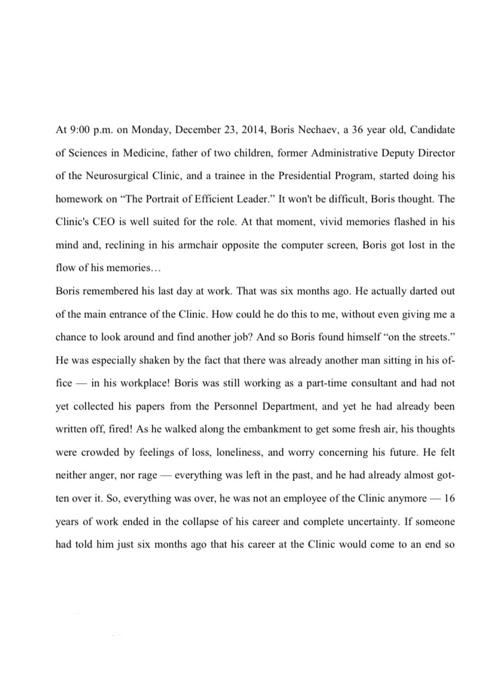
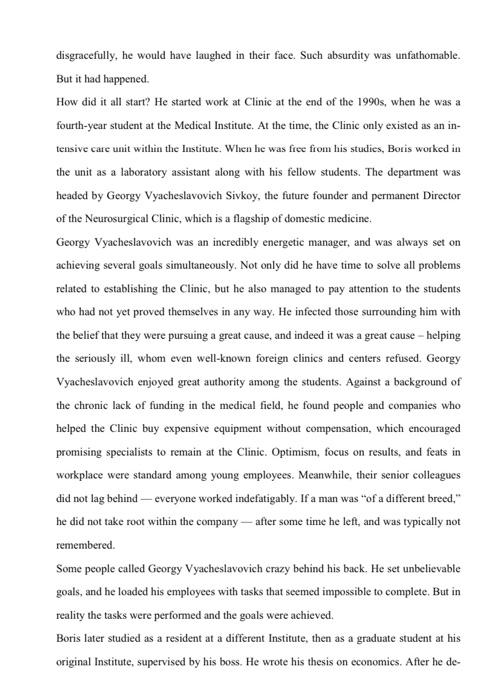
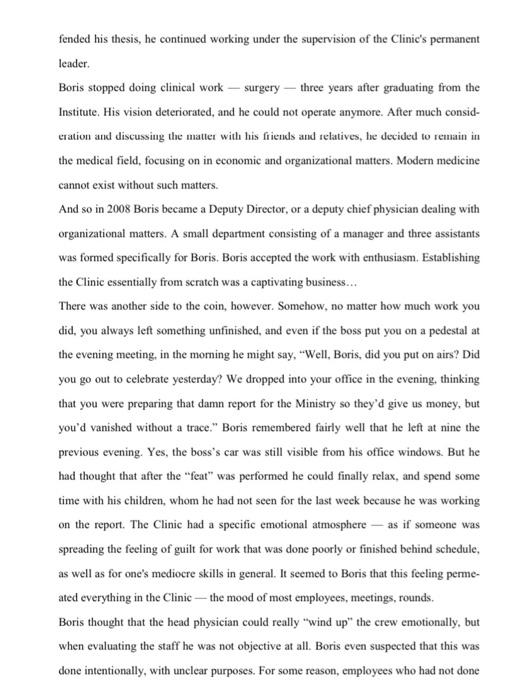
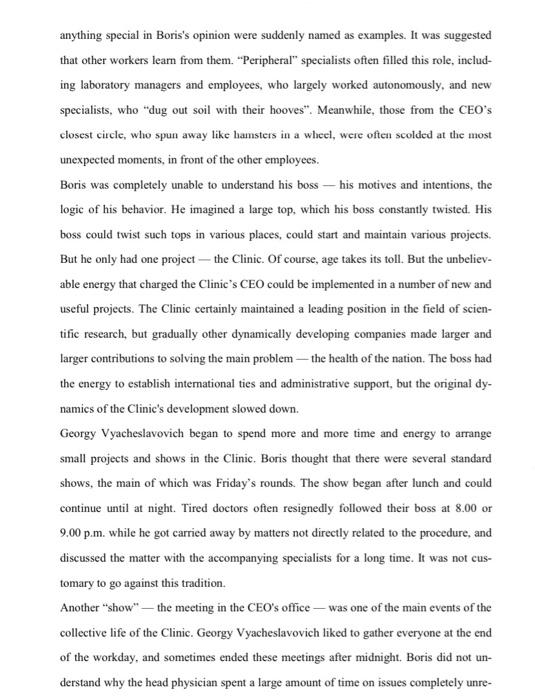
At 9:00 p.m. on Monday, December 23, 2014, Boris Nechaev, a 36 year old, Candidate of Sciences in Medicine, father of two children, former Administrative Deputy Director of the Neurosurgical Clinic, and a trainee in the Presidential Program, started doing his homework on "The Portrait of Efficient Leader." It won't be difficult, Boris thought. The Clinic's CEO is well suited for the role. At that moment, vivid memories flashed in his mind and, reclining in his armchair opposite the computer screen, Boris got lost in the flow of his memories... Boris remembered his last day at work. That was six months ago. He actually darted out of the main entrance of the Clinie. How could he do this to me, without even giving me a chance to look around and find another job? And so Boris found himself on the streets." He was especially shaken by the fact that there was already another man sitting in his of fice - in his workplace! Boris was still working as a part-time consultant and had not yet collected his papers from the Personnel Department, and yet he had already been written off, fired! As he walked along the embankment to get some fresh air, his thoughts were crowded by feelings of loss, loneliness, and worry concerning his future. He felt neither anger, nor rage -- everything was left in the past, and he had already almost got- ten over it. So, everything was over, he was not an employee of the Clinic anymore - 16 years of work ended in the collapse of his career and complete uncertainty. If someone had told him just six months ago that his career at the Clinic would come to an end so disgracefully, he would have laughed in their face. Such absurdity was unfathomable. But it had happened. How did it all start? He started work at Clinic at the end of the 1990s, when he was a fourth-year student at the Medical Institute. At the time, the Clinic only existed as an in- tensive care unit within the Institute. When he was free from his studies, Boris worked in the unit as a laboratory assistant along with his fellow students. The department was headed by Georgy Vyacheslavovich Sivkoy, the future founder and permanent Director of the Neurosurgical Clinic, which is a flagship of domestic medicine. Georgy Vyacheslavovich was an incredibly energetic manager, and was always set on achieving several goals simultaneously. Not only did he have time to solve all problems related to establishing the Clinic, but he also managed to pay attention to the students who had not yet proved themselves in any way. He infected those surrounding him with the belief that they were pursuing a great cause, and indeed it was a great cause helping the seriously ill, whom even well-known foreign clinics and centers refused. Georgy Vyacheslavovich enjoyed great authority among the students. Against a background of the chronic lack of funding in the medical field, he found people and companies who helped the Clinic buy expensive equipment without compensation, which encouraged promising specialists to remain at the Clinic. Optimism, focus on results, and feats in workplace were standard among young employees. Meanwhile, their senior colleagues did not lag behind - everyone worked indefatigably. If a man was of a different breed." he did not take root within the company -- after some time he left, and was typically not remembered Some people called Georgy Vyacheslavovich crazy behind his back. He set unbelievable goals, and he loaded his employees with tasks that seemed impossible to complete. But in reality the tasks were performed and the goals were achieved. Boris later studied as a resident at a different Institute, then as a graduate student at his original Institute, supervised by his boss. He wrote his thesis on economics. After he de anything special in Boris's opinion were suddenly named as examples. It was suggested that other workers learn from them. "Peripheral specialists often filled this role, includ- ing laboratory managers and employees, who largely worked autonomously, and new specialists, who "dug out soil with their hooves". Meanwhile, those from the CEO's closest circle, who spun away like hamsters in a wheel, were often scolded at the most unexpected moments, in front of the other employees. Boris was completely unable to understand his boss - his motives and intentions, the logic of his behavior. He imagined a large top, which his boss constantly twisted. His boss could twist such tops in various places, could start and maintain various projects. But he only had one project - the Clinic. Of course, age takes its toll. But the unbeliev- able energy that charged the Clinic's CEO could be implemented in a number of new and useful projects. The Clinic certainly maintained a leading position in the field of scien- tific research, but gradually other dynamically developing companies made larger and larger contributions to solving the main problem -- the health of the nation. The boss had the energy to establish international ties and administrative support, but the original dy- namics of the Clinic's development slowed down. Georgy Vyacheslavovich began to spend more and more time and energy to arrange small projects and shows in the Clinic. Boris thought that there were several standard shows, the main of which was Friday's rounds. The show began after lunch and could continue until at night. Tired doctors often resignedly followed their boss at 8.00 or 9.00p.m. while he got carried away by matters not directly related to the procedure, and discussed the matter with the accompanying specialists for a long time. It was not cus- tomary to go against this tradition. Another "show" the meeting in the CEO's office - was one of the main events of the collective life of the Clinic. Georgy Vyacheslavovich liked to gather everyone at the end of the workday, and sometimes ended these meetings after midnight. Boris did not un- derstand why the head physician spent a large amount of time on issues completely unre- lated to the Clinie. Sometimes only a few minutes were spent discussing business issues. The employees adapted to such marathons in various ways, but no one could evade the leader's sharp eye and evaluation. Some tried to enter a trance-like state and wait out the meeting in meditation, but the boss noticed this strategy and often asked, "And what do you think about that?" The man started and "woke up." Trying to join in quickly, le of ten answered irrelevantly, and was immediately caught for lacking logic. On the contrary, others tried actively participate and asked questions. But even they were "defeated" by the boss, as his quick reactions and brilliant arguments showed that their questions were trifling matters, and that the employees simply did not understand what it meant to work pursuing a great cause. The only remaining option was to keep silent and loyally look the boss in the eyes. What goals did the head physician pursue in such situations? Can it be that this is how cults are formed? Sometimes even Boris, who was generally a critical and pragmatic man, was engulfed by the common feeling that "The Leader is Everything". People were not attracted to the CEO's office or "sanctuary," however, and tried to stay away from it. Attending physicians tried to go about their own business rather than get involved in the general excitement over "miracles," as they had patients for whom they themselves were "celestial". Adherents were primarily administrative personnel - people surrounding the boss, and staff When Boris thought about the Clinic's CEO, he pictured the image of a "sun" you reach towards it, but you cannot come close or you will be burnt. He unexpectedly thought that many people who close to Georgy Vyacheslavovich did in fact "burn out psychologically." After occupying leading positions in the Clinic, the CEO often pushed them to find new posts in other medical institutions, mostly routine managerial work. Many were left unsatisfied, and although they were bored, it turned out that their energy was wasted at the Clinic. Many such people left the Clinic, Boris thought. Let it not be said that Boris never thought about resigning. He felt that he was not on the same wavelength as most people surrounding the boss due to his pragmatic approach to life. And there were specific reasons for dismissal. A year after the Clinic was estab- lished, when Boris was already manager of the administrative department, a new maga- zine held an editorial board meeting at the Clinic, which was attended by professors from all over the world. When everyone went outside to go on a tour, their bus slowly drove past without stopping. Later, it was revealed that the driver decided to make a turn at the next intersection. Everyone continued talking to each other, waiting calmly for the matter to be solved. But it was a challenge for the boss. He was not used to waiting! In front of everyone, he asked Boris, "Why are you not running after him? Catch him!" so Boris ran... That night, entirely exhausted from the pressure of preparing the event, which had been a month of psychosis." and upset by this pursuit, which he considered senseless, Boris wrote a notice of resignation. But at the morning briefing he was lauded as the He- ro who saved the conference, the man holding the whole Clinic together, and the boss was proud of him in general! By the evening, he no longer had thoughts of resigning. Soon Boris noticed that psychological opposition to the head physician's frequent spon- taneous ideas was growing inside him. He began to demonstrate his obedience to his boss less than before. Georgy Vyacheslavovich did not fail to notice this. Expressing dissatis- faction with a number of situations in which Boris failed to implement projects, the boss started to push him from the center of decision-making. It's strange to think that the process of "squeezing Boris out from the Clinic started with the fifth, traditional, symposium arranged under the aegis of the Clinic. World-renowned doctors and administrators from a dozen countries attended these events. Many came not only to share their new achievements in the professional sphere, but also to chat their friends. The boss always actively participated in the symposium: it was his duty to give the welcoming address, and over the course of the event he could be seen in various areas of the hall chatting with guests with ease. On the whole, it was a celebration of science and friendship. Once, however, Boris nearly ruined the celebration unwittingly. As usual, he was responsible for organizing the symposium, including a gala dinner in the form of drinks and a buffet. A local company had provided the symposium with high quality drinks and snacks many times. Boris thought that an arrangement had been made with the company, and that no problems would arise. Something horrible did occur, however - the company did not bring drinks to the buffet dinner The guests had already assembled, and the boss immediately started scolding his staff in front of them. This time, the three women working under Boris became the objects of the attack. Boris knew that two of them had nothing to do with the order, but all three gath- ered together, shedding tears, and all the while a quartet of world-renowned musicians played cheerful tunes. It seemed to Boris that guests were actually not very disappointed with the delay. Drinks were promptly brought to serve with dessert, and the guests happi- ly went on with the agenda. After dinner, the leader accused Boris of trying to disrupt the symposium and discredit his boss in front of a global community. He was called a "use less employee", "saboteur", "Traitor," etc. And the fact that the event ended at a high lev- el, as usual, was fully credited to the efforts of the boss, who saved the "grand event". After the event, the boss' attitude towards Boris changed drastically. Although there was no separate conversation summarizing and clarifying the relationship, clouds started gathering over Boris's head. Above all else, the boss" change in attitude was evident be cause the he communicated with Boris directly less often, and he never celebrated his achievements at the traditional meetings, Though Boris was psychologically disoriented and had no clear strategy for further ac- tion, it cannot be said that he did not try to relieve the tension growing between him and his boss and regulate the "misunderstanding," as he called it. Natalya Pavlovna, the Deputy Director, was utterly devoted to the boss. Boris even sus pected that she imposed obedience on herself when serving her boss. The head physician often insultingly criticized Natalya Pavlovna in front of the other employees. And he a spoke about her in the third person, as he liked to do: "We have some managers who... He added something about the employee's shortcomings and the consequences thereof. Ultimately, everyone who witnessed an anonymous scolding started feeling guilty, as no one knew whom the boss was speaking about. And even if someone knew, he uncon- sciously took it personally. Boris called Natalya Pavlovna and suggested that meet in a cafe. They had a good work- ing relationship and often helped each other. "Go to him, repent, and he will forgive you," she advised in her quiet, melodious voice. You screwed up go to him and re- pent, he is forgiving." Boris simply could not imagine how he could repent. What should he do? Fall on his knees as soon as he enters the office and looking pitifully into his boss' eyes like the cat from Shrek, move his boss with a story about an unbelievable co- incidence of circumstances? Or should he repent in some other way? But nothing new came to mind, Boris did not go to his boss shortly after the buffet dinner, and the process of "squeezing him out of the clinic continued. Even before the incident, Boris had thought that the position of the Administrative Depu- ty Director was the peak of his career in the Clinic. After the buffet incident and the start of the period of "disgrace." Boris tried to change his administrative activities to the scien- tific sector, and began a full-time Ph.D. program. But his boss, who was the head of the Academic Board of the Institute, tumed down all 23 topics Boris presented. As a result, Boris applied in September, and was dismissed from the doctoral program in March be- cause he did not have any approved thesis topics. It was presented as if the doctoral can- didate himself was responsible for the failure - as if he did not manage to do what was required. Boris thought that this might also be part of his boss' game, which was titled "No one should have a slightest doubt in my magnanimity." Boris was struck by another bitter thought. Could it be that, since his time as a student, he spent 16 years of his life working in vain for only one company? Is this the cause of his current depression and his absolute lack of youthful striving towards great goals, which gave him energy at the beginning of his career? He is 36, he is confused, he is paid exactly three times less in his new position than he was at the Clinic. This is a dilapidated, God forsaken hospital, to which an experienced manager who is well known in medical circles was arbitratily appointed with the task of pulling the institution out of the crisis. Boris went to his manager to discuss this. He trusted him, but who can guarantee that everything will work out? Boris looked at the empty Word document. It was time to start writing, but there was no answer to the question. Is the boss an efficient leader at the age of 65? Is such pressure at work a necessary price for the creation of a "scientific institute" and an "effective crew"? Another question came back to Boris again and again: "Why was the boss so unjust to him? What role did he really play for the head physician? That of a consumable material, or a son who did not live up to his expectations? Or someone else









 Study Help