







Question: 1.Explain the difference between the demand curve facing a perfectly competitive firm and one faced by a monopolist.How does each choose the optimal level of
1.Explain the difference between the demand curve facing a perfectly competitive firm and one faced by a monopolist.How does each choose the optimal level of output? What constrains the monopolist's choice to charge any price it wants?
2.What are the necessary conditions for a monopoly position in a market to be established or maintained?
3.Explain why the following would or would not be a monopoly:
a.the best restaurant in town
b.your barber or beautician
c.your local telephone company
d.Amtrak
e.The United States Postal Service
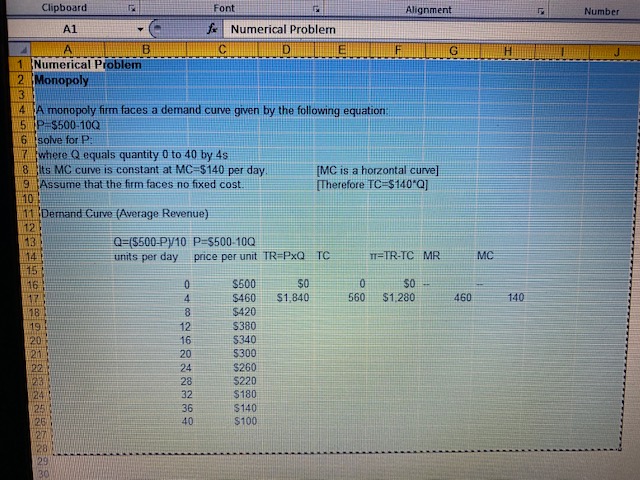
4.Fill in the table of the excel file HW9 2019 Numerical Help.
a.Plot the demand curve (for Q= 4 to 40 by 4s), calculate TR at each level of output, then calculate MR.
b.Plot the MR & MC curve on the same graph as in (a) to find Q* (optimal level of output).Be sure it is consistent with the table.
c.How much will the firm produce?
d.How much will it charge?
e.How much profit per day will it make?
f.If a fixed tax of $1,000 is imposed on the firm, will this affect its price? Explain.
5.For the following list of products (a - h), identify whether the industry is perfectly competitive (PC), monopolistically competitive (MC), oligopoly (OL) or monopoly (MP) (use the chart posted on Bb on Comparison of Market Structures)
a.potatoes
b.soft drinks
c.water and sewer services
d.optometrists
e.peaches
f.restaurants
Clipboard Font Alignment Number Al Numerical Problem A B C 1 Numerical Problem D E G H 2 Monopoly 3 4 A monopoly firm faces a demand curve given by the following equation: P $500-10Q 6 1 solve for P: 7 where Q equals quantity 0 to 40 by 4s 8 its MC curve is constant at MC $140 per day. [MC is a horzontal curve] 10 9 Assume that the firm faces no fixed cost. [Therefore TC=$140*Q] 11 Demand Curve (Average Revenue) 12 13 Q-($500-P//10 P=$500-10Q 14 units per day price per unit TR=PxQ TC "=TR-TC MR MC 15 146 $500 SO 0 SO 17 $460 $1 840 560 $1.280 460 1:10 8 $420 191 1 12 $380 20 1 16 $340 20 5300 24 $260 28 5220 24 32 $180 36 $140 40 $100
Step by Step Solution
There are 3 Steps involved in it

Get step-by-step solutions from verified subject matter experts
 Study Help