







Question: 1.:Given KB = (AVB) =>(C^A) and = (BVC) ^ A Does KB |= ? . Prove your example using truth table and explain on the
1.:Given KB = (AVB) =>(C^A) and = (BVC) ^ A Does KB |= ? . Prove your example using truth table and explain on the results
2 :Represent the following sentences in First Order Logic (20 points)
a) There is a student in a class that received the same grade in his mid and his finals.
b) Anyone passing his biology and winning the lottery is happy
c) Tom is lazy but clever
d) There is only one person in house5
4 : Following sentences are given in the Knowledge Base.
i. "x "y (~Mammal(x) v ~Bird(y)) v Smarter (x, y)
ii. "x Chicken(x) => Bird (x)
iii. "x Dog(x) => Mammal(x)
iiii. Chicken (Coco)
Does Smarter (Chris, Coco)? Use Forward Chaining to prove your answer and state which inference rules you used in each step.
4. Consider the following six well-formed formulas (wff)
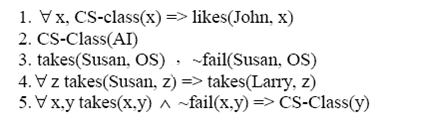
a) Convert these well formed formula (wff) into clause form
likes(john,OS) /\ likes(john, AI)
With each resolution step, also write down the substation made during unification if any
1. Vx, CS-class(x) => likes(John, x) 2. CS-Class(AI) 3. takes(Susan, OS), -fail(Susan, OS) 4. V z takes(Susan, z) => takes(Larry, z) 5. x,y takes(x,y) A fail(x,y) => CS-Class(y)
Step by Step Solution
There are 3 Steps involved in it

Get step-by-step solutions from verified subject matter experts
 Study Help