



Question: 1.How complicated is it to fill out customs forms? Any suggested solutions? 2.How much money do you think this problem costs the company each year?
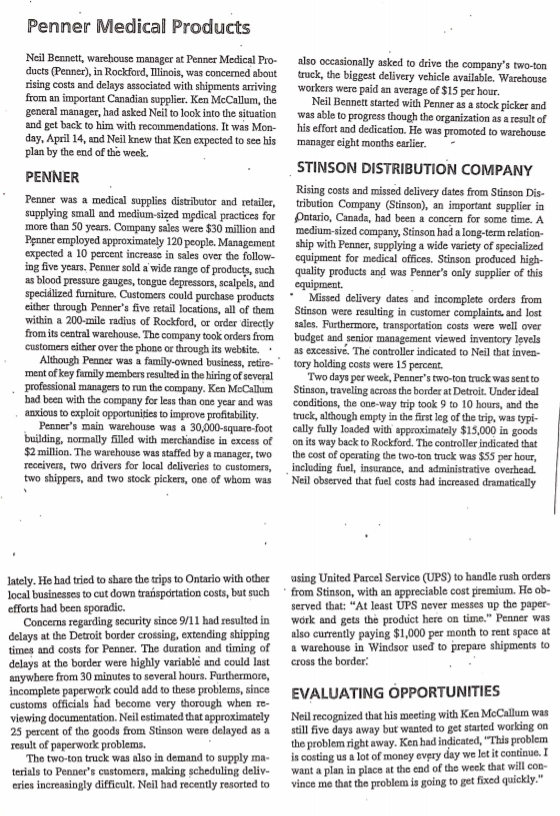
1.How complicated is it to fill out customs forms? Any suggested solutions?
2.How much money do you think this problem costs the company each year?
3.If you were Neil, what will be your suggestions?
4.Is changing to a new supplier be an option? Why or why not?
5.What is/are the main problem(s) in this case? How will you solve it/them?
Penner Medical Products Neil Bennett, warehouse manager at Penner Medical Pro- also occasionally asked to drive the company's two-ton ducts (Penner), in Rockford, Illinois, was concerned about truck, the biggest delivery vehicle available. Warehouse rising costs and delays associated with shipments arriving workers were paid an average of $15 per hour. from an important Canadian supplier. Ken McCallum, the Neil Bennett started with Penner as a stock picker and general manager, had asked Neil to look into the situation was able to progress though the organization as a result of and get back to him with recommendations. It was Mon- his effort and dedication. He was promoted to warehouse day, April 14, and Neil knew that Ken expected to see his manager eight months earlier. plan by the end of the week. STINSON DISTRIBUTION COMPANY PENNER Rising costs and missed delivery dates from Stinson Dis- Penner was a medical supplies distributor and retailer, tribution Company (Stinson), an important supplier in supplying small and medium-sized medical practices for Ontario, Canada, had been a concern for some time. A more than 50 years. Company sales were $30 million and medium-si i company, Stinson had a long-term relation- Penner employed approximately 120 people. Management ship with Penner, supplying a wide variety of specialized expected a 10 percent increase in sales over the follow- equipment for medical offices. Stinson produced high- ing five years. Penner sold a wide range of products, such quality products and was Penner's only supplier of this as blood pressure gauges, tongue depressors, scalpels, and equipment. specilized furniture. Customers could purchase products Missed delivery dates and incomplete orders from either through Penner's five retail locations, all of them Stinson were resulting in customer complaints and lost within a 200-mile radius of Rockford, or order directly sales. Furthermore, transportation costs were well over from its central warehouse. The company took orders from budget and senior management viewed inventory levels customers either over the phone or through its website. as excessive. The controller indicated to Neil that inven- Although Penner was a family-owned business, retire- tory holding costs were 15 percent. ment of key family members resulted in the hiring of several Two days per week, Penner's two-ton truck was sent to professional managers to run the company, Ken McCallum Stinson, traveling across the border at Detroit. Under ideal had been with the company for less than one year and was conditions, the one-way trip took 9 to 10 hours, and the anxious to exploit opportunities to improve profitability. truck, although empty in the first leg of the trip, was typi- Penner's main warehouse was a 30,000-square-foot cally fully loaded with approximately $15,000 in goods building, normally filled with merchandise in excess of on its way back to Rockford. The controller indicated that $2 million. The warehouse was staffed by a manager, two the cost of operating the two-ton truck was $55 per hour, receivers, two drivers for local deliveries to customers, including fuel, insurance, and administrative overhead. two shippers, and two stock pickers, one of whom was Neil observed that fuel costs had increased dramatically lately. He had tried to share the trips to Ontario with other using United Parcel Service (UPS) to handle rush orders local businesses to cut down trasportation costs, but such from Stinson, with an appreciable cost premium. He ob- efforts had been sporadic. served that: "At least UPS never messes up the paper Concerns regarding security since 9/11 had resulted in work and gets the product here on time." Penner was delays at the Detroit border crossing, extending shipping also currently paying $1,000 per month to rent space at times and costs for Penner. The duration and timing of a warehouse in Windsor used to prepare shipments to delays at the border were highly variable and could last cross the border: anywhere from 30 minutes to several hours. Furthermore, incomplete paperwork could add to these problems, since customs officials had become very thorough when re- EVALUATING OPPORTUNITIES viewing documentation. Neil estimated that approximately Neil recognized that his meeting with Ken McCallum was 25 percent of the goods from Stinson were delayed as a still five days away but wanted to get started working on result of paperwork problems. the problem right away. Ken had indicated, "This problem The two-ton truck was also in demand to supply ma is costing us a lot of money every day we let it continue. I terials to Penner's customers, making scheduling deliv- want a plan in place at the end of the week that will con eries increasingly difficult. Neil had recently resorted to vince me that the problem is going to get fixed quicklyStep by Step Solution
There are 3 Steps involved in it
1 Expert Approved Answer
Step: 1 Unlock

Question Has Been Solved by an Expert!
Get step-by-step solutions from verified subject matter experts
Step: 2 Unlock
Step: 3 Unlock