







Question: 1)In A. Bourjois & Co. v. Katzel, the U.S. Supreme Court determined that the actions of the defendant as an importer of cosmetics from a
1)In A. Bourjois & Co. v. Katzel, the U.S. Supreme Court determined that the actions of the defendant as an importer of cosmetics from a common French source violated the plaintiff's trademark. In K-mart Corp. v. Cartier, Inc., the U.S. Supreme Court held that a foreign importer would not violate an American trademark owner if both the owner and the foreign importer were subject to common ownership or control. How are these cases compatible? Please ensure you look at the facts of the case and the legal reasoning and that you understand HOW the facts relate to the legal principles. ? Case study 1 K MART CORP VS CARTIER ,INC 486 US 28. In situations with relatively little possibility of confusion, in which the quality of the gray market product is indistinguishable from the domestic product, U.S. courts have not been solicitous of the rights of licensors. In such cases, courts prize the benefits of price competition over concerns about a free ride for the gray marketer. More recent Supreme Court cases confirm this trend, favoring gray market forces where there is little chance of confusion. In K Mart Corp. v. Cartier, Inc., 486 U.S. 281 (1988), the U.S. Supreme Court allowed the entry of gray market imports as long as the foreign manufacturer and the domestic trademark owner were subject to common control. CASE 2
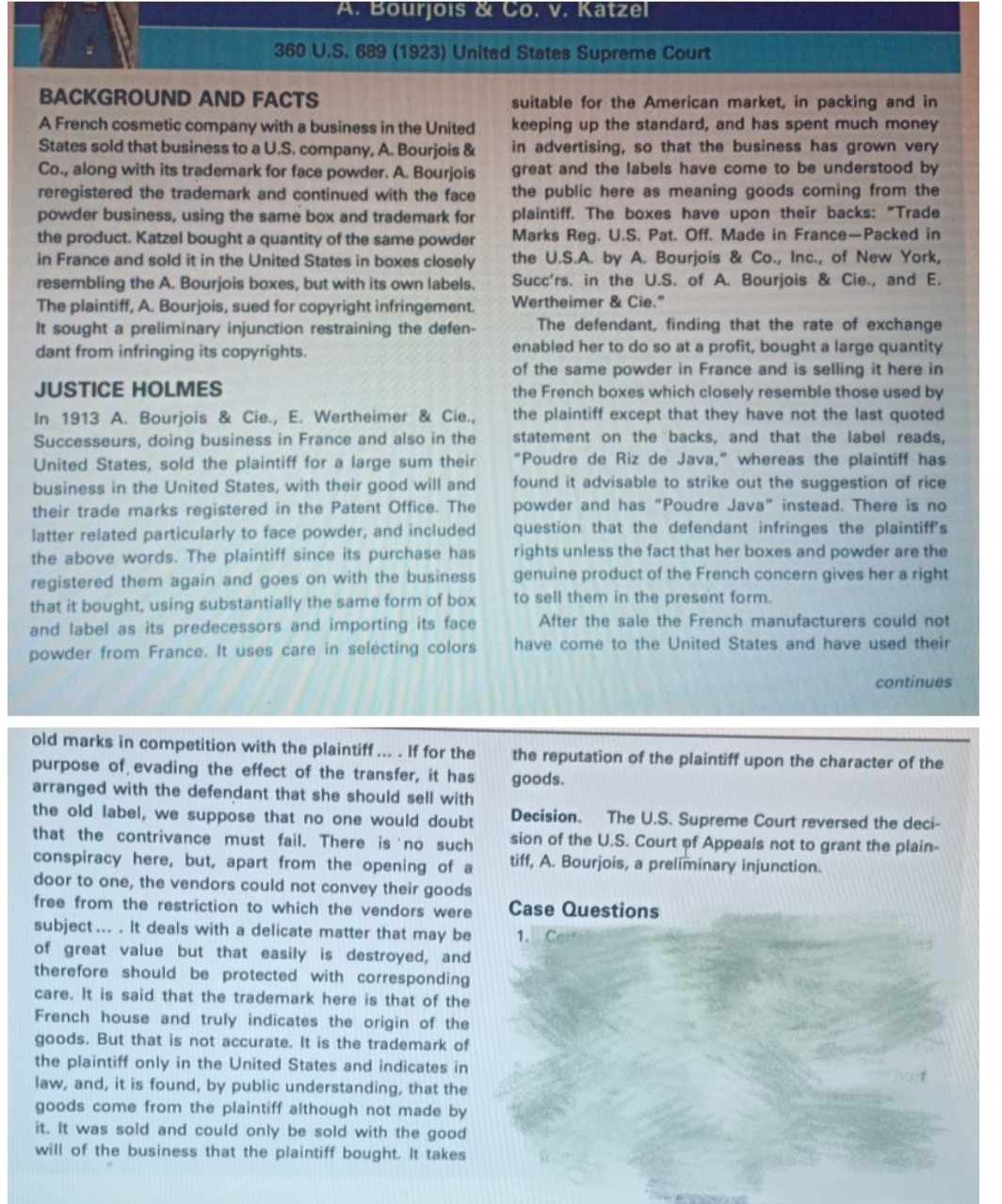
A. Bourjois & Co. v. Katzel 360 U.S. 689 (1923) United States Supreme Court BACKGROUND AND FACTS suitable for the American market, in packing and in A French cosmetic company with a business in the United keeping up the standard, and has spent much money States sold that business to a U.S. company, A. Bourjois & in advertising, so that the business has grown very Co., along with its trademark for face powder. A. Bourjois great and the labels have come to be understood by reregistered the trademark and continued with the face the public here as meaning goods coming from the powder business, using the same box and trademark for plaintiff. The boxes have upon their backs: "Trade the product. Katzel bought a quantity of the same powder Marks Reg. U.S. Pat. Off. Made in France-Packed in in France and sold it in the United States in boxes closely the U.S.A. by A. Bourjos & Co., Inc., of New York, resembling the A. Bourjois boxes, but with its own labels. Succ'rs. in the U.S. of A. Bourjois & Cie., and E. The plaintiff, A. Bourjois, sued for copyright infringement. Wertheimer & Cie." It sought a preliminary injunction restraining the defen- The defendant, finding that the rate of exchange dant from infringing its copyrights. enabled her to do so at a profit, bought a large quantity of the same powder in France and is selling it here in JUSTICE HOLMES the French boxes which closely resemble those used by In 1913 A. Bourjois & Cie., E. Wertheimer & Cie., the plaintiff except that they have not the last quoted Successeurs, doing business in France and also in the statement on the backs, and that the label reads, United States, sold the plaintiff for a large sum their "Poudre de Riz de Java," whereas the plaintiff has business in the United States, with their good will and found it advisable to strike out the suggestion of rice their trade marks registered in the Patent Office. The powder and has "Poudre Java" instead. There is no latter related particularly to face powder, and included question that the defendant infringes the plaintiff's the above words. The plaintiff since its purchase has rights unless the fact that her boxes and powder are the registered them again and goes on with the business genuine product of the French concern gives her a right that it bought, using substantially the same form of box to sell them in the present form. and label as its predecessors and importing its face After the sale the French manufacturers could not powder from France. It uses care in selecting colors have come to the United States and have used their continues old marks in competition with the plaintiff ... . If for the purpose of, evading the effect of the transfer, it has the reputation of the plaintiff upon the character of the arranged with the defendant that she should sell with goods. the old label, we suppose that no one would doubt that the contrivance must fail. There is 'no such Decision. The U.S. Supreme Court reversed the deci- conspiracy here, but, apart from the opening of a sion of the U.S. Court of Appeals not to grant the plain- tiff, A. Bourjois, a preliminary injunction. door to one, the vendors could not convey their goods free from the restriction to which the vendors were Case Questions subject ... . It deals with a delicate matter that may be 1. Com of great value but that easily is destroyed, and therefore should be protected with corresponding care. It is said that the trademark here is that of the French house and truly indicates the origin of the goods. But that is not accurate. It is the trademark of the plaintiff only in the United States and indicates in law, and, it is found, by public understanding, that the goods come from the plaintiff although not made by it. It was sold and could only be sold with the good will of the business that the plaintiff bought. It takes
Step by Step Solution
There are 3 Steps involved in it

Get step-by-step solutions from verified subject matter experts
 Study Help