







Question: 1.In a regression model, if every sample point is on the regression line (all errors are 0), then A. the correlation coefficient would be -1
1.In a regression model, if every sample point is on the regression line (all errors are 0), then A. the correlation coefficient would be -1 or 1. B. the coefficient of determination would be -1. C. the correlation coefficient would be 0. D. the coefficient of determination would be 0. 2. In a regression model, the y-intercept is A. the slope of the regression line. B. the constant value of forecast. C. the explanatory variable. D. the dependent variable. 3. A simple linear regression A. has two independent variables. B. has two dependent variables. C. has two variables. D. has two or more variables. 4. In a regression model, b1 or the slope of the regression line is A. the explanatory variable. B. the intercept. C. the constant change per unit change in X. D. the dependent variable. 5. Which of the following is true about scatter diagram? (1) The independent variable is normally plotted on the Y axis. (2) The dependent variable is normally plotted on the X axis. A. 1 only B. both 1 and 2 C. 2 only D. neither 1 nor 2 6. Which of the following statements is true? (1) The error is found by subtracting the actual data value from the predicted data value. (2) The dependent variable is the explanatory variable. A. both 1 and 2 B. 2 only C. 1 only D. neither 1 nor 2 7. Which of the following statements is true? (1) Estimates of the slope are found from sample data. (2) The regression line minimizes the sum of the squared errors. A. 1 only B. 2 only C. both 1 and 2 D. neither 1 nor 2 8. A regression analysis between sales, Y (in P1000) and advertising, X (in P1) resulted in the following least squares line: Y = 80 + 5X. This implies that an: A. increase of P1 in advertising is expected to result in an increase of P85 in sales. B. increase of P1 in advertising is expected to result in an increase of P5,000 in sales. C. increase P5 in advertising is expected to result in an increase of P5,000 in sales. D. increase of P1 in advertising is expected to result in an increase of P5 in sales. 9. In a perfect positive correlation (choose the correct statement): (1) the slope (b1) is positive. (2) the y-intercept is either positive or negative. A. neither 1 nor 2 B. both 1 and 2 C. 2 only D. 1 only 10. In a perfect positive correlation: (1) dependent variable increases every time the independent variable decreases. (2) forecasted value may or may not equal to the actual value. A. neither 1 nor 2 B. 1 only C. 2 only D. both 1 and 2 11. In a perfect positive correlation: (1) forecast error is zero, (2) y-intercept is always positive. A. 2 only B. both 1 and 2 C. 1 only D. neither 1 nor 2 12. In a perfect positive correlation: (1) coefficient of determination (r-squared) is equal to either 1 or -1. (2) correlation coefficient is equal to 1 or -1. A. 1 only B. neither 1 nor 2 C. 2 only D. both 1 and 2 13. In a perfect positive correlation: (1) the explained variability of Y in terms of X is 100%. (2) the forecast error is equal to zero. A. both 1 and 2 B. neither 1 nor 2 C. 1 only D. 2 only 14. In a perfect positive correlation: (1)SST is equal to SSR. (2) Coefficient of determination is equal to 1. A. 1 only B. both 1 and 2 C. neither 1 nor 2 D. 2 only 15. In a positive correlation: (1) SSE is more than zero. II. SSR is more than zero. A. 1 only B. neither 1 nor 2 C. 2 only D. both 1 and 2
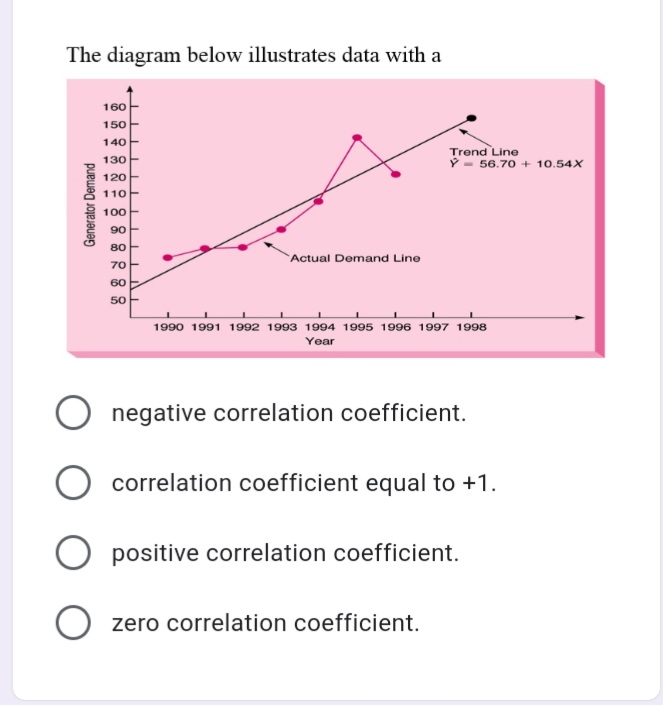
16.
Step by Step Solution
There are 3 Steps involved in it

Get step-by-step solutions from verified subject matter experts
 Study Help