



Question: 1loIJ swing a ball on the end ofa massless string. If you swing the ball faster so that i1: speed is decreased by a factor
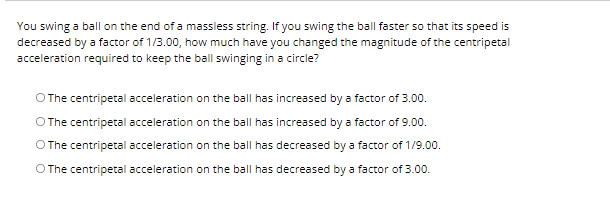
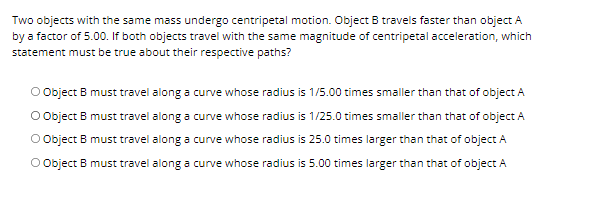
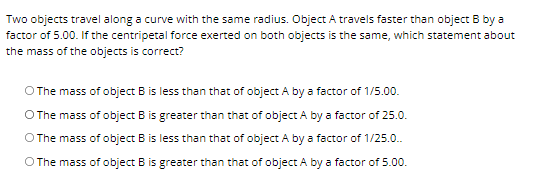
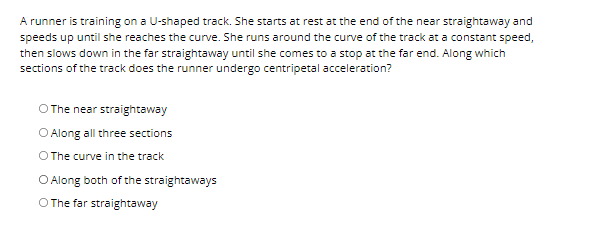
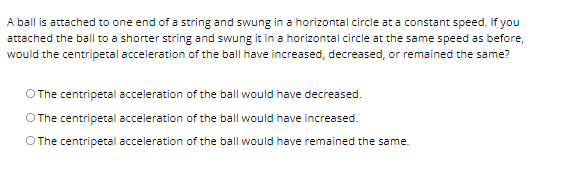
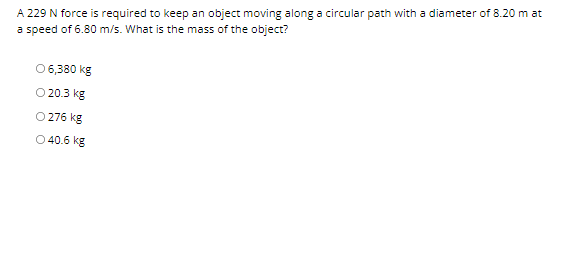
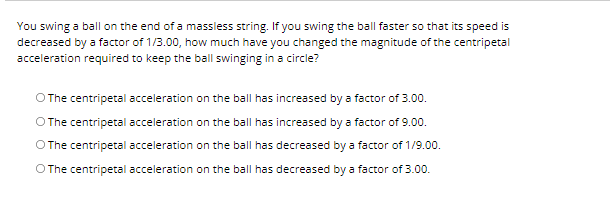
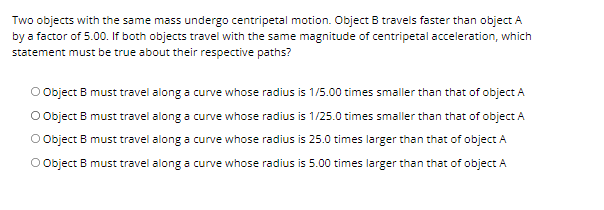
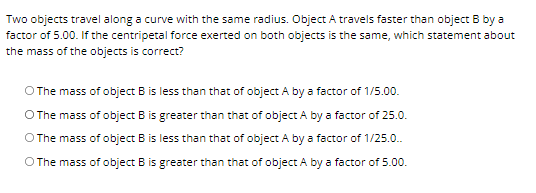
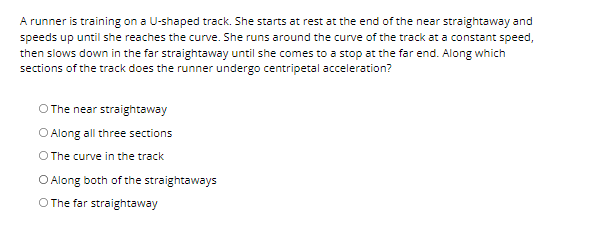
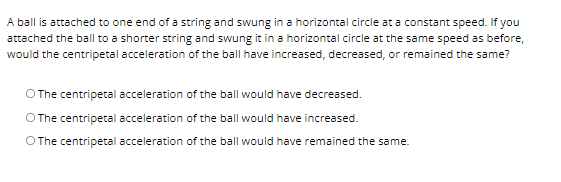
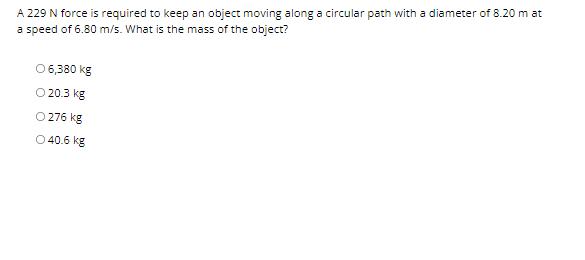
1l"oIJ swing a ball on the end ofa massless string. If you swing the ball faster so that i1: speed is decreased by a factor of 1 3-00, how much have you changed the magnitude of the centripetal acceleration required to keep the ball swinging in a circle? 0 The centripetal acceleration on the ball has increased by a factor of 3.00. D The centripetal acceleration on the ball has increased by a factor of 9.00. D The centripetal acceleration on the ball has decreased by a factor of 'I {9.130. D The centripetal acceleration on the ball has decreased by a factor of3.[|. Two objecls with the same mass undergo centripetal motion. Object B travels faster than object A by a factor of 5.01}. If both objects travel with the same magnitude of centripetal acceleration, which statement must be true about their respective paths? 0 Object 3 must travel along a curve whose radius is HSDIZI times smaller than that of object A D Object 3 must travel along a curve whose radius is WEE-J] times smaller than that of object A 0 Object B must travel along a curve whose radius is 25.0 times larger than that of object A 0 Object B must travel along a curve whose radius is 5.00 times larger than that of object A Two objects travel along a curve with the same radius. Object A travels faster than object B by a factor of 5.00. If the centripetal force exerted on both objects is the same, which statement about the mass of the objects is correct? The mass of object B is less than that of object A by a factor of 1/5.00. O The mass of object B is greater than that of object A by a factor of 25.0. O The mass of object B is less than that of object A by a factor of 1/25.0.. O The mass of object B is greater than that of object A by a factor of 5.00.\fA ball is attached to one end ofa string and swung in a horizontal circle at a constant speed. lfyou attached the hall to a shorter string and swung it in a horizontal circle at the same speed as before, would the centripetal acceleration of the hall have increased, decreased, or remain ed the same? 0 The centripetal acceleration of the hall would have decreased. 0 The centripetal acceleration of the hall would have increased. 0 The centripetal acceleration of the hall would have remained the same.
Step by Step Solution
There are 3 Steps involved in it

Get step-by-step solutions from verified subject matter experts