







Question: 1of 1 mpare Closed-Loop and Open-Loop Control Systems Objective In this activity, you will compare closed-loop and open-loop control systems. Background/Scenario An open-loop control system
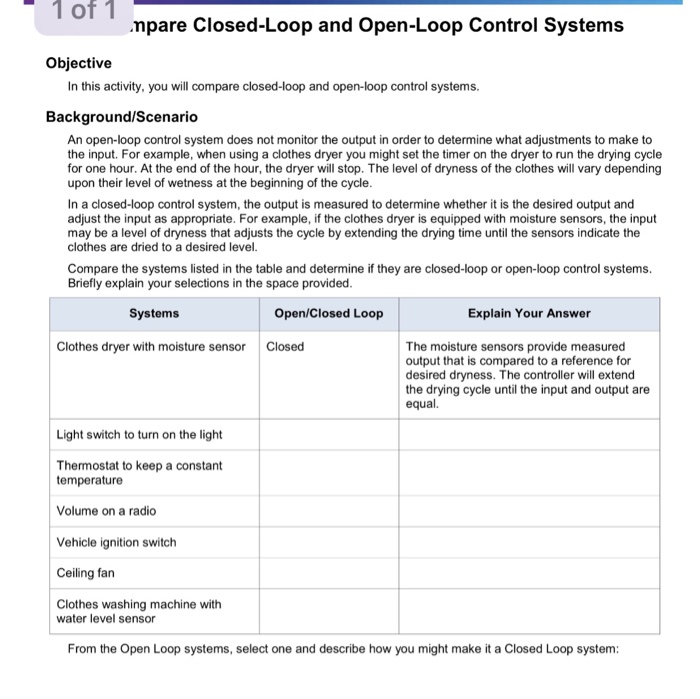
1of 1 mpare Closed-Loop and Open-Loop Control Systems Objective In this activity, you will compare closed-loop and open-loop control systems. Background/Scenario An open-loop control system does not monitor the output in order to determine what adjustments to make to the input. For example, when using a clothes dryer you might set the timer on the dryer to run the drying cycle for one hour. At the end of the hour, the dryer will stop. The level of dryness of the clothes will vary depending upon their level of wetness at the beginning of the cycle In a closed-loop control system, the output is measured to determine whether it is the desired output and adjust the input as appropriate. For example, if the clothes dryer is equipped with moisture sensors, the input may be a level of dryness that adjusts the cycle by extending the drying time until the sensors indicate the clothes are dried to a desired level Compare the systems listed in the table and determine if they are closed-loop or open-loop control systems. Briefly explain your selections in the space provided Systems Open/Closed Loop Explain Your Answer The moisture sensors provide measured output that is compared to a reference for desired dryness. The controller will extend the drying cycle until the input and output are equal. Clothes dryer with moisture sensor Closed Light switch to turn on the light Thermostat to keep a constant temperature Volume on a radio Vehicle ignition switch Ceiling fan Clothes washing machine witlh water level sensor From the Open Loop systems, select one and describe how you might make it a Closed Loop system
Step by Step Solution
There are 3 Steps involved in it

Get step-by-step solutions from verified subject matter experts
 Study Help