



Question: 1-Prove sum of deviations from the mean for any sample is equal to zero. (i.e. prove P(x/-x) = 0) 2- Prove two formulas for
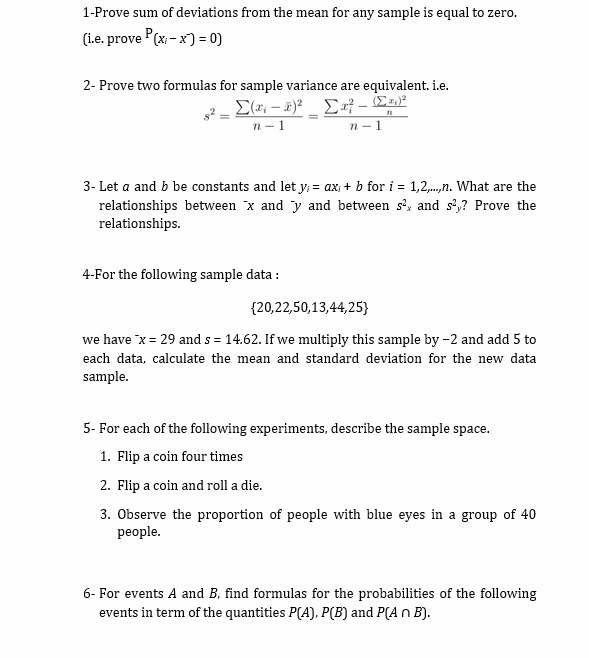
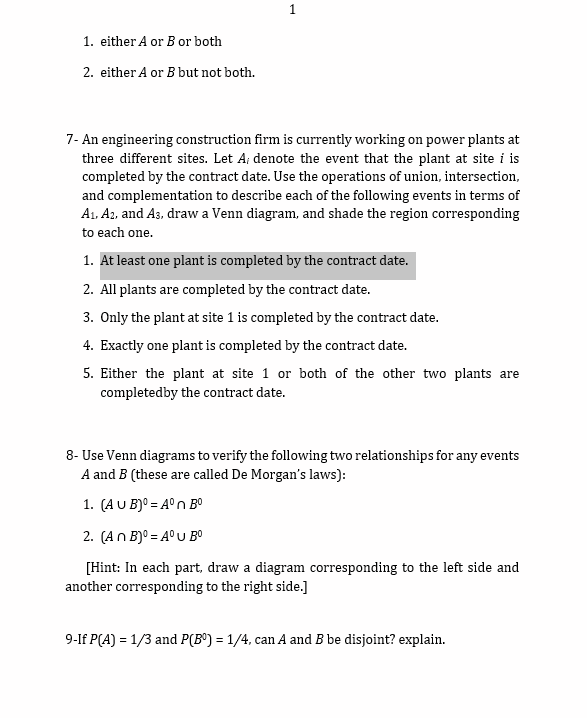
1-Prove sum of deviations from the mean for any sample is equal to zero. (i.e. prove P(x/-x) = 0) 2- Prove two formulas for sample variance are equivalent. i.e. $2 *, - 4) n-1 12 n-1 3- Let a and b be constants and let y = ax + b for i = 1,2,...,n. What are the relationships between x and y and between sx and s,? Prove the relationships. 4-For the following sample data: {20,22,50,13,44,25} we have x = 29 and s = 14.62. If we multiply this sample by -2 and add 5 to each data, calculate the mean and standard deviation for the new data sample. 5- For each of the following experiments, describe the sample space. 1. Flip a coin four times 2. Flip a coin and roll a die. 3. Observe the proportion of people with blue eyes in a group of 40 people. 6- For events A and B, find formulas for the probabilities of the following events in term of the quantities P(A), P(B) and P(A n B). 1. either A or B or both 2. either A or B but not both. 1 7- An engineering construction firm is currently working on power plants at three different sites. Let A, denote the event that the plant at site i is completed by the contract date. Use the operations of union, intersection, and complementation to describe each of the following events in terms of A1, A2, and A3, draw a Venn diagram, and shade the region corresponding to each one. 1. At least one plant is completed by the contract date. 2. All plants are completed by the contract date. 3. Only the plant at site 1 is completed by the contract date. 4. Exactly one plant is completed by the contract date. 5. Either the plant at site 1 or both of the other two plants are completed by the contract date. 8- Use Venn diagrams to verify the following two relationships for any events A and B (these are called De Morgan's laws): 1. (AUB) = An B 2. (ANB) = A U B [Hint: In each part, draw a diagram corresponding to the left side and another corresponding to the right side.] 9-If P(A) = 1/3 and P(B) = 1/4, can A and B be disjoint? explain.
Step by Step Solution
There are 3 Steps involved in it

Get step-by-step solutions from verified subject matter experts