







Question: 1Q2. Consider the linear, variable-coefficient ODE 22y 5zy' + 9y = 0. (1) (a) Show that y,(x) z is a solution of (1). (b) Look
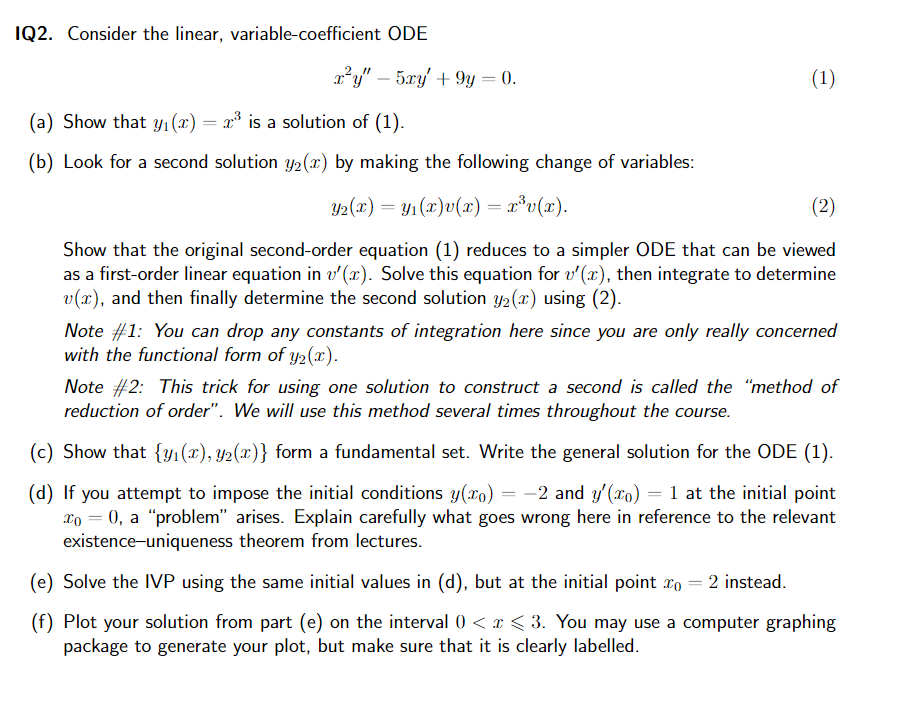
1Q2. Consider the linear, variable-coefficient ODE 22y 5zy' + 9y = 0. (1) (a) Show that y,(x) z" is a solution of (1). (b) Look for a second solution y>(x) by making the following change of variables: (c) (d) (e) () yo(z) = yi(x)o(z) = 2v(x). (2) Show that the original second-order equation (1) reduces to a simpler ODE that can be viewed as a first-order linear equation in v'(x). Solve this equation for v'(z), then integrate to determine v(x), and then finally determine the second solution () using (2). Note /#1: You can drop any constants of integration here since you are only really concerned with the functional form of (). Note #2: This trick for using one solution to construct a second is called the \"method of reduction of order\". We will use this method several times throughout the course. Show that {y,(x),y=(x)} form a fundamental set. Write the general solution for the ODE (1). If you attempt to impose the initial conditions y(xg) 2 and y'(x) 1 at the initial point g = 0, a \"problem\" arises. Explain carefully what goes wrong here in reference to the relevant existenceuniqueness theorem from lectures. Solve the IVP using the same initial values in (d), but at the initial point xy 2 instead. Plot your solution from part (e) on the interval 0
Step by Step Solution
There are 3 Steps involved in it

Get step-by-step solutions from verified subject matter experts
 Study Help