







Question: 1.Relative Risk (RR) and Attributable Risk (AR) A study was done regarding the association between family history and the risk of developing Alzheimer's disease (AD).
1.Relative Risk (RR) and Attributable Risk (AR)
A study was done regarding the association between family history and the risk of developing Alzheimer's disease (AD). The exposures were Family History of AD and No Family History of AD.The outcomes were either the development of AD and No development of AD.
Of the 3000 with No Family History, 25 developed AD, and 2,975 did not. Of the 2000 with Family History, 50 developed AD and 1950 did not.
Calculate the RR and AR. The contingency table is provided. What are the confidence intervals for the RR. Is the number "1" between the two boundaries of the confidence interval?
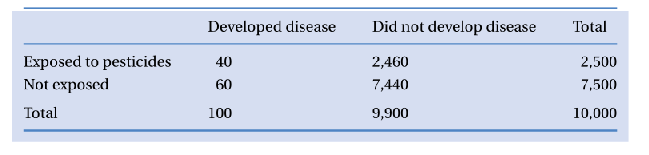
This table serves as an example to demonstrate how the RR is used beyond case exposure and not exposed and case and non-case.
| Alzheimer's Disease | No Alzheimer's Disease | Totals | Incidence of AD | |
| Family History | 50 | 1,950 | 2,000 | 25 per 1,000 |
| No Family History | 25 | 2,975 | 3,000 | 8.3 per 1,000 |
2.Odds Ratio and Relative Risk
A study was done of individuals with and without a high-risk genotype. For each group, the exposure was either low aspirin intake or high aspirin intake. The outcomes were development of polyps or no development of polyps. Group 1 is the individuals with the high-risk genotype. In Group 1, individuals with low aspirin intake, 75 developed polyps, and 25 did not. For individuals with high aspirin intake, 25 developed polyps and 75 did not.
For Group 2, for the 40 individuals who developed polys, 30 had low aspirin intake and 10 had high aspirin intake. For the 160 individuals with no polyps, 70 had low aspirin intake and 90 had high aspirin intake.
Calculate the odds ratio (OR)and relative risk (RR) for each group. Show the 2x2 contingency tables and your calculations. You should have one OR and one RR for each group.
What are the confidence boundaries for both the RR and OR?
3.
Step by Step Solution
There are 3 Steps involved in it

Get step-by-step solutions from verified subject matter experts
 Study Help