







Question: 1st missing data. (does not contain) 2nd (alternative or null) 3rd (sufficient or insufficient) 4th (support reject) 5th (insufficient or sufficient) 6th (support or reject)
1st missing data. (does not contain) 2nd (alternative or null) 3rd (sufficient or insufficient) 4th (support reject) 5th (insufficient or sufficient) 6th (support or reject)
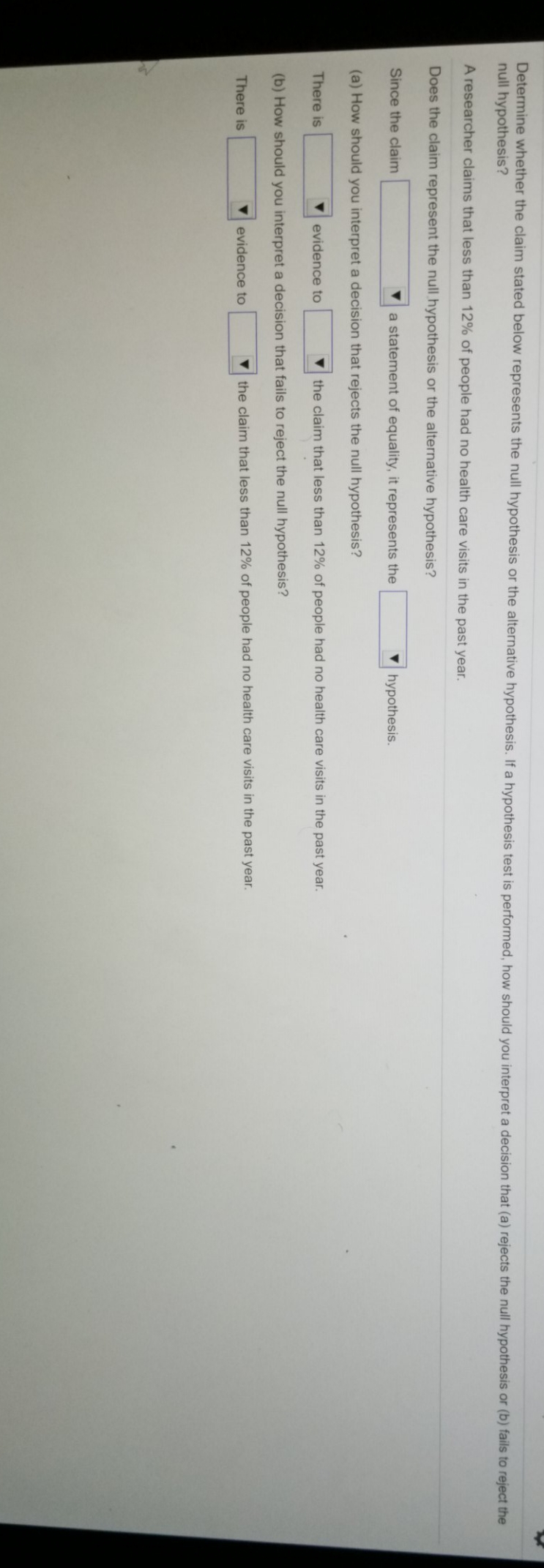
Determine whether the claim stated below represents the null hypothesis or the alternative hypothesis. If a hypothesis test is performed, how should you interpret a decision that (a) rejects the null hypothesis or (b) fails to reject the null hypothesis? A researcher claims that less than 12% of people had no health care visits in the past year. Does the claim represent the null hypothesis or the alternative hypothesis? Since the claim a statement of equality, it represents the hypothesis . (a) How should you interpret a decision that rejects the null hypothesis? There is evidence to the claim that less than 12% of people had no health care visits in the past year. (b) How should you interpret a decision that fails to reject the null hypothesis? There is evidence to the claim that less than 12% of people had no health care visits in the past year
Step by Step Solution
There are 3 Steps involved in it

Get step-by-step solutions from verified subject matter experts
 Study Help