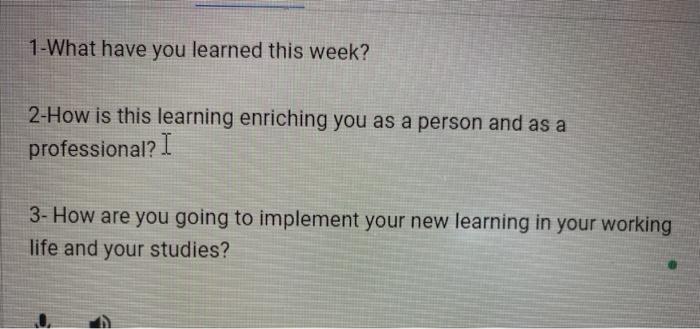
Question: 1-What have you learned this week? 2-How is this learning enriching you as a person and as a professional? I 3- How are you going
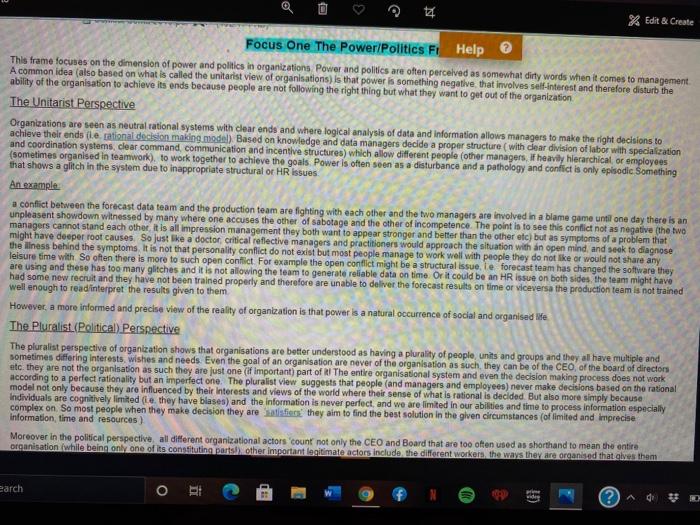
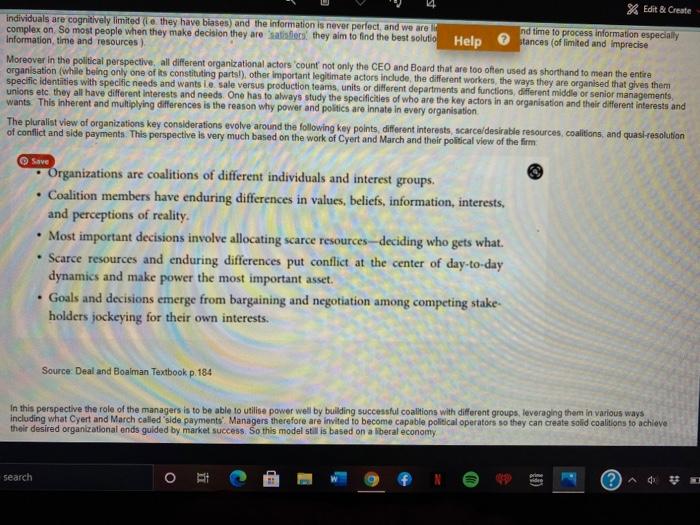
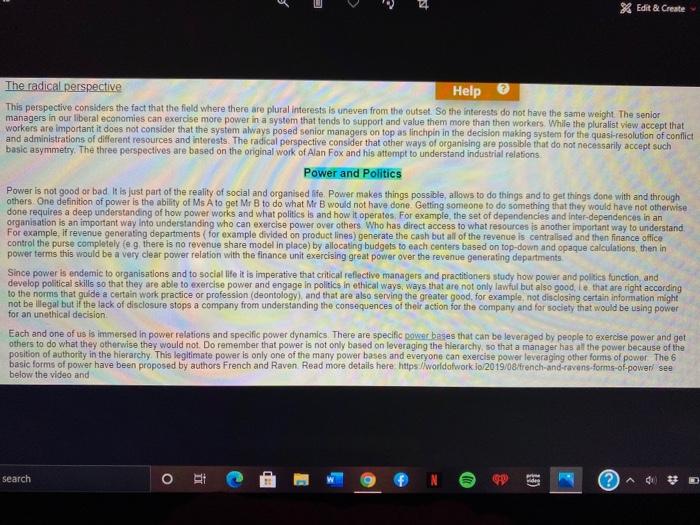
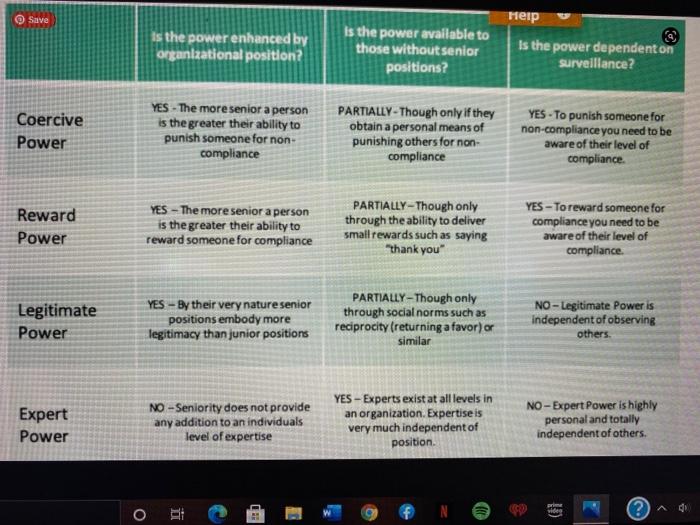
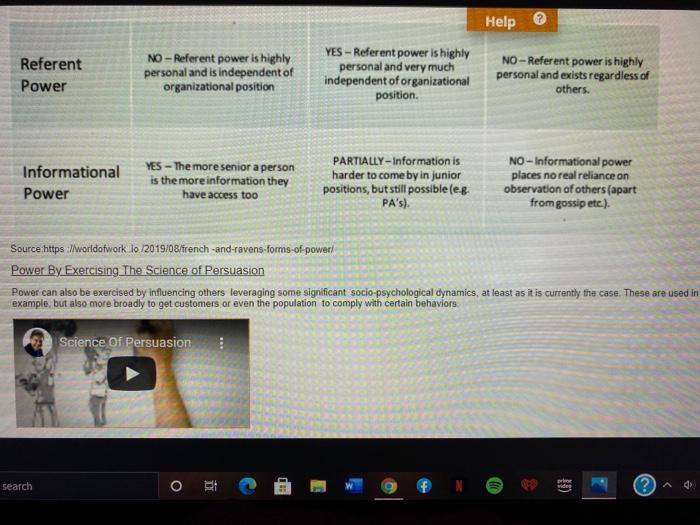
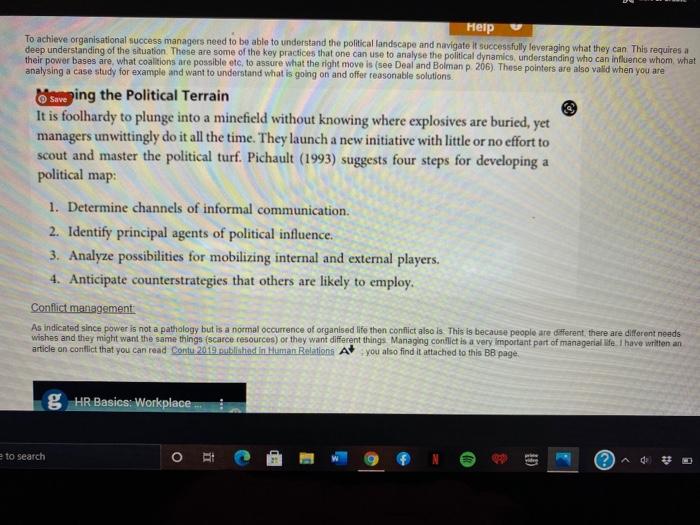
1-What have you learned this week? 2-How is this learning enriching you as a person and as a professional? I 3- How are you going to implement your new learning in your working life and your studies? 4 % Edit & Create Focus One The Power Politics Ft Help This frame focuses on the dimension of power and politics in organizations, Power and politics are often perceived as somewhat dirty words when it comes to management A common idea (also based on what is called the unitarist view of organisations) is that power is something negative that involves self-interest and therefore disturb the ability of the organisation to achieve its ends because people are not following the right thing but what they want to get out of the organization The Unitarist Perspective Organizations are seen as neutral rational systems with clear ends and where logical analysis of data and information allows managers to make the right decisions to achieve their ends (le rational decision making model) Based on knowledge and data managers decide a proper structure (with dear division of labor with specialization and coordination systems, clear command, communication and incentive structures) which allow different people (other managers, if heavily hierarchical or employees (sometimes organised in teamwork), to work together to achieve the goals Power is often seen as a disturbance and a pathology and conflict is only episodic Something that shows a glitch in the system due to inappropriate structural or HR issues. An example a conflict between the forecast data team and the production team are fighting with each other and the two managers are involved in a blame game until one day there is an unpleasent showdown witnessed by many where one accuses the other of sabotage and the other of incompetence. The point in to see this conflict not as negative (the two managers cannot stand each other it is all impression management they both want to appear stronger and better than the other etc) but as symptoms of a problem that might have deeper root causes. So just like a doctor critical reflective managers and practitioners would approach the situation with an open mind, and seek to diagnose the liness behind the symptoms. It is not that personality conflict do not exist but most people manage to work well with people they do not like or would not share any leisure time with So often there is more to such open conflict For example the open conflict might be a structural issue. le forecast team has changed the software they are using and these has too many glitches and it is not allowing the team to generate reliable data on time. Or it could be an HR issue on both sides the team might have had some new recruit and they have not been trained properly and therefore are unable to deliver the forecast results on time or viceversa the production team is not trained well enough to read interpret the results given to them However, a more informed and precise view of the reality of organization is that power is a natural occurrence of social and organised life The Pluralist.(Political) Perspective The pluralist perspective of organization shows that organisations are better understood as having a plurality of people units and groups and they all have multiple and sometimes differing interests wishes and needs. Even the goal of an organisation are never of the organisation as such, they can be of the CEO of the board of directors etc. they are not the organisation as such they are just one (if important part of the entire organisational system and even the decision making process does not work according to a perfect rationality but an imperfect one. The pluralist View suggests that people (and managers and employees) never make decisions based on the rational model not only because they are influenced by their interests and views of the world where their sense of what is rational is decided But also more simply because Individuals are cognitively limited (ie they have blases) and the information is never perfect, and we are limited in our abilities and time to process information especially complex on. So most people when they make decision they are satisfies they aim to find the best solution in the given circumstances (of limited and imprecise Information time and resources) Moreover in the political perspective, all different organizational actors 'count not only the CEO and Board that are too often used as shorthand to mean the entire organisation while being only one of its constitutina portal other important legitimate actors include the different workers the ways they are organised that alves them earch wide ? % Edit & Create individuals are cognitively limited (le they have biases and the information is never perfect, and we are in nd time to process information especially complex on So most people when they make decision they are satisfies they aim to find the best solutio Help stances (of limited and imprecise Information time and resources) Moreover in the political perspective, all different organizational actors count not only the CEO and Board that are too often used as shorthand to mean the entire organisation (While being only one of its constituting parts!), other important legitimate actors include the different workers, the ways they are organised that gives them specific identities with specific needs and wants le sale versus production teams, units or different departments and functions, different middle or senior managements unions etc they all have different interests and needs. One has to always study the specificities of who are the key actors in an organisation and their different interests and wants This inherent and multiplying differences is the reason why power and politics are innate in every organisation The pluralist view of organizations key considerations evolve around the following key points, different interests, scarce/desirable resources, coalitions, and quasi-resolution of conflict and side payments. This perspective is very much based on the work of Cyert and March and their political view of the firm Save Organizations are coalitions of different individuals and interest groups. Coalition members have enduring differences in values, beliefs, information, interests, and perceptions of reality. . Most important decisions involve allocating scarce resources-deciding who gets what. . Scarce resources and enduring differences put conflict at the center of day-to-day dynamics and make power the most important asset. . Goals and decisions emerge from bargaining and negotiation among competing stake- holders jockeying for their own interests. Source: Deal and Boalman Textbook p.184 In this perspective the role of the managers is to be able to utilise power well by building successful coalitions with different groups, leveraging them in various ways including what Cyert and March called 'side payments Managers therefore are invited to become capable political operators so they can create solid coalitions to achieve their desired organizational ends guided by market success. So this model still is based on a liberal economy search 11) ? % Edit & Create The radical perspective Help This perspective considers the fact that the field where there are plural interests is uneven from the outset. So the interests do not have the same weight. The senior managers in our liberal economies can exercise more power in a system that tends to support and value them more than then workers. While the pluralist view accept that workers are important it does not consider that the system always posed senior managers on top as linchpin in the decision making system for the quasi-resolution of conflict and administrations of different resources and interests. The radical perspective consider that other ways of organising are possible that do not necessarily accept such basic asymmetry. The three perspectives are based on the original work of Alan Fox and his attempt to understand industrial relations Power and Politics Power is not good or bad. It is just part of the reality of social and organised fife. Power makes things possible, allows to do things and to get things done with and through others. One definition of power is the ability of Ms A to get Mr B to do what Mr B would not have done. Getting someone to do something that they would have not otherwise done requires a deep understanding of how power works and what politics is and how it operatos. For example, the set of dependencies and inter-dependences in an organisation is an important way into understanding who can exercise power over others who has direct access to what resources is another important way to understand For example, if revenue generating departments (for example divided on product lines) generate the cash but all of the revenue is centralised and then finance office control the purse completely (eg there is no revenue share model in place) by allocating budgets to each centers based on top-down and opaque calculations, then in power terms this would be a very clear power relation with the finance unit exercising great power over the revenue generating departments Since power is endemic to organisations and to social life it is imperative that critical reflective managers and practitioners study how power and politics function and develop political skills so that they are able to exercise power and engage in politics in thical ways, ways that are not only lawful but also good, le that are right according to the norms that guide a certain work practice or profession (deontology) and that are also serving the greater good, for example, not disclosing certain information might not be illegal but if the lack of disclosure stops a company from understanding the consequences of their action for the company and for society that would be using power for an unethical decision Each and one of us is immersed in power relations and specific power dynamics. There are specific power bases that can be leveraged by people to exercise power and get others to do what they otherwise they would not. Do remember that power is not only based on leveraging the hierarchy, so that a manager has all the power because of the position of authority in the hierarchy This legitimate power is only one of the many power bases and everyone can exercise power leveraging other forms of power. The 6 basic forms of power have been proposed by authors French and Raven Read more details here: https://worldofworklo 2019/08/french-and-ravens-forms-of-power see below the video and search 0 CE 2 wide 90 o save Save is the power enhanced by organizational position? is the power available to those without senior positions? Is the power dependent on surveillance? Coercive Power YES - The more senior a person is the greater their ability to punish someone for non- compliance PARTIALLY-Though only if they obtain a personal means of punishing others for non- compliance YES - To punish someone for non-compliance you need to be aware of their level of compliance. Reward Power YES - The more senior a person is the greater their ability to reward someone for compliance PARTIALLY Though only through the ability to deliver small rewards such as saying "thank you YES - Toreward someone for compliance you need to be aware of their level of compliance Legitimate Power YES - By their very nature senior positions embody more legitimacy than junior positions PARTIALLY-Though only through social norms such as reciprocity (returning a favor) or similar NO - Legitimate Power is independent of observing others Expert Power NO - Seniority does not provide any addition to an individuals level of expertise YES - Experts exist at all levels in an organization. Expertise is very much independent of position. NO - Expert Power is highly personal and totally independent of others. video - Help Referent Power NO - Referent power is highly personal and is independent of organizational position YES - Referent power is highly personal and very much independent of organizational position NO - Referent power is highly personal and exists regardless of others. Informational Power YES - The more senior a person is the more information they have access too PARTIALLY-Information is harder to come by in junior positions, but still possible (eg. PA's) NO - Informational power places no real reliance on observation of others (apart from gossip etc.) Source httpsworldofwork lo /2015/08/french-and-ravens-forms-of-power Power By Exercising The Science of Persuasion Power can also be exercised by influencing others leveraging some significant socio-psychological dynamics, at least as it is currently the case. These are used in example, but also more broadly to get customers or even the population to comply with certain behaviors Science of Persuasion search OHH wider ? Help To achieve organisational success managers need to be able to understand the political landscape and navigate it successfully leveraging what they can This requires a deep understanding of the situation. These are some of the key practices that one can use to analyse the political dynamics, understanding who can influence whom what their power bases are, what coalitions are possible etc. to assure what the right moveis (see Deal and Bolman p206). These pointers are also valid when you are analysing a case study for example and want to understand what is going on and offer reasonable solutions savoping the Political Terrain It is foolhardy to plunge into a minefield without knowing where explosives are buried, yet managers unwittingly do it all the time. They launch a new initiative with little or no effort to scout and master the political turf. Pichault (1993) suggests four steps for developing a political map: 1. Determine channels of informal communication. 2. Identify principal agents of political influence. 3. Analyze possibilities for mobilizing internal and external players. 4. Anticipate counterstrategies that others are likely to employ. Conflict management: As indicated since power is not a pathology but is a normal occurrence of organised life then conflict also is This is because people are different, there are different needs wishes and they might want the same things (scarce resources) or they want different things Managing conflict is a very important part of managerial life. I have written an article on conflict that you can read Contu 2019 published in Human Relations at you also find it attached to this BB page. g HR Basics: Workplace to search O ? # 1-What have you learned this week? 2-How is this learning enriching you as a person and as a professional? I 3- How are you going to implement your new learning in your working life and your studies? 4 % Edit & Create Focus One The Power Politics Ft Help This frame focuses on the dimension of power and politics in organizations, Power and politics are often perceived as somewhat dirty words when it comes to management A common idea (also based on what is called the unitarist view of organisations) is that power is something negative that involves self-interest and therefore disturb the ability of the organisation to achieve its ends because people are not following the right thing but what they want to get out of the organization The Unitarist Perspective Organizations are seen as neutral rational systems with clear ends and where logical analysis of data and information allows managers to make the right decisions to achieve their ends (le rational decision making model) Based on knowledge and data managers decide a proper structure (with dear division of labor with specialization and coordination systems, clear command, communication and incentive structures) which allow different people (other managers, if heavily hierarchical or employees (sometimes organised in teamwork), to work together to achieve the goals Power is often seen as a disturbance and a pathology and conflict is only episodic Something that shows a glitch in the system due to inappropriate structural or HR issues. An example a conflict between the forecast data team and the production team are fighting with each other and the two managers are involved in a blame game until one day there is an unpleasent showdown witnessed by many where one accuses the other of sabotage and the other of incompetence. The point in to see this conflict not as negative (the two managers cannot stand each other it is all impression management they both want to appear stronger and better than the other etc) but as symptoms of a problem that might have deeper root causes. So just like a doctor critical reflective managers and practitioners would approach the situation with an open mind, and seek to diagnose the liness behind the symptoms. It is not that personality conflict do not exist but most people manage to work well with people they do not like or would not share any leisure time with So often there is more to such open conflict For example the open conflict might be a structural issue. le forecast team has changed the software they are using and these has too many glitches and it is not allowing the team to generate reliable data on time. Or it could be an HR issue on both sides the team might have had some new recruit and they have not been trained properly and therefore are unable to deliver the forecast results on time or viceversa the production team is not trained well enough to read interpret the results given to them However, a more informed and precise view of the reality of organization is that power is a natural occurrence of social and organised life The Pluralist.(Political) Perspective The pluralist perspective of organization shows that organisations are better understood as having a plurality of people units and groups and they all have multiple and sometimes differing interests wishes and needs. Even the goal of an organisation are never of the organisation as such, they can be of the CEO of the board of directors etc. they are not the organisation as such they are just one (if important part of the entire organisational system and even the decision making process does not work according to a perfect rationality but an imperfect one. The pluralist View suggests that people (and managers and employees) never make decisions based on the rational model not only because they are influenced by their interests and views of the world where their sense of what is rational is decided But also more simply because Individuals are cognitively limited (ie they have blases) and the information is never perfect, and we are limited in our abilities and time to process information especially complex on. So most people when they make decision they are satisfies they aim to find the best solution in the given circumstances (of limited and imprecise Information time and resources) Moreover in the political perspective, all different organizational actors 'count not only the CEO and Board that are too often used as shorthand to mean the entire organisation while being only one of its constitutina portal other important legitimate actors include the different workers the ways they are organised that alves them earch wide ? % Edit & Create individuals are cognitively limited (le they have biases and the information is never perfect, and we are in nd time to process information especially complex on So most people when they make decision they are satisfies they aim to find the best solutio Help stances (of limited and imprecise Information time and resources) Moreover in the political perspective, all different organizational actors count not only the CEO and Board that are too often used as shorthand to mean the entire organisation (While being only one of its constituting parts!), other important legitimate actors include the different workers, the ways they are organised that gives them specific identities with specific needs and wants le sale versus production teams, units or different departments and functions, different middle or senior managements unions etc they all have different interests and needs. One has to always study the specificities of who are the key actors in an organisation and their different interests and wants This inherent and multiplying differences is the reason why power and politics are innate in every organisation The pluralist view of organizations key considerations evolve around the following key points, different interests, scarce/desirable resources, coalitions, and quasi-resolution of conflict and side payments. This perspective is very much based on the work of Cyert and March and their political view of the firm Save Organizations are coalitions of different individuals and interest groups. Coalition members have enduring differences in values, beliefs, information, interests, and perceptions of reality. . Most important decisions involve allocating scarce resources-deciding who gets what. . Scarce resources and enduring differences put conflict at the center of day-to-day dynamics and make power the most important asset. . Goals and decisions emerge from bargaining and negotiation among competing stake- holders jockeying for their own interests. Source: Deal and Boalman Textbook p.184 In this perspective the role of the managers is to be able to utilise power well by building successful coalitions with different groups, leveraging them in various ways including what Cyert and March called 'side payments Managers therefore are invited to become capable political operators so they can create solid coalitions to achieve their desired organizational ends guided by market success. So this model still is based on a liberal economy search 11) ? % Edit & Create The radical perspective Help This perspective considers the fact that the field where there are plural interests is uneven from the outset. So the interests do not have the same weight. The senior managers in our liberal economies can exercise more power in a system that tends to support and value them more than then workers. While the pluralist view accept that workers are important it does not consider that the system always posed senior managers on top as linchpin in the decision making system for the quasi-resolution of conflict and administrations of different resources and interests. The radical perspective consider that other ways of organising are possible that do not necessarily accept such basic asymmetry. The three perspectives are based on the original work of Alan Fox and his attempt to understand industrial relations Power and Politics Power is not good or bad. It is just part of the reality of social and organised fife. Power makes things possible, allows to do things and to get things done with and through others. One definition of power is the ability of Ms A to get Mr B to do what Mr B would not have done. Getting someone to do something that they would have not otherwise done requires a deep understanding of how power works and what politics is and how it operatos. For example, the set of dependencies and inter-dependences in an organisation is an important way into understanding who can exercise power over others who has direct access to what resources is another important way to understand For example, if revenue generating departments (for example divided on product lines) generate the cash but all of the revenue is centralised and then finance office control the purse completely (eg there is no revenue share model in place) by allocating budgets to each centers based on top-down and opaque calculations, then in power terms this would be a very clear power relation with the finance unit exercising great power over the revenue generating departments Since power is endemic to organisations and to social life it is imperative that critical reflective managers and practitioners study how power and politics function and develop political skills so that they are able to exercise power and engage in politics in thical ways, ways that are not only lawful but also good, le that are right according to the norms that guide a certain work practice or profession (deontology) and that are also serving the greater good, for example, not disclosing certain information might not be illegal but if the lack of disclosure stops a company from understanding the consequences of their action for the company and for society that would be using power for an unethical decision Each and one of us is immersed in power relations and specific power dynamics. There are specific power bases that can be leveraged by people to exercise power and get others to do what they otherwise they would not. Do remember that power is not only based on leveraging the hierarchy, so that a manager has all the power because of the position of authority in the hierarchy This legitimate power is only one of the many power bases and everyone can exercise power leveraging other forms of power. The 6 basic forms of power have been proposed by authors French and Raven Read more details here: https://worldofworklo 2019/08/french-and-ravens-forms-of-power see below the video and search 0 CE 2 wide 90 o save Save is the power enhanced by organizational position? is the power available to those without senior positions? Is the power dependent on surveillance? Coercive Power YES - The more senior a person is the greater their ability to punish someone for non- compliance PARTIALLY-Though only if they obtain a personal means of punishing others for non- compliance YES - To punish someone for non-compliance you need to be aware of their level of compliance. Reward Power YES - The more senior a person is the greater their ability to reward someone for compliance PARTIALLY Though only through the ability to deliver small rewards such as saying "thank you YES - Toreward someone for compliance you need to be aware of their level of compliance Legitimate Power YES - By their very nature senior positions embody more legitimacy than junior positions PARTIALLY-Though only through social norms such as reciprocity (returning a favor) or similar NO - Legitimate Power is independent of observing others Expert Power NO - Seniority does not provide any addition to an individuals level of expertise YES - Experts exist at all levels in an organization. Expertise is very much independent of position. NO - Expert Power is highly personal and totally independent of others. video - Help Referent Power NO - Referent power is highly personal and is independent of organizational position YES - Referent power is highly personal and very much independent of organizational position NO - Referent power is highly personal and exists regardless of others. Informational Power YES - The more senior a person is the more information they have access too PARTIALLY-Information is harder to come by in junior positions, but still possible (eg. PA's) NO - Informational power places no real reliance on observation of others (apart from gossip etc.) Source httpsworldofwork lo /2015/08/french-and-ravens-forms-of-power Power By Exercising The Science of Persuasion Power can also be exercised by influencing others leveraging some significant socio-psychological dynamics, at least as it is currently the case. These are used in example, but also more broadly to get customers or even the population to comply with certain behaviors Science of Persuasion search OHH wider ? Help To achieve organisational success managers need to be able to understand the political landscape and navigate it successfully leveraging what they can This requires a deep understanding of the situation. These are some of the key practices that one can use to analyse the political dynamics, understanding who can influence whom what their power bases are, what coalitions are possible etc. to assure what the right moveis (see Deal and Bolman p206). These pointers are also valid when you are analysing a case study for example and want to understand what is going on and offer reasonable solutions savoping the Political Terrain It is foolhardy to plunge into a minefield without knowing where explosives are buried, yet managers unwittingly do it all the time. They launch a new initiative with little or no effort to scout and master the political turf. Pichault (1993) suggests four steps for developing a political map: 1. Determine channels of informal communication. 2. Identify principal agents of political influence. 3. Analyze possibilities for mobilizing internal and external players. 4. Anticipate counterstrategies that others are likely to employ. Conflict management: As indicated since power is not a pathology but is a normal occurrence of organised life then conflict also is This is because people are different, there are different needs wishes and they might want the same things (scarce resources) or they want different things Managing conflict is a very important part of managerial life. I have written an article on conflict that you can read Contu 2019 published in Human Relations at you also find it attached to this BB page. g HR Basics: Workplace to search O ? #









 Study Help