





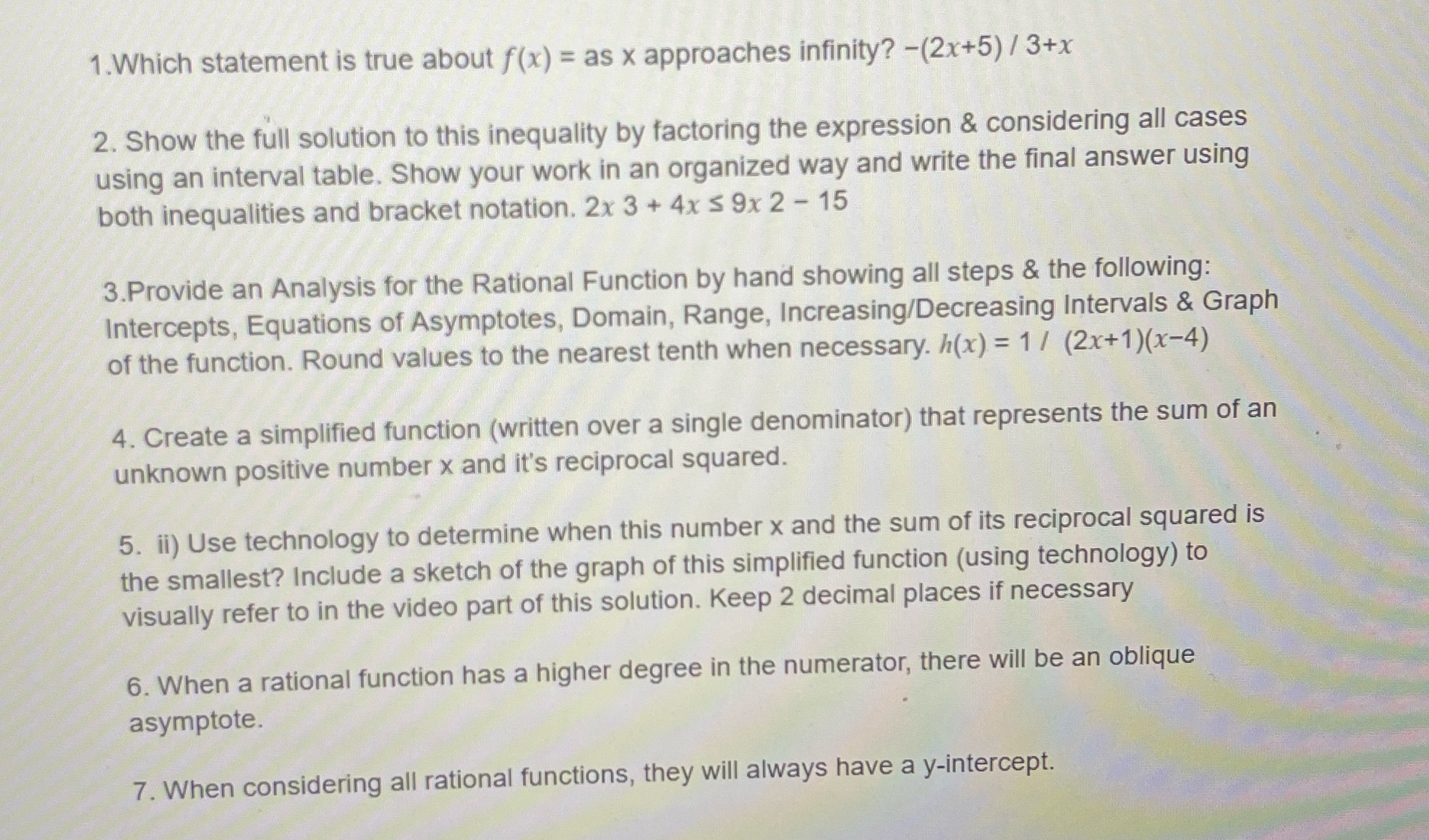
Question: 1.Which statement is true about f(x) = as x approaches infinity? -(2x+5) / 3+x 2. Show the full solution to this inequality by factoring the
1.Which statement is true about f(x) = as x
1.Which statement is true about f(x) = as x approaches infinity? -(2x+5) / 3+x 2. Show the full solution to this inequality by factoring the expression & considering all cases using an interval table. Show your work in an organized way and write the final answer using both inequalities and bracket notation. 2x 3 + 4x $ 9x 2 - 15 3.Provide an Analysis for the Rational Function by hand showing all steps & the following: Intercepts, Equations of Asymptotes, Domain, Range, Increasing/Decreasing Intervals & Graph of the function. Round values to the nearest tenth when necessary. h(x) = 1/ (2x+1)(x-4) 4. Create a simplified function (written over a single denominator) that represents the sum of an unknown positive number x and it's reciprocal squared. 5. ii) Use technology to determine when this number x and the sum of its reciprocal squared is the smallest? Include a sketch of the graph of this simplified function (using technology) to visually refer to in the video part of this solution. Keep 2 decimal places if necessary 6. When a rational function has a higher degree in the numerator, there will be an oblique asymptote. 7. When considering all rational functions, they will always have a y-intercept

Step by Step Solution

There are 3 Steps involved in it

1 Expert Approved Answer
Step: 1 Unlock blur-text-image

Question Has Been Solved by an Expert!

Get step-by-step solutions from verified subject matter experts

Step: 2 Unlock
Step: 3 Unlock

Students Have Also Explored These Related Mathematics Questions!