







Question: 1.write a brief 1 paragraph summary ot the case 2. in what ways does Trend pie represent a typical entreprenuerial venture? 3. what were the
1.write a brief 1 paragraph summary ot the case 2. in what ways does Trend pie represent a typical entreprenuerial venture? 3. what were the actions Victor had taken to protect his business idea and ensure the continued growth of his business? What do you think of them? did he fail to take an needed actions
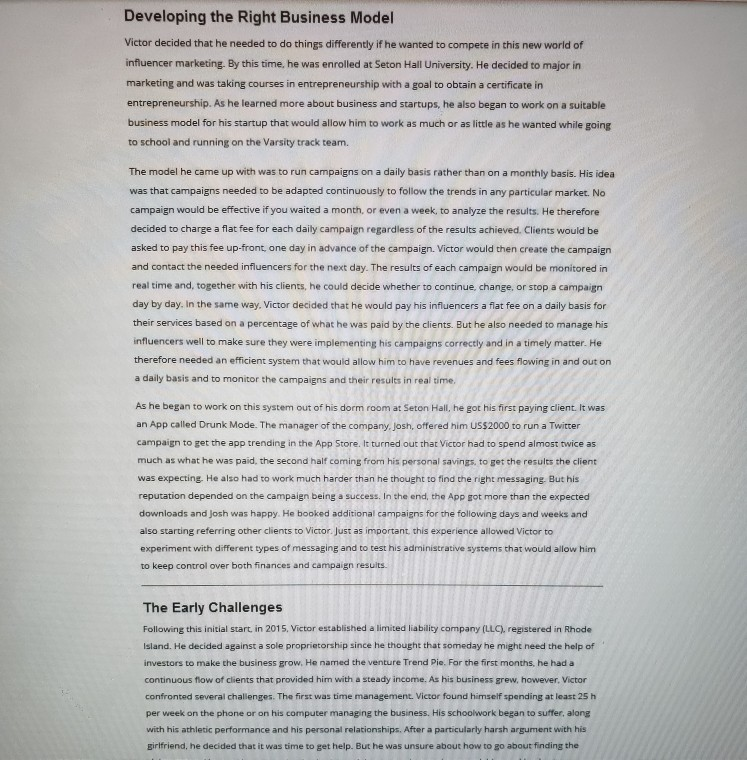
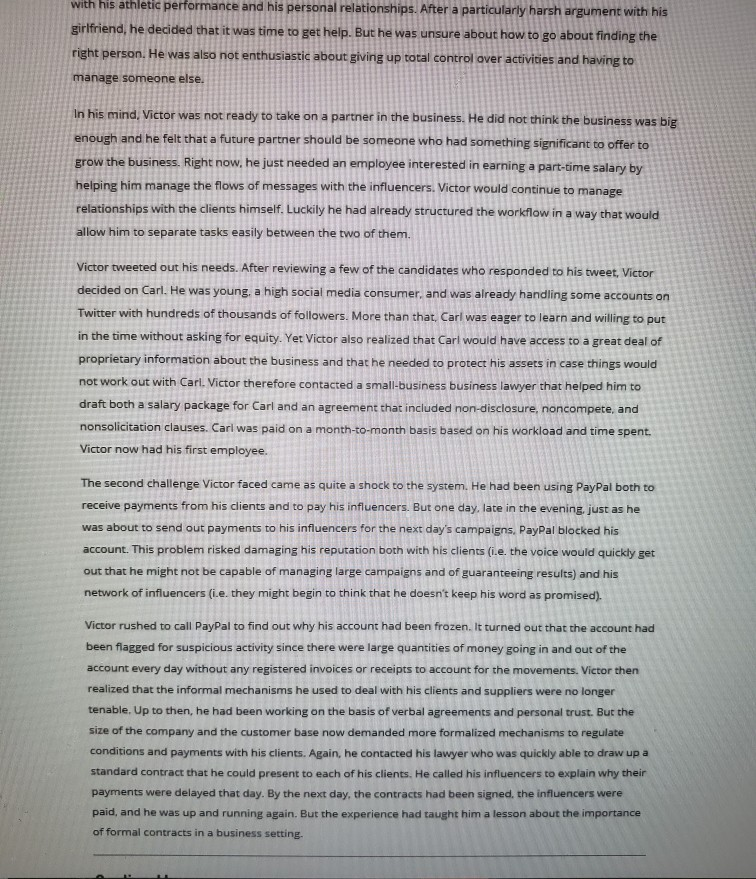
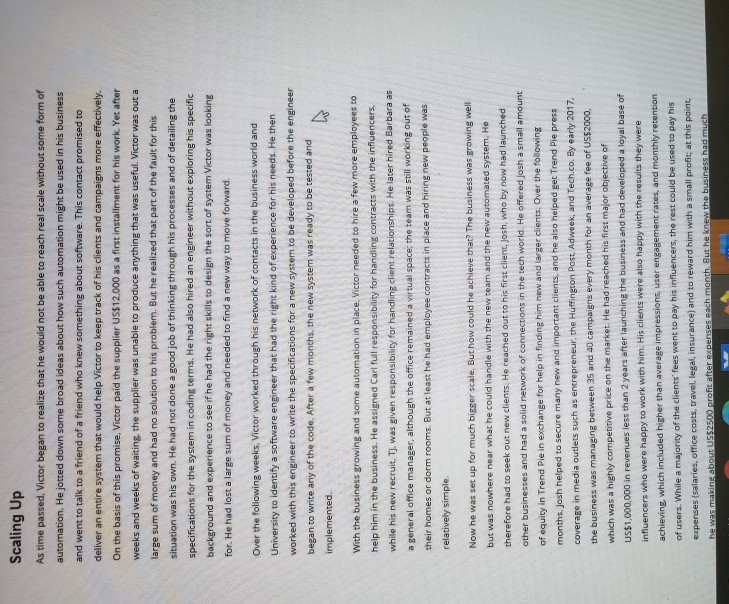
Developing the Right Business Model Victor decided that he needed to do things differently if he wanted to compete in this new world of influencer marketing. By this time, he was enrolled at Seton Hall University. He decided to major in marketing and was taking courses in entrepreneurship with a goal to obtain a certificate in entrepreneurship. As he learned more about business and startups, he also began to work on a suitable business model for his startup that would allow him to work as much or as little as he wanted while going to school and running on the Varsity track team. The model he came up with was to run campaigns on a daily basis rather than on a monthly basis. His idea was that campaigns needed to be adapted continuously to follow the trends in any particular market. No campaign would be effective if you waited a month, or even a week, to analyze the results. He therefore decided to charge a flat fee for each daily campaign regardless of the results achieved. Clients would be asked to pay this fee up-front, one day in advance of the campaign. Victor would then create the campaign and contact the needed influencers for the next day. The results of each campaign would be monitored in real time and, together with his clients, he could decide whether to continue, change or stop a campaign day by day. In the same way. Victor decided that he would pay his influencers a flat fee on a daily basis for their services based on a percentage of what he was paid by the clients. But he also needed to manage his influencers well to make sure they were implementing his campaigns correctly and in a timely matter. He therefore needed an efficient system that would allow him to have revenues and fees flowing in and out on a daily basis and to monitor the campaigns and their results in real time. As he began to work on this system out of his dorm room at Seton Hall, he got his first paying client. It was an App called Drunk Mode. The manager of the company. josh, offered him US$2000 to run a Twitter campaign to get the app trending in the App Store. It turned out that Victor had to spend almost twice as much as what he was paid, the second half coming from his personal savings, to get the results the client was expecting. He also had to work much harder than he thought to find the right messaging. But his reputation depended on the campaign being a success. In the end, the App got more than the expected downloads and Josh was happy. He booked additional campaigns for the following days and weeks and also starting referring other clients to Victor. Just as important this experience allowed Victor to experiment with different types of messaging and to test his administrative systems that would allow him to keep control over both finances and campaign resuits. The Early Challenges Following this initial start, in 2015, Victor established a limited liability company (LLC), registered in Rhode Island. He decided against a sole proprietorship since he thought that someday he might need the help of investors to make the business grow. He named the venture Trend Pie. For the first months, he had a continuous flow of clients that provided him with a steady income. As his business grew, however, Victor confronted several challenges. The first was time management. Victor found himself spending at least 25 h per week on the phone or on his computer managing the business. His schoolwork began to suffer, along with his athletic performance and his personal relationships. After a particularly harsh argument with his girlfriend, he decided that it was time to get help. But he was unsure about how to go about finding the with his athletic performance and his personal relationships. After a particularly harsh argument with his girlfriend, he decided that it was time to get help. But he was unsure about how to go about finding the right person. He was also not enthusiastic about giving up total control over activities and having to manage someone else. In his mind, Victor was not ready to take on a partner in the business. He did not think the business was big enough and he felt that a future partner should be someone who had something significant to offer to grow the business. Right now, he just needed an employee interested in earning a part-time salary by helping him manage the flows of messages with the influencers. Victor would continue to manage relationships with the clients himself. Luckily he had already structured the workflow in a way that would allow him to separate tasks easily between the two of them. Victor tweeted out his needs. After reviewing a few of the candidates who responded to his tweet, Victor decided on Carl. He was young, a high social media consumer, and was already handling some accounts on Twitter with hundreds of thousands of followers. More than that, Carl was eager to learn and willing to put in the time without asking for equity. Yet Victor also realized that Carl would have access to a great deal of proprietary information about the business and that he needed to protect his assets in case things would not work out with Carl. Victor therefore contacted a small-business business lawyer that helped him to draft both a salary package for Carl and an agreement that included non-disclosure, noncompete, and nonsolicitation clauses. Carl was paid on a month-to-month basis based on his workload and time spent Victor now had his first employee. The second challenge Victor faced came as quite a shock to the system. He had been using PayPal both to receive payments from his clients and to pay his influencers. But one day, late in the evening, just as he was about to send out payments to his influencers for the next day's campaigns, PayPal blocked his account. This problem risked damaging his reputation both with his clients (i.e. the voice would quickly get out that he might not be capable of managing large campaigns and of guaranteeing results) and his network of influencers (ie they might begin to think that he doesn't keep his word as promised). Victor rushed to call PayPal to find out why his account had been frozen. It turned out that the account had been flagged for suspicious activity since there were large quantities of money going in and out of the account every day without any registered invoices or receipts to account for the movements. Victor then realized that the informal mechanisms he used to deal with his clients and suppliers were no longer tenable. Up to then, he had been working on the basis of verbal agreements and personal trust. But the size of the company and the customer base now demanded more formalized mechanisms to regulate conditions and payments with his clients. Again, he contacted his lawyer who was quickly able to draw up a standard contract that he could present to each of his clients. He called his influencers to explain why their payments were delayed that day. By the next day, the contracts had been signed the influencers were paid, and he was up and running again. But the experience had taught him a lesson about the importance of formal contracts in a business setting. Scaling Up As time passed, Victor began to realize that he would not be able to reach real scale without some form of automation. He jotted down some broad ideas about how such automation might be used in his business and went to talk to a friend of a friend who knew something about software. This contact promised to deliver an entire system that would help Victor to keep track of his clients and campaigns more effectively. On the basis of this promise. Victor paid the supplier US$12,000 as a first installment for his work. Yet after weeks and weeks of waiting, the supplier was unable to produce anything that was useful. Victor was out a large sum of money and had no solution to his problem. But he realized that part of the fault for this situation was his own. He had not done a good job of thinking through his processes and of detailing the specifications for the system in coding terms. He had also hired an engineer without exploring his specific background and experience to see if he had the right skills to design the sort of system Victor was looking for. He had lost a large sum of money and needed to find a new way to move forward. Over the following weeks, Victor worked through his network of contacts in the business world and University to identify a software engineer that had the right kind of experience for his needs. He then worked with this engineer to write the specifications for a new system to be developed before the engineer began to write any of the code. After a few months, the new system was ready to be tested and implemented With the business growing and some automation in place, Victor needed hire a few more employees to help him in the business. He assigned Carl full responsibility for handling contracts with the influencers, while his new recruit. T). was given responsibility for handling client relationships. He later hired Barbara as a general office manager, although the office remained a virtual space the team was still working out of their homes or dorm rooms. But at least he had employee contracts in place and hiring new people was relatively simple. Now he was set up for much bigger scale. But how could he achieve that? The business was growing well but was nowhere near what he could handle with the new team and the new automated system. He therefore had to seek out new clients. He reached out to his first client, Josh, who by now had launched other businesses and had a solid network of connections in the tech world. He offered Josh a small amount of equity in Trend Pie in exchange for help in finding him now and larger clients. Over the following months. Josh helped to secure many new and important clients, and he also helped get Trend Pie press coverage in media outlets such as entrepreneur, the Huffington Post. Adweek, and Tech.co. By early 2017 the business was managing between 35 and 40 campaigns every month for an average fee of US$2000. which was a highly competitive price on the market. He had reached his first major objective of US$1,000,000 in revenues less than 2 years after launching the business and had developed a loyal base of influencers who were happy to work with him. His clients were also happy with the results they were achieving, which included higher than average impressions, user engagement rates, and monthly retention of users. While a majority of the clients' fees went to pay his influencers, the rest could be used to pay his expenses (salaries, office costs, travel, legal, insurance) and to reward him with a small profit, at this point, he was making about US$2500 profit after expenses each month. But he knew the business had muchStep by Step Solution
There are 3 Steps involved in it
1 Expert Approved Answer
Step: 1 Unlock

Question Has Been Solved by an Expert!
Get step-by-step solutions from verified subject matter experts
Step: 2 Unlock
Step: 3 Unlock
 Study Help