







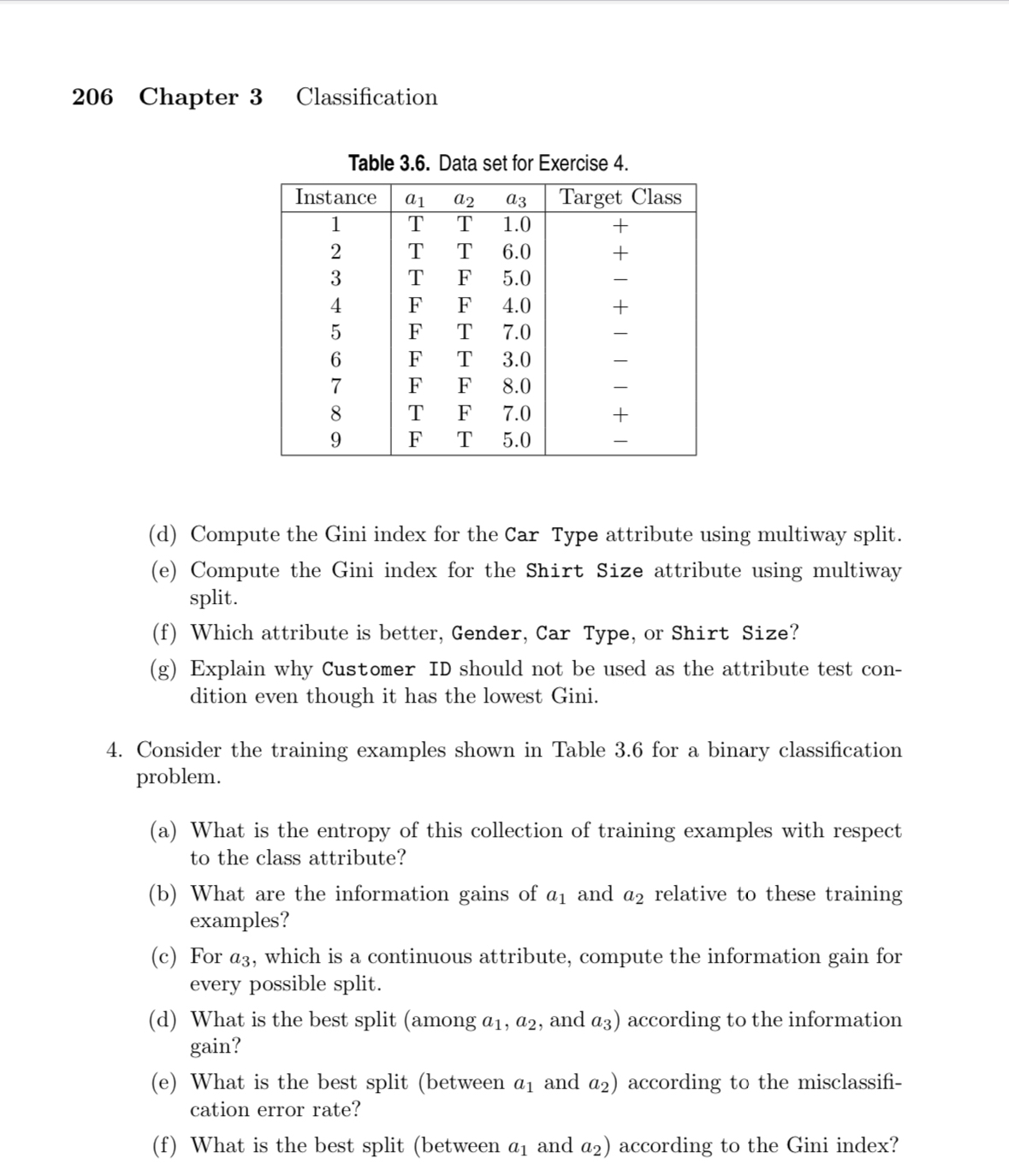
Question: 2 0 6 Chapter 3 Classification Table 3 . 6 . Data set for Exercise 4 . table [ [ Instance , a 1
Chapter Classification
Table Data set for Exercise
tableInstanceTarget ClassTTTTTFFFFTFTFFTFFT
d Compute the Gini index for the Car Type attribute using multiway split.
e Compute the Gini index for the Shirt Size attribute using multiway split.
f Which attribute is better, Gender, Car Type, or Shirt Size?
g Explain why Customer ID should not be used as the attribute test condition even though it has the lowest Gini.
Consider the training examples shown in Table for a binary classification problem.
a What is the entropy of this collection of training examples with respect to the class attribute?
b What are the information gains of and relative to these training examples?
c For which is a continuous attribute, compute the information gain for every possible split.
d What is the best split among and according to the information gain?
e What is the best split between and according to the misclassification error rate?
f What is the best split between and according to the Gini index?
Step by Step Solution
There are 3 Steps involved in it
1 Expert Approved Answer
Step: 1 Unlock

Question Has Been Solved by an Expert!
Get step-by-step solutions from verified subject matter experts
Step: 2 Unlock
Step: 3 Unlock
 Study Help