







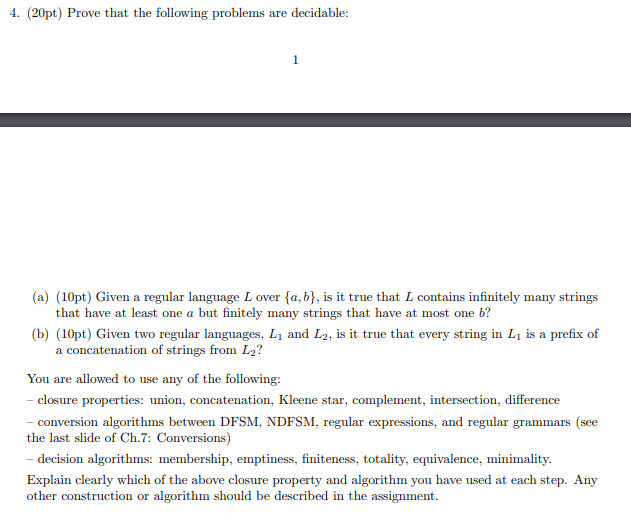
Question: ( 2 0 pt ) Prove that the following problems are decidable: ( a ) ( 1 0 pt ) Given a regular language L
pt Prove that the following problems are decidable:
apt Given a regular language over is it true that contains infinitely many strings that have at least one a but finitely many strings that have at most one
b Given two regular languages, and is it true that every string in is a prefix of a concatenation of strings from
You are allowed to use any of the following:
closure properties: union, concatenation, Kleene star, complement, intersection, difference
conversion algorithms between DFSM NDFSM regular expressions, and regular grammars
decision algorithms: membership, emptiness, finiteness, totality, equivalence, minimality.
Explain clearly which of the above closure property and algorithm you have used at each step.
Step by Step Solution
There are 3 Steps involved in it
1 Expert Approved Answer
Step: 1 Unlock

Question Has Been Solved by an Expert!
Get step-by-step solutions from verified subject matter experts
Step: 2 Unlock
Step: 3 Unlock
 Study Help