







Question: ( 2 0 pts ) Problem 5 A converging - diverging nozzle is used in aerospace applications to accelerate a gas to generate thrust. A
pts Problem
A convergingdiverging nozzle is used in aerospace applications to accelerate a gas to generate
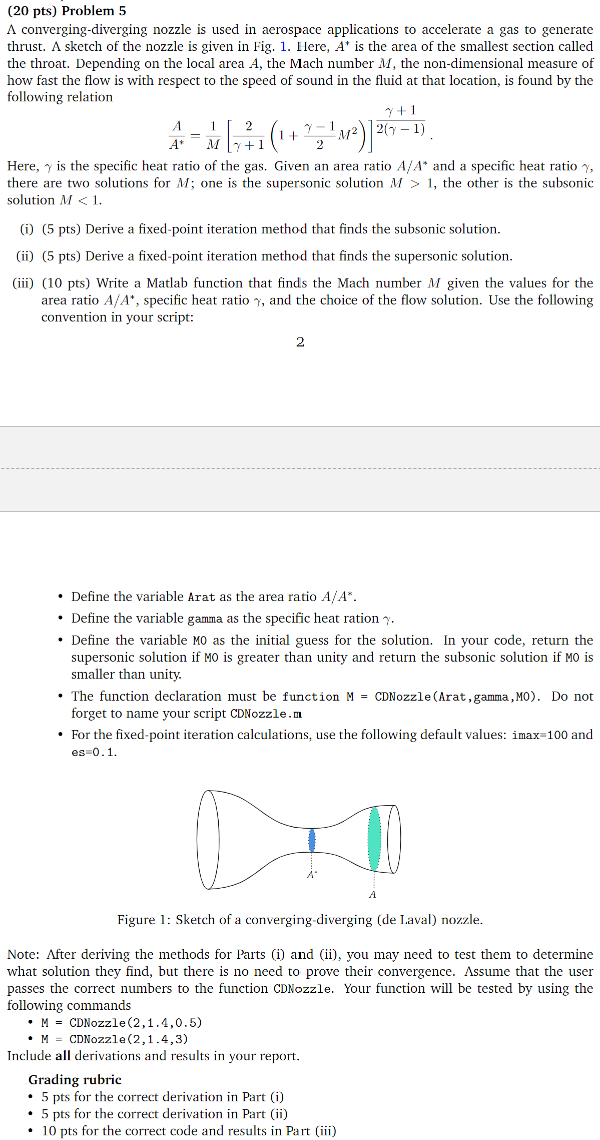
thrust. A sketch of the nozzle is given in Fig. Here, is the area of the smallest section called
the throat. Depending on the local area the Mach number the nondimensional measure of
how fast the flow is with respect to the speed of sound in the fluid at that location, is found by the
following relation
Here, is the specific heat ratio of the gas. Given an area ratio and a specific heat ratio
there are two solutions for ; one is the supersonic solution the other is the subsonic
solution
i pts Derive a fixedpoint iteration method that finds the subsonic solution.
ii pts Derive a fixedpoint iteration method that finds the supersonic solution.
iii pts Write a Matlab function that finds the Mach number given the values for the
area ratio specific heat ratio and the choice of the flow solution. Use the following
convention in your script:
Define the variable Arat as the area ratio
Define the variable gamma as the specific heat ration
Define the variable M as the initial guess for the solution. In your code, return the
supersonic solution if MO is greater than unity and return the subsonic solution if M is
smaller than unity.
The function declaration must be function CDNozzleArat gamma, M Do not
forget to name your script CDNozzle.m
For the fixedpoint iteration calculations, use the following default values: imax and
es
Figure : Sketch of a convergingdiverging de Laval nozzle.
Note: After deriving the methods for Parts i and ii you may need to test them to determine
what solution they find, but there is no need to prove their convergence. Assume that the user
passes the correct numbers to the function CDNozzle. Your function will be tested by using the
following commands
CDNozzle
CDNozzle
Include all derivations and results in your report.
Grading rubric
pts for the correct derivation in Part i
pts for the correct derivation in Part ii
pts for the correct code and results in Part iii
Step by Step Solution
There are 3 Steps involved in it
1 Expert Approved Answer
Step: 1 Unlock

Question Has Been Solved by an Expert!
Get step-by-step solutions from verified subject matter experts
Step: 2 Unlock
Step: 3 Unlock
 Study Help