







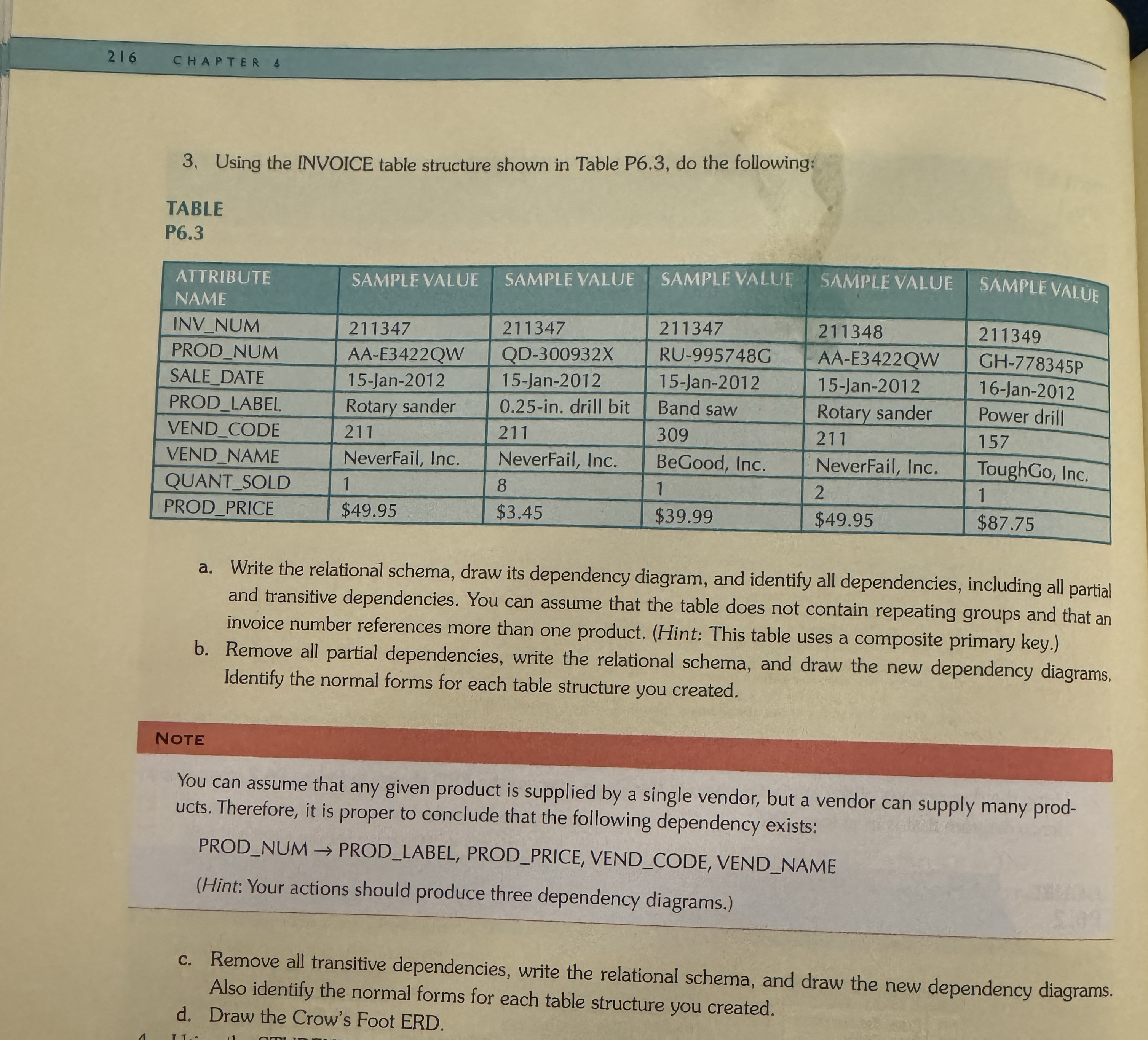
Question: 2 1 6 CHAPTER 3 . Using the INVOICE table structure shown in Table P 6 . 3 , do the following: TABLE P 6
CHAPTER
Using the INVOICE table structure shown in Table P do the following:
TABLE
P
tabletableATTRIBUTENAMESAMPLE VALUE,SAMPLE VALUE,SAMPLE VALUE,SAMPLE VALUE,SAMPLE VALUEINVNUM,PRODNUM,AAEQWQDXRUCAAEQWGHPSALEDATE,JanJanJanJanJanPRODLABEL,Rotary sander,in drill bit,Band saw,Rotary sander,Power drillVENDCODE,VENDNAME,NeverFail, Inc.,NeverFail, Inc.,BeGood, Inc.,NeverFail, Inc.,ToughGo, Inc.QUANTSOLD,PRODPRICE,$$$$$
a Write the relational schema, draw its dependency diagram, and identify all dependencies, including all partial and transitive dependencies. You can assume that the table does not contain repeating groups and that an invoice number references more than one product. Hint: This table uses a composite primary key.
b Remove all partial dependencies, write the relational schema, and draw the new dependency diagrams, Identify the normal forms for each table structure you created.
NOTE
You can assume that any given product is supplied by a single vendor, but a vendor can supply many products. Therefore, it is proper to conclude that the following dependency exists:
PRODNUM PRODLABEL, PRODPRICE, VENDCODE, VENDNAME
Hint: Your actions should produce three dependency diagrams.
c Remove all transitive dependencies, write the relational schema, and draw the new dependency diagrams. Also identify the normal forms for each table structure you created.
d Draw the Crow's Foot ERD.
Step by Step Solution
There are 3 Steps involved in it
1 Expert Approved Answer
Step: 1 Unlock

Question Has Been Solved by an Expert!
Get step-by-step solutions from verified subject matter experts
Step: 2 Unlock
Step: 3 Unlock
 Study Help