







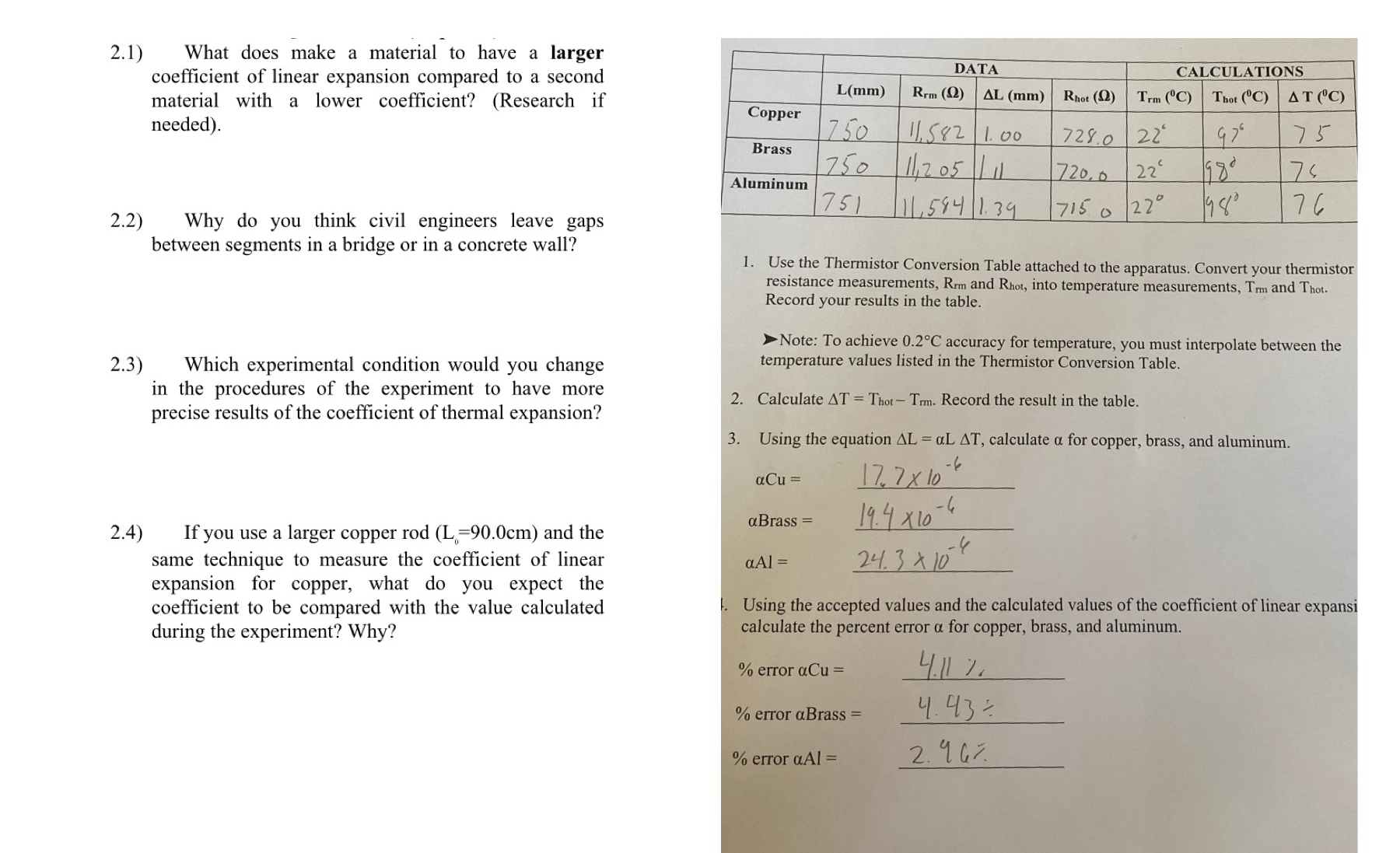
Question: 2 . 1 ) What does make a material to have a larger coefficient of linear expansion compared to a second material with a lower
What does make a material to have a larger coefficient of linear expansion compared to a second material with a lower coefficient? Research if needed
Why do you think civil engineers leave gaps between segments in a bridge or in a concrete wall?
Which experimental condition would you change in the procedures of the experiment to have more precise results of the coefficient of thermal expansion?
If you use a larger copper and the same technique to measure the coefficient of linear expansion for copper, what do you expect the coefficient to be compared with the value calculated during the experiment? Why?
Use the Thermistor Conversion Table attached to the apparatus. Convert your thermistor resistance measurements, and into temperature measurements, and Record your results in the table.
Note: To achieve accuracy for temperature, you must interpolate between the temperature values listed in the Thermistor Conversion Table.
Calculate Record the result in the table.
Using the equation calculate for copper, brass, and aluminum.
Brass
Using the accepted values and the calculated values of the coefficient of linear expansi calculate the percent error for copper, brass, and aluminum.
error
error Brass
error
Step by Step Solution
There are 3 Steps involved in it
1 Expert Approved Answer
Step: 1 Unlock

Question Has Been Solved by an Expert!
Get step-by-step solutions from verified subject matter experts
Step: 2 Unlock
Step: 3 Unlock
 Study Help