







Question: 2. (10 marks): Let S = {a,b,c}. Give a deterministic finite automaton that has the same nondeterministic finite automaton and explain why your answer is
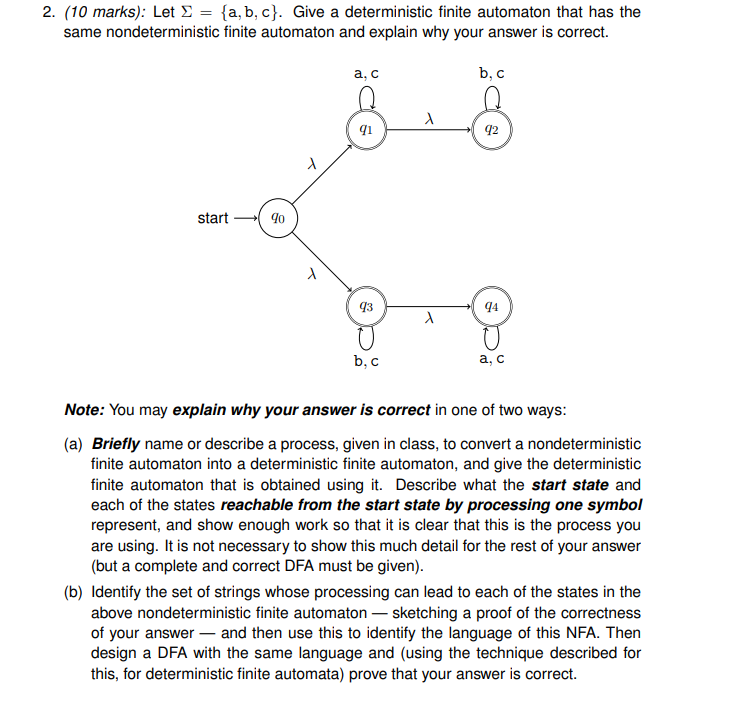
2. (10 marks): Let S = {a,b,c}. Give a deterministic finite automaton that has the same nondeterministic finite automaton and explain why your answer is correct. a, c b, c 91 92 X start 90 93 94 b, c ac Note: You may explain why your answer is correct in one of two ways: (a) Briefly name or describe a process, given in class, to convert a nondeterministic finite automaton into a deterministic finite automaton, and give the deterministic finite automaton that is obtained using it. Describe what the start state and each of the states reachable from the start state by processing one symbol represent, and show enough work so that it is clear that this is the process you are using. It is not necessary to show this much detail for the rest of your answer (but a complete and correct DFA must be given). (b) Identify the set of strings whose processing can lead to each of the states in the above nondeterministic finite automaton - sketching a proof of the correctness of your answer and then use this to identify the language of this NFA. Then design a DFA with the same language and (using the technique described for this, for deterministic finite automata) prove that your answer is correct. 2. (10 marks): Let S = {a,b,c}. Give a deterministic finite automaton that has the same nondeterministic finite automaton and explain why your answer is correct. a, c b, c 91 92 X start 90 93 94 b, c ac Note: You may explain why your answer is correct in one of two ways: (a) Briefly name or describe a process, given in class, to convert a nondeterministic finite automaton into a deterministic finite automaton, and give the deterministic finite automaton that is obtained using it. Describe what the start state and each of the states reachable from the start state by processing one symbol represent, and show enough work so that it is clear that this is the process you are using. It is not necessary to show this much detail for the rest of your answer (but a complete and correct DFA must be given). (b) Identify the set of strings whose processing can lead to each of the states in the above nondeterministic finite automaton - sketching a proof of the correctness of your answer and then use this to identify the language of this NFA. Then design a DFA with the same language and (using the technique described for this, for deterministic finite automata) prove that your answer is correct
Step by Step Solution
There are 3 Steps involved in it

Get step-by-step solutions from verified subject matter experts
 Study Help