







Question: 2. (10 points) Consider a nondimensionalized extended predator-prey model dx E=ax+ry+r$z %Zry(ly}kxy dz E=z{1-z}$z with predator population z(t) and two prey populations with logistic growth
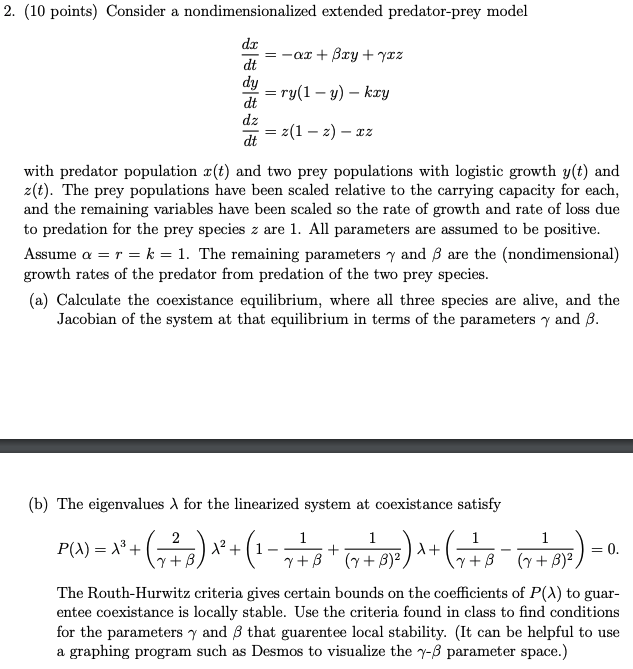
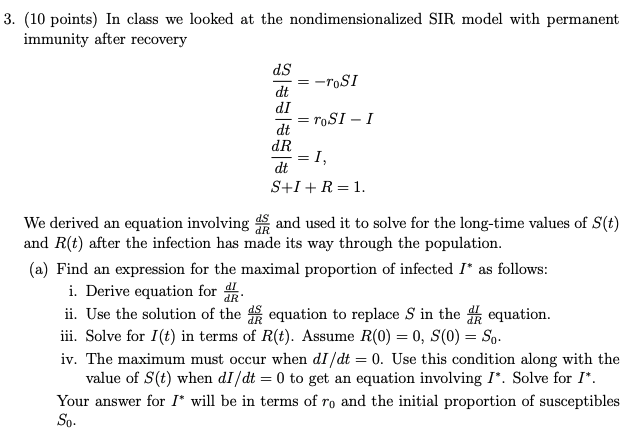
2. (10 points) Consider a nondimensionalized extended predator-prey model dx E=ax+ry+r$z %Zry(ly}kxy dz E=z{1-z}$z with predator population z(t) and two prey populations with logistic growth y(t) and z(t). The prey populations have been scaled relative to the carrying capacity for each, and the remaining variables have been scaled so the rate of growth and rate of loss due to predation for the prey species z are 1. All parameters are assumed to be positive, Assume o = r = k = 1. The remaining parameters v and 5 are the (nondimensional) growth rates of the predator from predation of the two prey species. (a) Calculate the coexistance equilibrium, where all three species are alive, and the Jacobian of the system at that equilibrium in terms of the parameters + and 3. (b) The eigenvalues A for the linearized system at coexistance satisfy The Routh-Hurwitz criteria gives certain bounds on the coefficients of P(A) to guar- entee coexistance is locally stable. Use the criteria found in class to find conditions for the parameters v and 3 that guarentee local stability. (It can be helpful to use a graphing program such as Desmos to visualize the -5 parameter space.) 3. (10 points) In class we looked at the nondimensionalized SIR model with permanent immunity after recovery We derived an equation involving % S+I+ R=1. and used it to solve for the long-time values of S(t) and R(t) after the infection has made its way through the population. (a) Find an expression for thL maximal proportion of infected I'* as follows: i. Derive equation for 4 E ii. Use the solution of the equation to replace S in the % equation. iii. Solve for I{t) in terms of R(t). Assume R(0) =0, S(0) = iv. The maximum must occur when dI /df = (). Use this condition along with the value of S(t) when dI/dt = 0 to get an equation involving I*. Solve for I*. Your answer for I* will be in terms of ry and the initial proportion of susceptibles So
Step by Step Solution
There are 3 Steps involved in it

Get step-by-step solutions from verified subject matter experts
 Study Help