







Question: 2. (10 points.) Trosset chapter 11.4 Problem Set D, parts 14. Data: http : [/mtrosset . pages . in . edu/ Statlnf eR/ Data! globulin
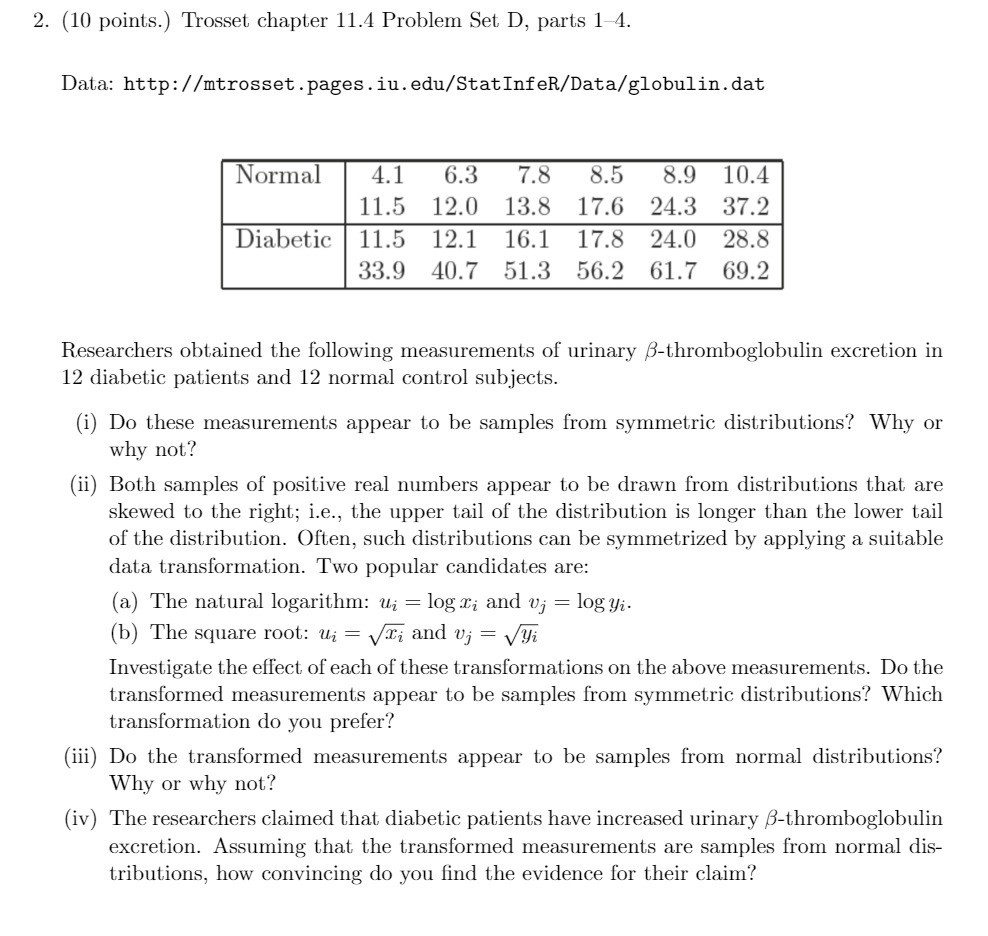
2. (10 points.) Trosset chapter 11.4 Problem Set D, parts 14. Data: http : [/mtrosset . pages . in . edu/ Statlnf eR/ Data! globulin . dat 4.1 6.3 7.8 8.5 8.9 10.4 11.5 12.0 13.8 17.6 24.3 37.2 11.5 12.1 16.1 17.8 24.0 28.8 33.9 40.7 51.3 56.2 61.7 69.2 Researchers obtained the following measurements of urinary -thrombogloblin excretion in 12 diabetic patients and 12 normal control subjects. (i) Do these measurements appear to be samples from symmetric distributions? W'hy or why not? (ii) Both samples of positive real numbers appear to be drawn from distributions that are skewed to the right; i.e.1 the upper tail of the distribution is longer than the lower tail of the distribution. Often, such distributions can be symrnetrized by applying a suitable data transformation. Two popular candidates are: (a) The natural logarithm: m- : log 1:.- and 113.- : log yi. (b) The square root: 1.9.; 2 JE- and '03: = { Investigate the effect of each of these transformations on the above measurements. Do the transformed measurements appear to be samples from symmetric distributions? TWhich transformation do you prefer? (iii) Do the transformed measurements appear to be samples from normal distributions? Why or why not? (iv) The researchers claimed that diabetic patients have increased urinary -thromboglobul'm excretion. Assuming that the transformed measurements are samples from normal dis- tributions, how convincing do you nd the evidence for their claim
Step by Step Solution
There are 3 Steps involved in it

Get step-by-step solutions from verified subject matter experts
 Study Help