







Question: 2. (10 points.) Write a Python function called has0p that takes two arguments. The first string or tuple that represents an expression, also as in
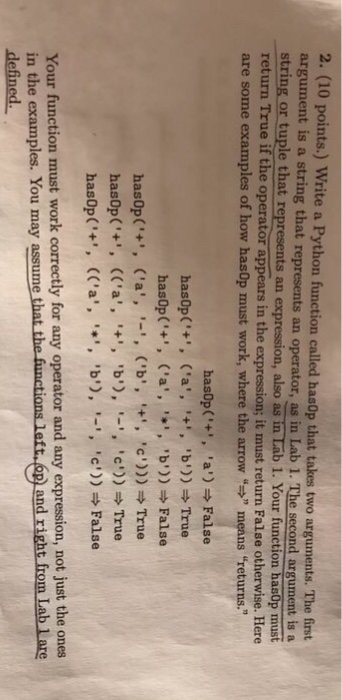
2. (10 points.) Write a Python function called has0p that takes two arguments. The first string or tuple that represents an expression, also as in Lab 1. Your function hasop must return True if the operator appears in the expression; it must return False otherwise. Here are some examples of how hasp must work, where the arrow "=>" means "returns." hasOp('+', 'a') False hasOp('+', ('a','+', 'b'))True hasOp('+', ('a', '*', 'b'))=> False ('a', '-' , ('b', '+', 'c')))=> True (('a', '+', 'b'), '-', 'c'))=> True (('a','+', 'b'), '-', 'c'))=> False has0p('+', has0p('+', hasOp('+', Your function must work correctly for any operator and any in the examples. You may assume that the functions laft op) and right from Lab Lare expression, not just the ones
Step by Step Solution
There are 3 Steps involved in it

Get step-by-step solutions from verified subject matter experts
 Study Help