







Question: 2. (10 pts) Consider steady, laminar, fully developed flow between two parallel plates, separated by distance H, with the top plate moving to the right
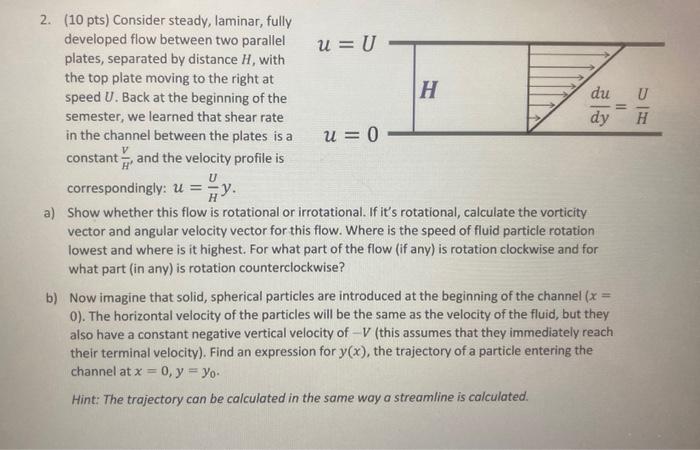
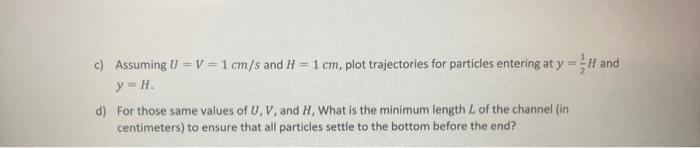
2. (10 pts) Consider steady, laminar, fully developed flow between two parallel plates, separated by distance H, with the top plate moving to the right at speed U. Back at the beginning of the semester, we learned that shear rate in the channel between the plates is a constant HV, and the velocity profile is correspondingly: u=HUy. a) Show whether this flow is rotational or irrotational. If it's rotational, calculate the vorticity vector and angular velocity vector for this flow. Where is the speed of fluid particle rotation lowest and where is it highest. For what part of the flow (if any) is rotation clockwise and for what part (in any) is rotation counterclockwise? b) Now imagine that solid, spherical particles are introduced at the beginning of the channel (x= 0 ). The horizontal velocity of the particles will be the same as the velocity of the fluid, but they also have a constant negative vertical velocity of V (this assumes that they immediately reach their terminal velocity). Find an expression for y(x), the trajectory of a particle entering the channel at x=0,y=y0. Hint: The trajectory can be calculated in the same way a streamline is calculated. c) Assuming U=V=1cm/s and H=1cm, plot trajectories for particles entering at y=21H and y=H d) For those same values of U,V, and H, What is the minimum length L of the channel (in centimeters) to ensure that all particles settle to the bottom before the end
Step by Step Solution
There are 3 Steps involved in it

Get step-by-step solutions from verified subject matter experts
 Study Help