







Question: 2. (10pts) Consider again Example 1 in Lecture Notes 8 Sequential-Move Games. This time assume the players reverse their order of moves: Player B goes
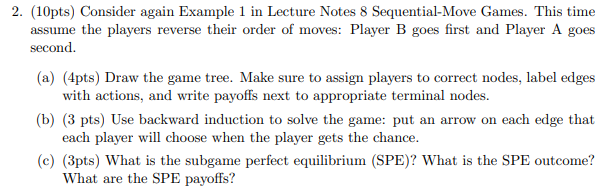
2. (10pts) Consider again Example 1 in Lecture Notes 8 Sequential-Move Games. This time assume the players reverse their order of moves: Player B goes first and Player A goes second. (a) (4pts) Draw the game tree. Make sure to assign players to correct nodes, label edges with actions, and write payoffs next to appropriate terminal nodes. (b) (3 pts) Use backward induction to solve the game: put an arrow on each edge that each player will choose when the player gets the chance. (c) (3pts) What is the subgame perfect equilibrium (SPE)? What is the SPE outcome? What are the SPE payoffs? 2. (10pts) Consider again Example 1 in Lecture Notes 8 Sequential-Move Games. This time assume the players reverse their order of moves: Player B goes first and Player A goes second. (a) (4pts) Draw the game tree. Make sure to assign players to correct nodes, label edges with actions, and write payoffs next to appropriate terminal nodes. (b) (3 pts) Use backward induction to solve the game: put an arrow on each edge that each player will choose when the player gets the chance. (c) (3pts) What is the subgame perfect equilibrium (SPE)? What is the SPE outcome? What are the SPE payoffs
Step by Step Solution
There are 3 Steps involved in it

Get step-by-step solutions from verified subject matter experts
 Study Help